
One Quote, Six Jobs: What a Whole-House Well Water System Actually Costs in 2026
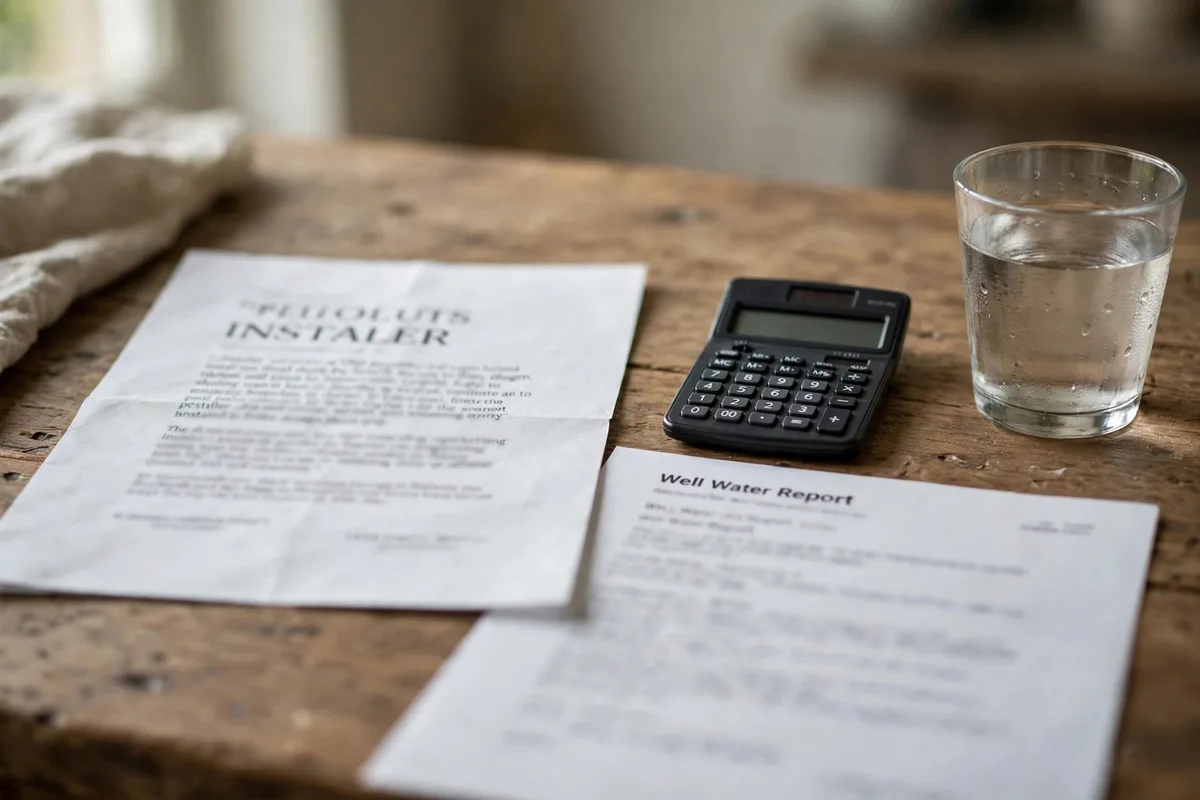
The quote that prices everything and explains nothing
The quote arrives as one number. Four figures, sometimes five, on a single line: whole-house well water treatment system, installed. Underneath, if you are lucky, a brand name and a tank size. What the number does not say is which dollars remove the iron, which raise the pH, which kill bacteria, and which soften — or whether all four problems are even in your water.
That bundling is not an accident of paperwork. It is how the industry prefers to sell, because a bundled quote cannot be compared, stage by stage, against anything. This guide unbundles it. A whole-house setup is six jobs in a fixed order — test, sediment, disinfection, pH, iron and manganese, softener — and each job has its own price, its own running cost, and its own reason for existing. Your lab report decides how many of the six you actually pay for. Every price below was checked on the manufacturer's or a major retailer's own page in November 2026, and each one is labeled with its source, because a price without a page and a date is a rumor.
The stack, priced stage by stage
| Stage | Job | Priced example (checked Nov 2026) | Price |
|---|---|---|---|
| 0 | Lab test | Penn State accredited lab, Aesthetics/Corrosivity package | $85 |
| 1 | Sediment | iSpring WSP spin-down pre-filter | $69.99 |
| 2 | Disinfection | iSpring UVF55FS UV system (at Target) | $271.19 |
| 3 | pH correction | US Water Matrixx pH Neutralizer, 10 GPM | $1,395 |
| 4 | Iron & manganese | iSpring WGB32BM cartridge system | $535.99 |
| 4 | Iron & manganese | SpringWell WS1 air-injection system | $2,231 |
| 4 | Iron & manganese | US Water Matrixx inFusion, 10 GPM | $2,737 |
| 5 | Softener | iSpring WCS45KG, 45,000 grain | $1,558.99 |
Read the table the way your water demands: not every row, only the rows your test forces. The stages follow in the order the water meets them.
Stage 0: the test — the cheapest line in the whole project
Everything downstream is sized and selected from one document, so the test is where the money is aimed. Penn State's Agricultural Analytical Services Laboratory — a state-accredited drinking water lab — publishes its fees openly. The package that matters here is its Aesthetics/Corrosivity panel at $85: coliform and E. coli, pH, total dissolved solids, hardness, alkalinity, corrosivity index, copper, iron, and manganese. That is every number that selects equipment, from an accredited lab, for less than a service call. A bacteria-only retest in later years is $40 on the same fee schedule.
One manufacturer builds the test into the purchase itself. SpringWell will not ship its well system until your results come back, charges $134.25 for its own test (non-refundable, as we noted in our three-system comparison), and cancels with a full refund if your water falls outside what the system can treat. Hold that structure in mind; it returns below, under false economies. Our guide to reading your well water test numbers covers what each line on the panel decides.
Stage 1: sediment — the small guard in front of everything
Sediment is first because grit damages or clogs every stage behind it, and the guard itself is the cheapest hardware in the stack. iSpring's classic WSP spin-down pre-filter — a reusable stainless screen you flush rather than replace — is $69.99 on the manufacturer's own store; the auto-flushing WSPARB version is $252.99. A cartridge system like the WGB32BM below carries its own sediment cartridge as stage one, but iSpring itself recommends a spin-down ahead of it when sediment is heavy, because every grain the screen catches is a grain the paid cartridges never see. Our sediment guide works through sizing and micron choice.
Stage 2: disinfection — priced only if the bacteria test says so
This stage exists only when a coliform result demands it, which is why it is bought after a test and not before. The first response to a positive result is shock chlorination of the well itself — a procedure, not a product, done with household bleach; no manufacturer publishes a price for it because there is almost nothing to sell, and the honest cost line is your own afternoon.
Standing disinfection is the priced version. iSpring's UVF55FS — a 55-watt UV chamber rated 12 GPM — was $271.19 at Target (regular price $338.99) when checked. Its running cost is written into its manual: the lamp is rated up to 9,000 hours and iSpring recommends replacing it annually whether it still glows or not, because a lamp past its life lights up without disinfecting; the quartz sleeve gets cleaned every 6 to 12 months. We could not confirm the replacement lamp's price on iSpring's own store, so it appears in the totals below as a known cost with no number attached — the only honest way to print it.
Stage 3: pH — the stage that quietly adds a second one
Acidic water is corrected before iron treatment because iron filters lose their chemistry below their pH floor — the order is not negotiable, and our low pH guide explains why. The standard machine is a backwashing calcite neutralizer. US Water Systems' Matrixx pH Neutralizer is $1,395 in its 10 GPM size and $1,595 at 20 GPM on the manufacturer's page. Its running costs are unusual in both directions: the control valve's electronics use, in US Water's own words, less than $2.00 of electricity per year — and the calcite bed is consumed doing its job, dissolving into the water it neutralizes, so the bed has to be topped up periodically for as long as you own it. US Water states the replenishment plainly and sells the system with a fill port for exactly that job; the top-up media's price is one we could not pin to a figure on its page, so it is carried below as an unpriced recurring cost.
Two warnings ride on this stage. Below pH 5.8 the same system switches to a calcite–magnesium oxide blend, and below 5.0 US Water directs you away from calcite entirely, to a soda ash injection system — a different machine at a different price. And calcite raises hardness as it raises pH, which is how a house that never needed a softener can leave this stage needing one. Stage 3 is the only stage that can give birth to Stage 5.
Stage 4: iron and manganese — where the spread lives
This is the stage with a ten-fold price range, because three different machines do the job three different ways, and your iron number — not your budget — decides which ones are even eligible.
- iSpring WGB32BM — a three-cartridge system (sediment, carbon block, iron/manganese cartridge) at $535.99 on iSpring's store. Its ceiling is printed on its own page: iron up to 3.0 ppm, manganese up to 1.0 ppm, with the iron cartridge rated for 50,000 gallons at 3.0 ppm. Inside that envelope it is the cheapest legitimate iron treatment sold. Check the current price at iSpring →
- SpringWell WS1 — a single-tank air-injection oxidation system, $2,231 on the manufacturer's page in November 2026 (list price $2,625), rated to 7 ppm iron, 8 ppm hydrogen sulfide, and 1 ppm manganese. Its running-cost line is the shortest in this guide: air injection consumes nothing, there is nothing to refill, and SpringWell rates the media life at 10+ years.
- US Water Matrixx inFusion — hydrogen peroxide injection ahead of a catalytic carbon tank, $2,737 at 10 GPM and $3,035 at 15 GPM on US Water's page. The oxidant is a consumable by design — the system drinks peroxide from a 15-gallon solution tank — and the manufacturer's manual puts catalytic carbon replacement at 3 to 5 years, as our iron filter maintenance guide details. Peroxide consumption scales with your iron and your water use, and US Water publishes no annual figure, so none is invented here.
Stage 5: the softener — last, and only if hardness says so
The softener closes the train because everything upstream would foul it or be wasted on it. The priced example is iSpring's WCS45KG — 45,000 grains, rated for hardness up to 94 gpg — at $1,558.99 on iSpring's store.
- iSpring WCS45KG — a salt-based ion exchange softener with pre-filled resin and automatic backwash. Two notes on its own page set its place in the stack: it has no built-in sediment filter (iSpring recommends a pre-filter ahead of it), and if your water has iron, iSpring instructs you to install an iron filter before it. The manufacturer is telling you the order this guide is built on. Check the current price at iSpring →
Its running costs are salt and water. Salt is the most ordinary price in this article: a 40-pound bag of Morton Clean and Protect pellets was $9.99 at Target when checked. The water cost is regeneration — the EPA's WaterSense guide puts a typical softener at 20 to 70 gallons per regeneration — which on a well is pump wear and septic load rather than a metered bill. Our softener maintenance guide covers the salt discipline itself.
Installation: the line nobody can price for you
Here is the sentence most cost guides will not print: no manufacturer in this article publishes an installation price, because there isn't one. iSpring sells both of its systems here as DIY installations for an owner with basic plumbing knowledge, and its manuals are written to that owner. A plumber's quote for the same work is real money, but it is set by your basement, not by the equipment: whether a drain is reachable for backwash lines, whether an outlet is near the install point, your pipe material and diameter, whether a bypass loop already exists, whether your well pump can deliver the backwash flow the largest tank demands, and whether your locality wants a permit. Any article that hands you a national average for that list is inventing it. Ask a quoting plumber to itemize against those six questions instead — and note that some plumbers decline to install equipment they did not sell, which is worth one phone call before the boxes arrive, not after.
The running-cost ledger
| System | Consumable | Rhythm (manufacturer's own) | Priced at |
|---|---|---|---|
| iSpring WGB32BM | F3WGB32BM cartridge pack | Sediment 6–12 months; carbon and iron cartridges 12 months; set rated 100,000 gallons | $159.99 per pack (iSpring) |
| SpringWell WS1 | None — air injection | Media life rated 10+ years | $0 in consumables |
| US Water inFusion | Hydrogen peroxide; catalytic carbon | Peroxide continuous; carbon at 3–5 years (manual) | No annual figure published |
| iSpring WCS45KG | Softener salt; regeneration water | Salt as consumed; 20–70 gallons per regeneration (EPA) | $9.99 per 40-lb bag (Target) |
| US Water neutralizer | Calcite top-ups; valve electricity | Bed replenished as it dissolves; under $2/year electricity (US Water) | Top-up price not published |
| iSpring UVF55FS | UV lamp | Replace annually; 9,000-hour lamp life (manual) | Lamp price not confirmed |
| Any system | Bacteria retest | Annual (Penn State lab fee schedule) | $40 |
Five years, three waters
Totals below are assembled only from the prices above, with the arithmetic shown. Installation is excluded throughout — see why above. Each profile includes the $85 opening panel and a $40 bacteria retest in each of the five years ($200).
Profile 1 — iron only. Iron 2.0 mg/L, manganese 0.2, pH 7.1, hardness 5 gpg, bacteria absent. Two honest ways to build it:
| Line | Cartridge path | Air-injection path |
|---|---|---|
| Test | $85 (lab panel) | $134.25 (SpringWell's required test) |
| Sediment | $69.99 (WSP spin-down) | — (backwashing tank) |
| Iron system | $535.99 (WGB32BM) | $2,231 (WS1) |
| Cartridges, 5 years | 5 × $159.99 = $799.95 | $0 |
| Bacteria retests | $200 | $200 |
| Five-year total | $1,690.93 | $2,565.25 |
The cartridge path wins the five-year window and loses the long game on a schedule you can compute: after purchase it spends $159.99 a year more than the air-injection path, so the $1,674.27 head start takes about ten and a half years to burn through — which is, not coincidentally, roughly when the WS1's 10+-year media reaches its own replacement conversation. Cheap to buy and steady to feed, or dear to buy and nearly free to run: the water is the same, the decade is the difference.
Profile 2 — iron plus hardness. Iron 2.0 mg/L, hardness 18 gpg, pH 7.0. The softener joins the train: $85 test + $69.99 spin-down + $535.99 WGB32BM + $1,558.99 WCS45KG = $2,249.97 of equipment. Running: five cartridge packs, $799.95; five years of retests, $200; and salt — priced per bag at $9.99, with the usage stated as the assumption it is: at one 40-pound bag a month, 60 bags × $9.99 = $599.40. Harder water or a bigger household moves that line, and only that line, proportionally. Five-year total: $3,849.32.
Profile 3 — low pH plus iron. pH 6.2, iron 3.5 mg/L, hardness 4 gpg. Watch the iron number make a decision by itself: 3.5 mg/L is over the WGB32BM's published 3.0 ppm ceiling, so the cartridge path does not exist for this house — the cheapest eligible iron stage is a tank system. The build: $85 test + $69.99 spin-down + $1,395 Matrixx neutralizer (which must come first, to lift the pH into the iron filter's working range) + $2,231 WS1 + $200 retests = $3,980.99 over five years, plus calcite top-ups at an unpriced rhythm, and one contingent line: if the neutralizer's added hardness climbs enough to scale the water heater, a softener joins later and this profile inherits Profile 2's salt line too.
The false economies
A cartridge system on high iron. The WGB32BM's iron cartridge is rated 50,000 gallons at 3.0 ppm — capacity is consumed by iron mass, so at higher iron the same cartridge dies in a fraction of the gallons, and above 3.0 ppm the system is outside its own rating entirely. Minnesota's Department of Health states the general version: cartridge filters remove small amounts of iron but are quickly plugged by it. A $535.99 system replaced by a $2,231 one in year two is the most expensive way to buy the $2,231 one.
The smaller tank. Every backwashing system here is sold in flow sizes, and the step up is modest — the inFusion charges $298 more to go from 10 to 15 GPM; the neutralizer, $200 from 10 to 20. An undersized tank does not save that difference; it spends it on pressure drop at the morning peak and on backwashes run below the flow the media requires — US Water's own sizing note warns that a system must be backwashed at its specified rate to be flushed properly. Media that never gets a proper backwash is media on a shorter life.
Skipping the test. The $85 panel is 2 to 4 percent of any equipment total in this guide, and it is the only line that can delete a stage. SpringWell's $134.25 gate exists because the manufacturer would rather refund a system than ship one into water it cannot treat. An owner who skips testing to save $85 is betting a four-figure equipment choice on a guess, and the bet is lost quietly — the wrong system usually still runs; it just runs at the wrong problem for years.
The softener as an iron filter. A softener will exchange dissolved iron, inside a narrow envelope Penn State Extension prints: pH above 6.7, hardness 3 to 20 gpg, dissolved iron below 5 mg/L — and oxidized iron fouls the resin it lands on. Outside that envelope, "saving" the iron filter's price spends the softener's resin instead, and a rebed is a service visit, as our softener maintenance guide lays out.
What moves the bill
Down: a test that clears a stage entirely (no bacteria, no UV; pH in range, no neutralizer); iron low enough to stay inside the cartridge envelope; one system whose manufacturer bundles a required stage, like the WGB32BM's own sediment cartridge; DIY installation, which both iSpring systems are explicitly sold for. Up: an iron number that crosses a technology ceiling — 3.0 ppm is the most expensive line on the lab report, worth roughly $1,700 in forced upgrades; pH low enough to add a neutralizer, and lower still if it pushes you from calcite to injection; hardness the neutralizer itself adds; a fourth bathroom, which steps every tank up a size; and iron bacteria anywhere in the picture, which adds disinfection ahead of everything and shortens every maintenance interval behind it — the one contaminant that taxes the whole stack.
The IronInMyWater rule
Test first, treat second — and never choose equipment from one number alone. Iron, pH, manganese, and hardness together decide the system; the manufacturer's published ratings, checked against your test, decide the model. How we work
FAQ
How much does a whole-house well water system cost in total?
It depends on how many of the six stages your test forces. From the priced examples in this guide: an iron-only house can be treated for $1,690.93 over five years on a cartridge system; adding a softener for hard water brings a five-year total to $3,849.32; low pH plus higher iron reaches $3,980.99 — all before installation, which no manufacturer prices because it is set by your plumbing, not the equipment.
Is the expensive air-injection system worth it over cartridges?
On five-year math, no — the cartridge path is cheaper in Profile 1 above. The air-injection system's case is the second five years: it spends nothing on consumables while the cartridge path keeps spending $159.99 a year, and the two lines cross at roughly ten and a half years. It is also the only one of the two still eligible when iron rises above 3.0 ppm.
Why is there no installation cost in these totals?
Because no primary source publishes one. The manufacturers here sell their systems as DIY installs with manuals written for owners; plumber quotes vary with drain access, electrical, pipe size and material, bypass plumbing, well-pump backwash capacity, and permits. A single national figure would be invented, so this guide prices everything that can be priced from a manufacturer's page and names the questions that set the rest.
Sources
The ratings, prices and guidelines in this guide were checked against these primary sources in November 2026.
- Penn State Agricultural Analytical Services Laboratory — Drinking Water Testing (state-accredited lab's published fees: Aesthetics/Corrosivity package $85 with iron, manganese, hardness, pH and bacteria; bacteria-only test $40)
- iSpring — WGB32BM whole house system (manufacturer's store: $535.99; iron ceiling 3.0 ppm, manganese 1.0 ppm; iron cartridge rated 50,000 gallons at 3.0 ppm)
- iSpring — F3WGB32BM replacement filter pack (manufacturer's store: $159.99 per full three-cartridge pack)
- iSpring — Pre-filter collection (manufacturer's store: WSP classic spin-down sediment filter $69.99; WSPARB auto-flushing model $252.99)
- iSpring — WCS45KG whole house water softener (manufacturer's store: $1,558.99; 45,000 grains, hardness up to 94 gpg; no built-in sediment filter, iron filter required ahead of it on iron-bearing water)
- SpringWell — Whole House Iron Filter WS1/WS4 (manufacturer's page: air-injection oxidation, iron 7 ppm, hydrogen sulfide 8 ppm, manganese 1 ppm, 10+ year media life, nothing to refill; WS1 $2,231, list $2,625, with a required $134.25 pre-purchase water test)
- US Water Systems — Matrixx inFusion (manufacturer's page: $2,737 at 10 GPM, $3,035 at 15 GPM; hydrogen peroxide injection with a 15-gallon solution tank)
- US Water Systems — Matrixx pH Neutralizer (manufacturer's page: $1,395 at 10 GPM, $1,595 at 20 GPM; calcite bed is consumed and periodically replenished; calcite adds hardness; valve electronics under $2 of electricity per year)
- Target — iSpring UVF55FS whole house UV filter (retailer's page: $271.19, regular price $338.99; 55W, 12 GPM)
- Target — Morton Clean and Protect water softener pellets, 40 lb (retailer's page: $9.99 per bag)
- US EPA WaterSense — Soften Water Without Wasting It (a typical softener uses 20 to 70 gallons of water per regeneration)
- iSpring — WGB32BM instruction manual (manufacturer's replacement schedule: sediment cartridge every 6–12 months, carbon block and iron/manganese cartridges every 12 months; set rated at 100,000 gallons)
- US Water Systems — Matrixx inFusion manual (catalytic carbon media replaced at 3–5 years)
The numbers, on one sheet
The benchmarks behind every guide here — iron, manganese, pH, hardness, coliform, nitrate — plus the treatment order and the equipment ceilings, on a free two-page PDF. Get the free cheat sheet
The IronInMyWater rule
Test first, treat second — and never choose equipment from one number alone. Iron, pH, manganese, and hardness together decide the system; the manufacturer's published ratings, checked against your test, decide the model. How we work
Read next

Getting Started
The New Well Owner's Checklist: The Paperwork, the First Test, the Wellhead Walk, and the First-Year Calendar
The keys came with a folder: one old test result and a page you can't read. The paperwork hunt, the baseline lab test before any treatment talk, the wellhead walk, and the first-year calendar — the sequence that turns a house with a well into a water supply you actually know.
Read the guide →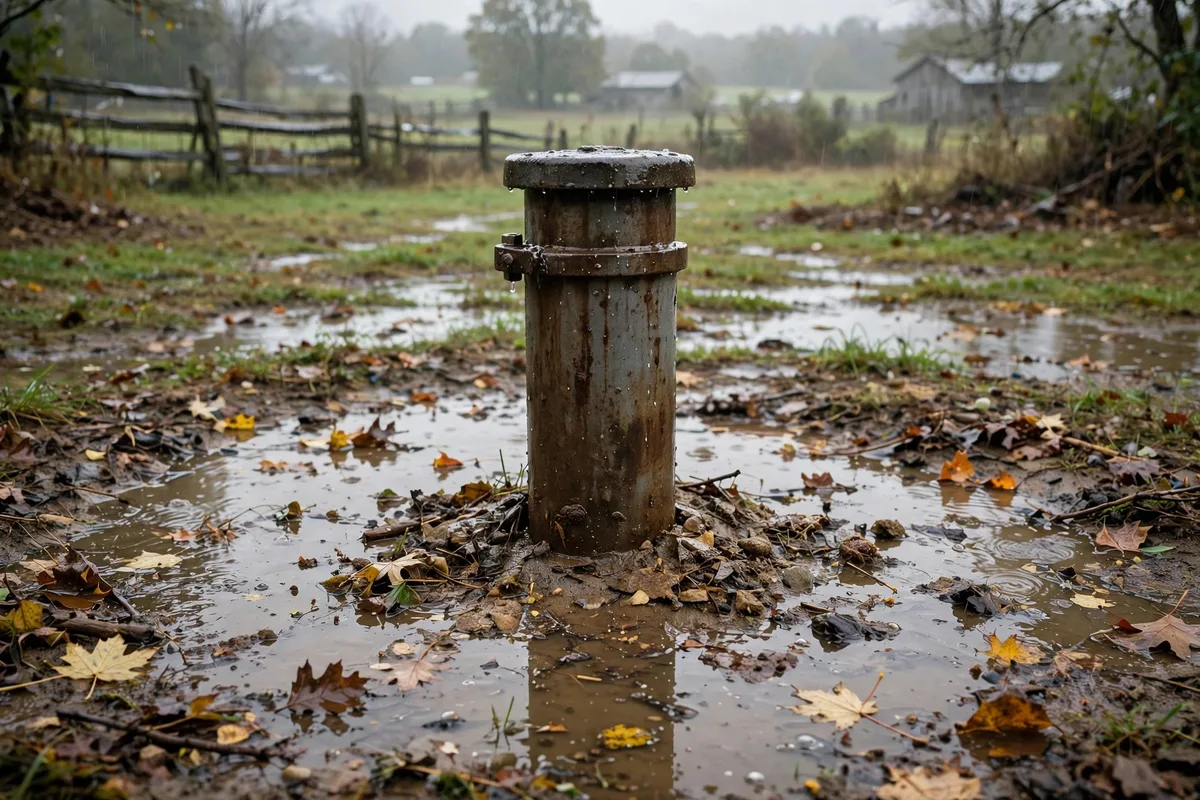
Bacteria & Disinfection
Well Water After Heavy Rain and Flooding: Which Changes Are Signals, and the Order of Operations When the Well Goes Under
The storm is over and the water runs cloudy for the first time in years. Most rain changes nothing — but water that reached the wellhead changes everything. How to read the changes, the agencies' order of operations for a flooded well, and the grading and cap work that keeps the next storm out.
Read the guide →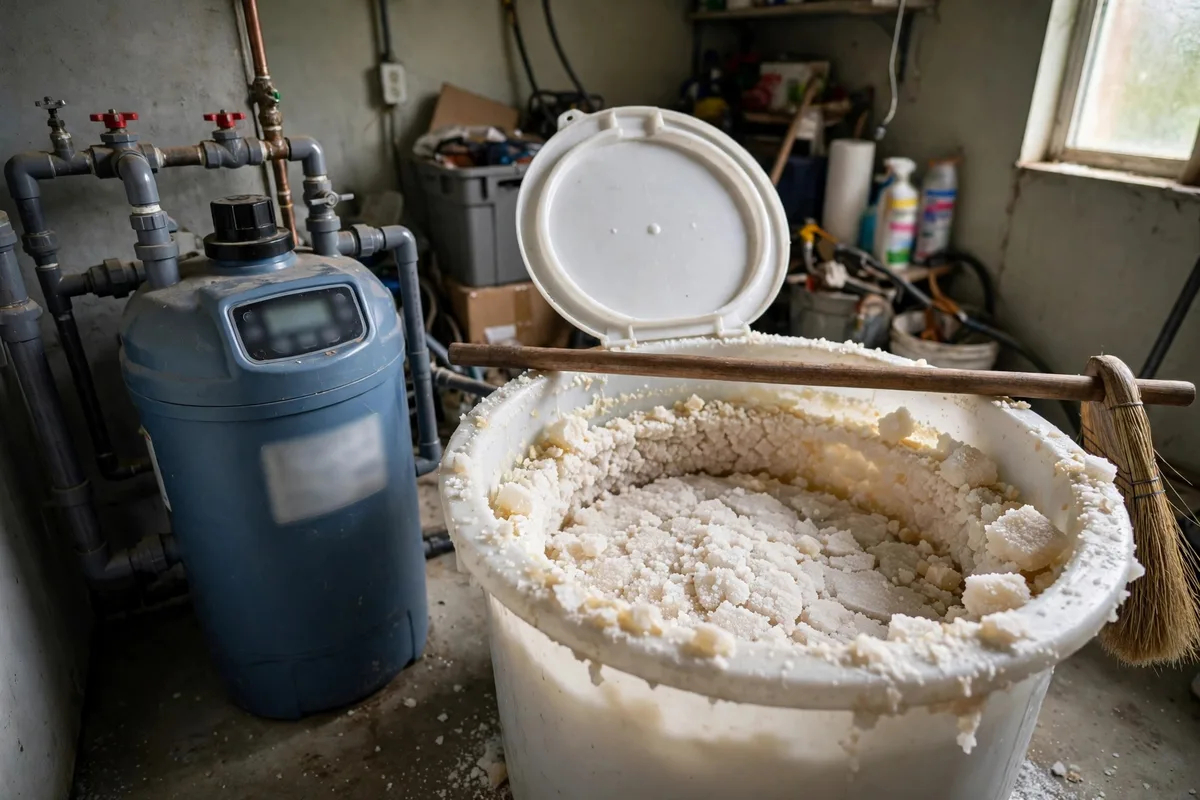
Care & Maintenance
The Softener That Stopped Using Salt: A Maintenance Guide for Brine Tanks, Resin, and Valves on Well Water
The brine tank has been full for months and the scale is quietly back — a crust of fused salt arched over hollow brine. Salt levels and types, resin care on iron-bearing well water, the clock check after every outage, and the injector rinse, on the EPA's and the manufacturers' own instructions.
Read the guide →