Well Water Smells Like Rotten Eggs: Sulfur, Bacteria, and How to Tell Them Apart
The shower smelled like a boiled egg, and the water looked perfectly fine
You turned on the shower on a normal morning, and the steam carried a smell you recognized instantly: rotten eggs. Not faint, not sometimes — right there, in the hot water, every morning this week. The water itself looked clear. It did not taste strange in a way you could name. But the smell was strong enough that you started wondering whether the water was safe, whether the pipes were rotting, and whether the fix was going to cost thousands of dollars.
Here is the reassuring part, and the part that makes this problem fixable: that smell is almost always one gas, hydrogen sulfide, and it comes from one of three places. The three places need three very different fixes — and the most expensive mistake in this whole story is buying the fix for the wrong one. A whole-house treatment system will not stop a water heater from making new gas. A new part in the water heater will not touch gas that is already dissolved in the groundwater. A one-time disinfection will not hold back gas that forms in the rock itself.
The good news is that telling the three apart takes no equipment and about ten minutes. It takes two taps, hot and cold, and paying attention to when the smell shows up and when it fades. This guide walks through what the smell actually is, the three sources, the simple test that separates them, the numbers a water test should show, and the fix that matches each cause — in that order, because the order is the whole point.
What the smell is: hydrogen sulfide gas, not sulfur itself
The rotten-egg smell is hydrogen sulfide gas — H2S — dissolved in your water. It is a gas, not a sediment and not a solid, which is why the water can look perfectly clear while smelling terrible. Your nose is extraordinarily sensitive to it: Penn State Extension notes that most people can smell hydrogen sulfide well below 0.5 milligrams per liter (mg/L), the same unit as parts per million (ppm) on a lab report. A tiny amount produces a smell out of all proportion to the quantity in the water.
It helps to understand what kind of number the regulations give you here, because it is thinner than most people expect. The US Environmental Protection Agency sets no federal primary drinking water standard for hydrogen sulfide. Penn State puts the reason plainly: hydrogen sulfide "does not have a drinking water standard because it makes the water aesthetically undrinkable long before it reaches harmful concentrations." What the EPA does publish are secondary standards — guidelines for nuisance chemicals, not health-based limits, and not enforceable even for public water systems. Two of them touch this problem: sulfate at 250 mg/L (sulfate is the mineral that bacteria and the water-heater reaction turn into the gas) and odor at 3 threshold odor number. And the EPA does not regulate private wells at all. Nobody tests your well water but you.
Read those numbers the way they are meant to be read: as a yardstick for how bad the nuisance is, not as a safety line. The smell is the symptom. It tells you something is happening in the well, the plumbing, or the heater — and the thing that is happening is what you need to find.
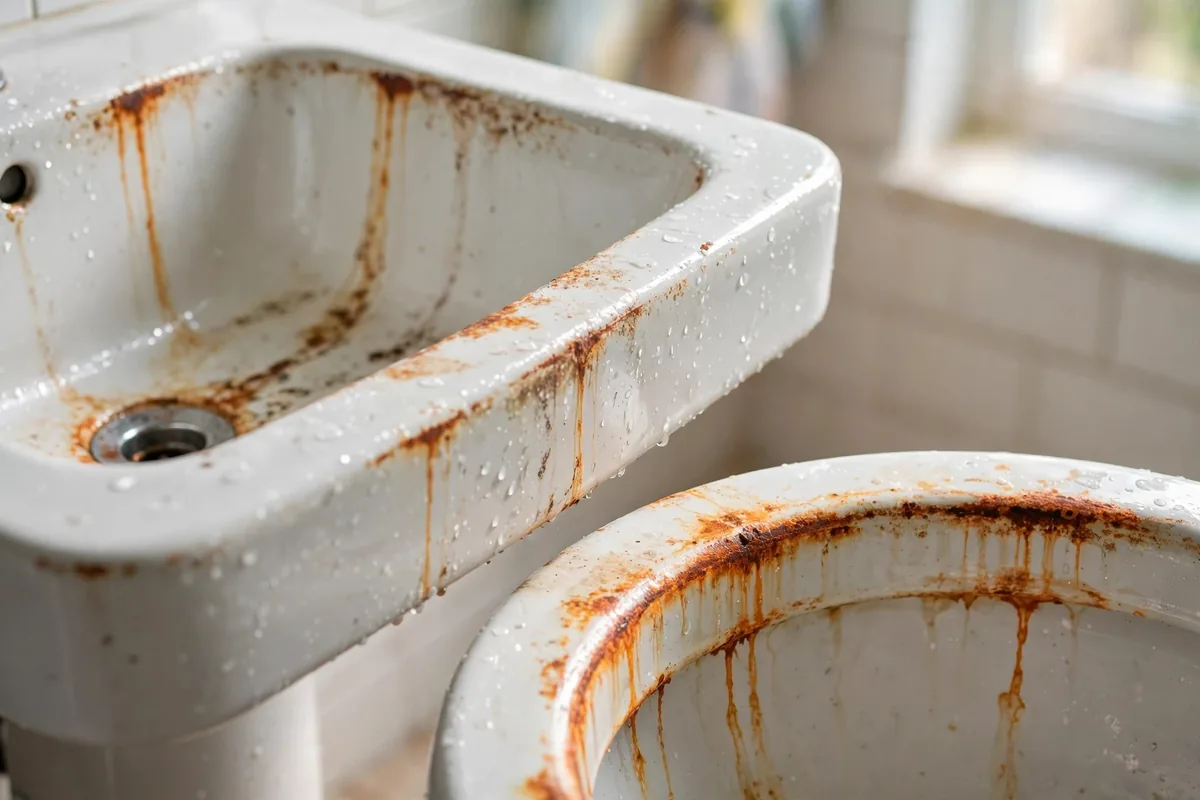
Hydrogen sulfide also does quiet damage while you are deciding. It corrodes copper plumbing, blackens silverware, and fouls water-heater parts. The smell is annoying; the corrosion is the slow cost. Both go away when the source is fixed, and neither is fixed by masking the odor.
The three sources of the smell
Every rotten-egg complaint traces back to one of three sources. They share a smell and almost nothing else.
| Source | Where the gas is made | The tell |
|---|---|---|
| Sulfur bacteria | In the well, the plumbing, or the water softener | Smell is worst after water sits, then fades as the tap runs; may come and go week to week |
| Water heater | Inside the tank, from the magnesium anode rod reacting with sulfate | Hot water smells; cold water does not |
| Groundwater | Dissolved in the aquifer itself, before the water reaches your house | Hot and cold both smell, steadily, no matter how long the water runs |
1. Sulfur bacteria. These are the primary producers of large quantities of hydrogen sulfide in drinking water, according to University of Nebraska–Lincoln Extension. Sulfate-reducing bacteria live without oxygen in wells and plumbing, strip oxygen from sulfate, and exhale hydrogen sulfide as a byproduct. They build slimy biofilms on the well casing, the pump, and the pressure tank, and they often live alongside iron bacteria — the two communities reinforce each other, which is why a sulfur smell and rusty slime sometimes arrive together. The bacteria are not the kind that make people sick, but they are persistent: they live in the system, so they come back unless the system itself is dealt with.
2. The water heater. Inside every conventional tank water heater sits a sacrificial anode rod, usually magnesium, whose job is to corrode so the tank does not. In water that contains sulfate, that same magnesium rod can chemically reduce sulfate to hydrogen sulfide — the tank manufactures the gas. Bacteria living in the warm tank can join in. This is the only one of the three sources that lives entirely inside one appliance, which is also why it is the cheapest to fix and the most commonly misdiagnosed: the homeowner treats the whole house for a problem that lives in a single tank.
3. Hydrogen sulfide in the groundwater. In some aquifers, the gas is already dissolved in the water underground, formed in low-oxygen rock — wells drilled into shale and sandstone are the classic case. Nothing in your house made it, and nothing short of treating the water as it enters the house will change it. This is the one case where a whole-house treatment system is the right answer, and it is also the case where buying equipment first and diagnosing later is most likely to end in a system sized for the wrong problem.
One warning belongs here, before any diagnosis: hydrogen sulfide gas is heavier than air and can collect in well pits, well houses, and basements. Your sense of smell is not a reliable warning for it. Do not enter a well pit or any enclosed space where the gas may be present. That work belongs to a well professional.
The ten-minute test: hot tap, cold tap, and whether it fades
The Minnesota Department of Health's method is free and takes one morning. After you have been away from home for a few hours — first thing in the morning works — smell the water coming out of the hot and cold taps separately. Then run each tap for two to three minutes and smell again. If you have a softener or filter, also smell water that bypasses it, such as an outdoor spigot before any treatment equipment. Write down what you find; the pattern is the diagnosis.
| What you notice | Most likely source | How to confirm |
|---|---|---|
| Hot water smells, cold water does not | Water heater | Run a cold tap for a minute and smell it. No odor cold means the heater is the source |
| Cold water smells at first, then fades as it runs | Sulfur bacteria in the well or plumbing | Let a cold tap run several minutes. A smell that weakens points at bacteria living in the system |
| Hot and cold both smell, steady no matter how long it runs | Hydrogen sulfide in the groundwater | Confirm with a lab test for hydrogen sulfide. The odor does not fade with running |
| Only taps fed by the softener smell | Bacteria growing in the softener | Compare a tap upstream of the softener with one downstream. Raw water clean but treated water smelly means the equipment is growing bacteria |
Two details make the test work. First, test after the water has sat — overnight, or after a trip away — because bacteria-made gas builds up while water sits still, and that buildup is itself a clue. Second, test the raw water, before any treatment equipment. If the outdoor spigot smells fine and the kitchen tap does not, the problem is downstream of the spigot, in your equipment — and no whole-house system will fix equipment that is growing bacteria.
If the smell started suddenly, and arrived with cloudy water or anyone in the house feeling ill, stop diagnosing and test first: get a coliform and E. coli test from a certified lab, and do not drink the water until the results come back. A sudden change can mean surface water or sewage getting into the well, which is a different problem from sulfur entirely.
Test first: the numbers that decide the treatment
A smell tells you there is hydrogen sulfide. It does not tell you how much, and how much decides the treatment. Hydrogen sulfide escapes from a sample quickly, so the test has to be done at the home or the sample must be handled the way the lab instructs — ask the lab before you collect it, or the number will come back lower than reality.
| Test number | Why it decides the treatment | Reference point |
|---|---|---|
| Hydrogen sulfide (mg/L) | The size of the problem. Low levels can be handled by carbon; high levels need oxidation sized to the measured level | Most people smell it well below 0.5 mg/L (Penn State) |
| Sulfate (mg/L) | The raw material the bacteria and the heater turn into gas; high sulfate points at the groundwater case | EPA secondary guideline: 250 mg/L |
| Iron (mg/L) | Sulfur bacteria and iron bacteria travel together; iron changes what the treatment has to remove | EPA secondary guideline: 0.3 mg/L |
| Manganese (mg/L) | Iron's companion; black staining alongside the smell means the system has more than one job | EPA secondary guideline: 0.05 mg/L |
| pH | Oxidation — the step most groundwater treatments depend on — works poorly in acidic water | EPA secondary range: 6.5–8.5 |
| Total coliform / E. coli | Only when the smell started suddenly, or with cloudiness or illness — checks whether the well itself is compromised | Any detection means stop and get professional advice |
The EPA advises private well owners to test when water quality changes, and at least yearly for total coliform bacteria, nitrate, total dissolved solids, and pH. A sulfur smell is exactly the kind of change that advice is written for.
The fix for each cause
This is where the diagnosis pays for itself. Each fix below matches one source and does little or nothing for the other two.
If it is the water heater: replace the magnesium anode rod with an aluminum-zinc rod or a powered anode, or have the tank disinfected and flushed. This is a heater repair, not a water treatment project, and it is the cheapest of the three fixes. One method the Minnesota Department of Health lists is raising the tank to 160°F (about 71°C) for several hours to kill sulfur bacteria inside the heater — but water that hot scalds, so this is a job for a licensed plumber, with the thermostat lowered again afterward and a working pressure-relief valve confirmed. Do not guess at this one.
If it is sulfur bacteria: shock-chlorinate the well — a controlled dose of chlorine through the whole system, left to sit, then flushed out. It kills the bacteria living in the well and plumbing. The honest limit is that it is a treatment, not a cure: if the bacteria live in the aquifer or keep recolonizing from biofilm the chlorine did not reach, the smell comes back and the shock has to be repeated. A smell that returns weeks after every shock is the system telling you the bacteria are not the whole story, and it is time to test for the groundwater case instead of shocking again.
If it is hydrogen sulfide in the groundwater: treat the incoming supply with an oxidizing system sized to your measured level — aeration or chemical oxidation that converts the dissolved gas, followed by filtration to catch what the oxidation produces. Activated carbon can handle low levels on its own, but carbon is a polish, not a workhorse: at higher levels it exhausts quickly and then does nothing. The system must be rated for your measured hydrogen sulfide level, not for a smell described as "strong" — which is why the test comes first.
What does not fix it: a water softener. A softener removes hardness minerals; it does not remove hydrogen sulfide gas, and a softener left unmaintained can itself become a home for sulfur bacteria — which is why "only the softener-fed taps smell" is a diagnostic row of its own. Buying a softener for a sulfur smell is the most common wrong box in this story, and it is the one this site exists to prevent.
Three mistakes to avoid
Buying equipment before the hot-and-cold test. The test is free, takes ten minutes, and separates a heater repair from a whole-house system. Every dollar spent before it is a gamble on which of three problems you have.
Shock-chlorinating a groundwater problem. Chlorine kills bacteria. It does not change the chemistry of an aquifer. If the smell is steady in hot and cold water and never fades with running, another shock is not the answer — the answer is treatment sized to the gas level, and the shock is money and effort spent on the wrong cause.
Ignoring a sudden change. A sulfur smell that has been there for years is a nuisance with a known shape. A sulfur smell that appeared overnight, especially with cloudy water or illness in the house, is a signal to test for coliform and E. coli and to stop drinking the water until the results are in. Familiarity is not a diagnosis.
When to call a professional
Most of this problem is diagnosable at home, but three situations belong to a licensed well contractor or plumber: gas that may have collected in an enclosed well pit or basement; any work that involves raising a water heater to scalding temperatures; and a sudden smell with cloudiness or illness, where the well itself may be compromised. A certified lab test is also professional work in the only sense that matters — it is the number every treatment decision depends on, and it is cheap compared with the system you might otherwise buy for the wrong cause.
The IronInMyWater rule
Test first, treat second — and never choose equipment from one number alone. Iron, pH, manganese, and hardness together decide the system; the manufacturer's published ratings, checked against your test, decide the model. How we work
FAQ
Is water that smells like rotten eggs safe to drink? At the levels found in most homes, the smell is a nuisance rather than a health threat — Penn State's point is that people smell hydrogen sulfide long before it could reach a harmful concentration. But "usually a nuisance" is not a test result. Test the water, find the source, and if the smell started suddenly or anyone is ill, do not drink it until a certified lab has checked it.
Why does the smell come and go? Because bacteria-made gas builds up while water sits still and clears as fresh water moves through. A smell that is worst first thing in the morning, after a trip away, or at a guest-bathroom tap that sat unused, and then fades as the tap runs, points at bacteria in the system rather than gas in the groundwater.
Why does only the hot water smell? Because the gas is being made inside the water heater, most often by its magnesium anode rod reacting with sulfate. Cold water that does not smell is the proof. The fix lives in the heater, not in the water coming into the house.
Will a water softener fix the smell? No. A softener removes hardness, not hydrogen sulfide gas. It can even make the problem worse if bacteria colonize inside it. If only softener-fed taps smell, the softener is the source, not the solution.
Will the smell come back after shock chlorination? It can. Shock chlorination kills the bacteria present at the time, but if they live in the aquifer or in biofilm the chlorine did not reach, they recolonize and the smell returns. A smell that keeps returning after shocks is a reason to test for hydrogen sulfide in the groundwater and treat the incoming supply instead.
Do I need to test, or can I just buy a filter? Test. The treatment is sized to the measured hydrogen sulfide level, and the three causes need different fixes. A filter bought for a smell described as "strong" is a guess; a system rated for your measured number is a decision.
The IronInMyWater rule
Test first, treat second — and never choose equipment from one number alone. Iron, pH, manganese, and hardness together decide the system; the manufacturer's published ratings, checked against your test, decide the model. How we work