
Well Water After Heavy Rain and Flooding: Which Changes Are Signals, and the Order of Operations When the Well Goes Under
The first glass of the morning
The storm spent itself overnight — hours of rain hard enough to hear through the roof, a yard still half pond at first light. You run the kitchen tap the way you have every morning for years, and the water that fills the glass is cloudy. Not orange, not black. Just clouded, in a house where the water has always run clear.
So the coffee waits, and the question stands there with it: is this anything?
Most of the time, it is not. Rain is what wells are built to shrug off — a sound well takes its water from deep underground, through soil and rock that strain the surface out of it, and a storm overhead changes nothing at the tap. But "after heavy rain" hides two different events inside one phrase. In the first, the rain stayed where rain belongs: on the ground, draining away. In the second, water reached the well itself — pooled around the casing, stood over the wellhead, or found a crack — and surface water and a working well were briefly in direct contact. The first event needs nothing from you. The second has a procedure, published in detail by the CDC, the EPA, and state health departments, and it starts with not drinking the water.
This guide is about telling the two apart: what rain can actually do to a well, which changes at the tap are signals and which are noise, and — for the morning the well really did go under — the order of operations the agencies prescribe.
What rain can do to a well — and what it can't
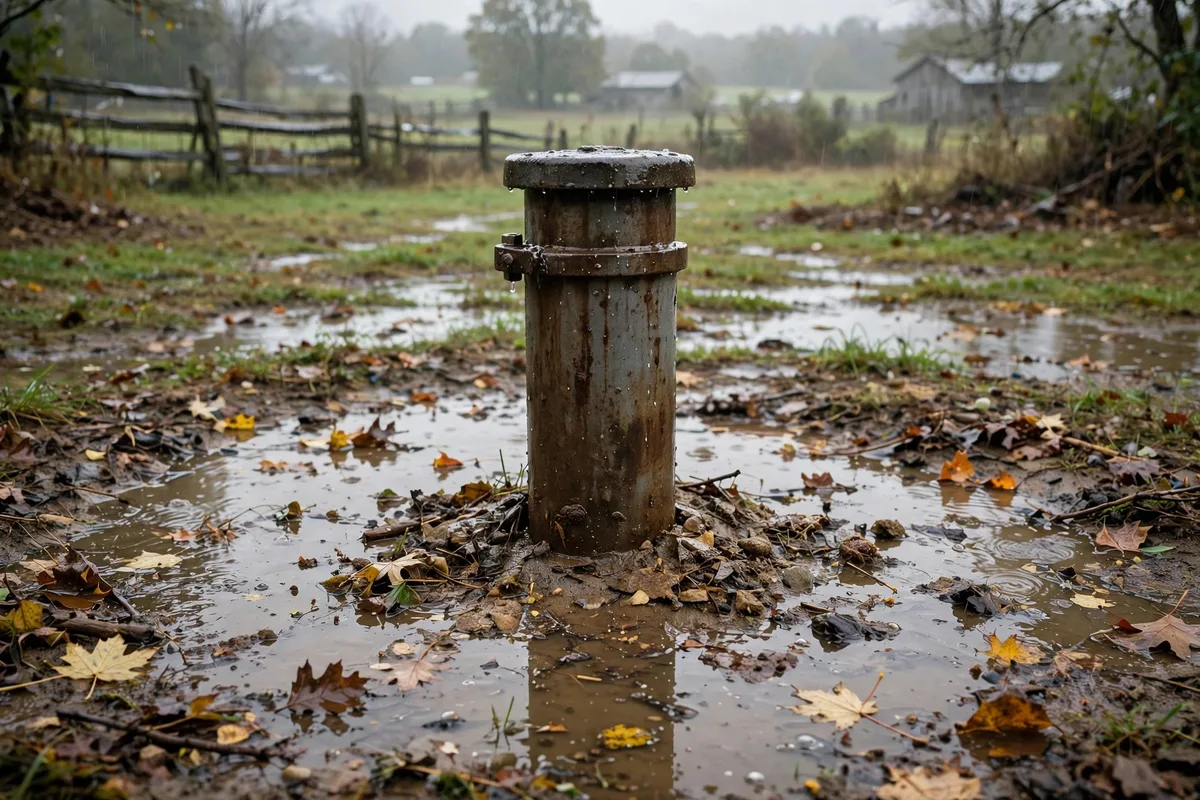
A well is contaminated by rain through a pathway, never by weather alone. Penn State Extension names the two routes plainly. Contaminated surface water can enter directly, "through a loosely fitting well cap or damaged well casing." And contaminated groundwater can migrate underground to your well "from nearby flooded wells, pits, or excavations." Everything a storm does to well water travels one of those two roads.
Moving floodwater adds force to the first route. The EPA's flood fact sheet warns that swiftly moving water "can carry large debris that could loosen well hardware, dislodge well construction materials or distort casing," and that coarse sediment can erode pump components. If the well is not tightly capped, the same water carries sediment — and whatever the surface held, including sewage and farm waste — straight down the casing.
Some wells stand closer to the surface than others, and the EPA draws the line in one sentence worth memorizing: "Wells that are more than 10 years old or less than 50 feet deep are likely to be contaminated, even if there is no apparent damage." A shallow or aging well does not get the benefit of the doubt after a flood, because its water was never far from the surface to begin with.
And the limit of the whole subject: a well whose head stayed dry, delivering water that looks, smells, and tastes exactly as it did last week, has no new problem. The agencies' procedures all begin at the same trigger — water reached the well, or the water changed. Absent both, there is nothing to disinfect and nothing to fix.
The changes, read one at a time
Cloudy water. Turbidity is the change storms produce most often, and it has more than one cause. Runoff stirred into the aquifer, or sediment washed toward the well, can cloud water that was clear — which is why the EPA's disinfection procedure begins, before any bleach, with running an outside spigot "until the water becomes clear and free of sediments." The glass test in our sediment guide separates the harmless versions (air bubbles that clear from the bottom up) from settled grit. Cloudiness that is new, arrives with the storm, and does not settle out is the version to take seriously: it can be surface water announcing itself.
A change in taste or smell. Penn State's inspection step lists the visible changes that mean a flood has impacted a water source: "discoloration, cloudiness, floating debris and particulates, or unusual smell." Its instruction is to assume the source was impacted when you see them. A new smell after a storm means something from the surface is in the water.
Sudden sand or grit. A faucet aerator that fills with sand the week of a storm is not a filter problem. As our sediment guide covers, sudden new sand points at the well itself — a screen or casing giving way, or floodwater that entered carrying its load. That is a well inspection, not a cartridge change.
Nothing at all. The most common result, and a real one. Clear water, normal taste, a dry wellhead: the storm was weather, not an event. Keep the annual test on the calendar.
The dividing line: did water reach the well?
The Minnesota Department of Health writes the decision as three cases, and they are worth taking whole, because they calibrate the response to the event instead of to the anxiety.
Flood water reached your well, or covered the top of the casing. "Assume your well is contaminated." The water "should not be used for drinking, cooking, or brushing your teeth" until the water recedes and the full sequence — inspection, disinfection, testing — is complete. This is the serious case, and the next section is its procedure.
Flood water came within 50 feet of the well, but did not reach it. You "may still want to have your water tested as a precaution" — and note what Minnesota does not say: "You do not need to disinfect your well before having it tested." Proximity buys a test, not a treatment.
The water never came near, and the tap never changed. Nothing in the agencies' guidance asks for action. The annual bacteria test the CDC sets as the floor for every well is the standing answer to ordinary weather.
If the well went under: the order of operations
1. Safety before water
The EPA's fact sheet carries two warnings in capital letters, and the first is do not turn on the pump. "There is danger of electrical shock and damage to your well or pump if they have been flooded." The CDC starts the same way: turn off all electricity to the well area before clearing debris, and do not attempt repairs unless you are experienced. Before power goes back on, a qualified electrician, well contractor, or pump contractor should check the wiring; if the pump's control box was submerged, every component must be dry before service is restored. The EPA adds the detail people get wrong: rubber boots and gloves are not adequate protection from electric shock.
Two more hazards ride along. Do not enter a well pit — the CDC and Minnesota both warn that gases and vapors build up in pits, and Minnesota notes people have died in them from asphyxiation and electrocution. And inspect with your eyes first: if the cap is missing or not watertight, or the casing is damaged, debris and sediment may already be inside — and starting the pump in that state can damage it. A damaged well is a contractor's job before it is anything else.
2. Stop drinking — and know exactly what boiling does
Until the sequence is finished, the well is out of service for the mouth. Minnesota's list is drinking, cooking, and brushing teeth; the CDC warns users "not to drink or bathe in water until all the well disinfection steps have been completed"; Penn State extends the list to mixing baby formula, making ice, and dishwashing. Bottled water is the agencies' first choice — the CDC calls it the safest option after a disaster.
If you must use the well water for drinking or food preparation before the well has been disinfected and tested, Minnesota's instruction is that it "must be brought to a full rolling boil for at least one minute." The CDC says the same: boil, rolling boil for one minute, until the test results are in.
Know the boundary of that pot of water — it is the most misunderstood line in flood response. Boiling and disinfection are bacteria tools. The CDC's warning is explicit: water contaminated with fuel or toxic chemicals "will not be made safe by boiling or disinfection." The EPA adds that well disinfection "will not provide protection from pesticides, heavy metals and other types of non-biological contamination." Nitrate belongs on the chemical side of that line — neither boiling nor shock chlorination removes it, as our nitrate guide works through. If the water smells like fuel or chemicals, the answer is not a kettle or a bleach jug; it is bottled water and a call to the health department, which can arrange a chemical analysis. Boiling is a bridge for the bacteria case only, while the real sequence runs.
3. Inspect, then purge
North Carolina State Extension compresses the physical work into three verbs: wells should be "1) inspected for damage, 2) purged of contaminated water, and 3) disinfected." Inspection comes first because of what may be inside. If floodwater covered the well or may have entered directly, Minnesota has a licensed contractor inspect it and clean out any sediment or debris — with a warning that surprises people: "Using your well pump to do this could ruin the pump." Sediment removal is not a pumping job.
Once the well is intact and the electrical system is cleared, purge it: run the water from the outside faucet closest to the well until it runs clear, keeping the contaminated water out of the house plumbing — the CDC, the EPA, and NC State all put the purge at an outside tap for that reason. Minnesota's procedure gives the duration as 15 minutes to an hour, or until the water runs clear; if contaminated water has already entered the plumbing, each faucet runs until it clears too. Discharge the purged water where it cannot flow back toward the well.
4. Disinfect — one procedure, followed whole
Disinfection after a flood is shock chlorination, and the full step-by-step lives in our coliform guide, which follows the Minnesota procedure used across this site. The flood changes the emphasis, not the chemistry — and it is worth seeing how the agencies' numbers sit together, because they are not identical and are not meant to be mixed. The CDC's emergency procedure calculates its bleach tables to exceed 100 mg/L of chlorine and holds the solution for a minimum of 12 hours. Minnesota's flooded-well procedure holds for at least 8 hours, and scales the bleach up — up to four times the standard amount — for a well that was submerged. The EPA's fact sheet, built around one gallon of non-scented household bleach, waits 6 to 24 hours. Different documents, one shape: inspect, dose, circulate to every tap, hold, flush. Pick one procedure — your own state's, if it publishes one — and follow it start to finish.
Two flood-specific notes. The EPA and the CDC both send drilled, driven, and bored wells to a professional: these wells "are best disinfected by a well or pump contractor, because it is difficult for the private owner to thoroughly disinfect these wells," and the CDC's reason is safety. And through the whole holding period, nobody uses the water: it carries disinfection-strength chlorine, which is the point of it.
5. The treatment equipment sits this out
Every procedure routes around the treatment train before the chlorine moves. The EPA's step is one line: "If you have a water treatment system, switch it to bypass before turning on the indoor faucets." The CDC is more specific about why — "the disinfection process may damage water softeners due to the large amounts of chlorine used" — and has you close the valves to softener units and follow the manufacturer's instructions for disinfecting the softener itself. Minnesota's flooded-well procedure disconnects household filters and softeners outright, and adds the step owners forget: if the filters or softeners were themselves exposed to flood water, ask the dealer for instructions on disinfecting them. The same step drains the water heater, with its gas or electricity off first. Afterward, as the coliform guide covers, filters go back only once the lab confirms the water is clear.
6. Flush, wait, and let the lab decide
Flush the chlorinated water out through an outside faucet, onto ground where it will not harm plants, streams, ponds, or the septic system — the CDC and Minnesota both route the discharge away from all four. Then comes the part of the sequence that feels wrong and matters most: wait.
The test does not happen the day the chlorine smell fades. The EPA instructs: "Have your water tested for bacteria 7 to 10 days after disinfection." The CDC and NC State give the same window, and the CDC explains it — sampling "cannot be done until all traces of chlorine have been flushed from the system." Test too early and you are measuring the bleach, not the well. The sample itself is specific: total coliform, and either E. coli or fecal coliform, from a certified laboratory. Until the lab reports, keep boiling or using the alternative source; Minnesota is blunt that "you must continue to boil your water until the laboratory reports that the water is safe."
A clean result starts the follow-up clock rather than ending the story. Minnesota advises testing again in two weeks to confirm the disinfection held; the CDC's schedule is a further test in the next 2 to 4 weeks and another in 3 to 4 months, with bacterial monitoring at least twice a year after that. If coliform shows up at any point, repeat the disinfection and testing — Minnesota notes it may take several rounds. And the EPA closes its fact sheet with the honest long view: because groundwater moves, and septic effluent or chemicals can seep in afterward, "your well may not be a safe source of water for many months after the flood," even after a test has come back safe. Testing frequency goes up after a flood, not back to normal. The flooded well graduates to a watched well.
What to test after the water goes down
Bacteria first, always. Total coliform and E. coli are the flood tests — the standard for both is zero, and they are the indicators that the surface pathway opened. Everything else is conditional.
Nitrate, when the runoff had a source. Penn State's post-flood testing step adds chemical testing with a specific trigger: "Nitrates can become a concern if the drinking water source is impacted by an adjacent septic system, runoff from manure amended or fertilized agricultural fields, or sewage treatment plants." If the water that stood around your well crossed a septic field, a manure pile, or a fertilized field on its way, add nitrate to the panel — the standard is 10 mg/L — and remember that no amount of chlorination speaks to it.
Chemicals, when there is evidence. A fuel or solvent smell, an oily sheen, chemical containers washed onto the property — the EPA directs those to the state or county health department, and the CDC to a chemical analysis before the water is used. This is a health-department case, not a lab-panel upgrade.
Not a home kit. A flooded well is precisely the decision our guide to home test kits versus a certified lab draws its line at: strips and vials are for watching change in a well you already understand, and the agencies' post-flood instructions all run through certified laboratories and health departments. The result that returns a family to its own tap has to be one a health department will stand behind.
Before the next storm
Everything here is cheap in dry weather, impossible in rising water.
The wellhead itself. Penn State's long-term standard: "the casing extends 12 inches above the ground and is fitted with a watertight sanitary well cap, and the ground should be sloping away from the wellhead." Minnesota adds grading that lets water flow away from the well to its pre-flood checklist. A casing raised, capped watertight, and sitting on ground that sheds water is a well the rain cannot reach.
If your well has flooded before. Minnesota raises the permanent fix: discuss "permanently extending the casing of your well above the flood level" with a licensed contractor. A well that has gone under once has told you its flood line; the casing can be made taller than it.
When a flood is forecast. Minnesota's before-flood steps, in order: store a supply of clean water before taking the well out of service; disconnect the power supply; and, if there is time, have a contractor swap the vented cap for a watertight one. With no time for a contractor, clean the outside of the casing and cover the top with heavy plastic sheeting secured with electrical tape, strapping, or wire — "do not use duct tape; it won't hold under flooding conditions." The wrapping does not prevent the disinfection and testing afterward; it keeps debris and sediment out and makes the cleanup shorter. And keep the annual test current in ordinary times — a clean dry-weather baseline is what makes a post-storm result readable at a glance.
The IronInMyWater rule
Test first, treat second — and never choose equipment from one number alone. Iron, pH, manganese, and hardness together decide the system; the manufacturer's published ratings, checked against your test, decide the model. How we work
FAQ
It rained hard for two days, but no water reached my well and the water looks normal. Do I need to do anything?
Nothing beyond your routine. Even Minnesota's middle case — flood water within 50 feet that never reached the well — calls only for a precautionary bacteria test, with no disinfection beforehand. With no water near the wellhead and no change at the tap, the standing answer is the annual test: total coliform, nitrate, total dissolved solids, and pH. A storm that never touched the well is weather, not an event.
Can I just boil the water and skip the disinfection?
Boiling protects the glass in front of you; it does nothing for the well, the pressure tank, or the pipes, which remain contaminated for the next glass. It also has a hard boundary: it does nothing for chemical contamination — fuel, pesticides, heavy metals, or nitrate. The agencies' sequence for a flooded well is disinfect, flush, wait, and test, with boiling as the bridge across the days that takes — not a substitute for it.
How long until I can drink the water again after a flood?
Work the sequence and the calendar is what it is: inspection and any repairs first, then disinfection with its holding period (8 to 24 hours depending on the procedure), then flushing, then a wait of 7 to 10 days before the bacteria sample can be taken, then the lab's turnaround. Keep using bottled or boiled water until the lab reports the water safe — and plan on follow-up tests at two weeks and again a few months out, because a single clean result after a flood is a milestone, not a verdict. If a round comes back positive, the round repeats.
The wellhead stayed dry, but the water turned cloudy right after the storm. Is that an emergency?
It is a signal, and it deserves the calm version of the response. Run the glass test from our sediment guide: cloudiness that clears from the bottom up is air; cloudiness that settles is sediment the storm stirred up. But new cloudiness timed to a storm can also mean surface water is reaching the well — and if it comes with any change in taste or smell, Penn State's instruction is to assume the source was impacted and use an alternative supply until testing confirms the water is safe. A coliform test is decisive here. What it is not is a reason to shock chlorinate on suspicion alone — test first, and let the result choose the procedure.
Sources
The ratings, prices and guidelines in this guide were checked against these primary sources in November 2026.
- US CDC — How to Disinfect Wells After an Emergency (contractor first for safety; bleach tables calculated above 100 mg/L; minimum 12-hour hold; sample 7–10 days after disinfection for total coliform and E. coli; follow-ups at 2–4 weeks and 3–4 months; fuel- or chemical-contaminated water is not made safe by boiling or disinfection)
- US EPA — What to Do After the Flood, EPA 816-F-05-021 (do not turn on the pump; do not wash with well water; wells more than 10 years old or less than 50 feet deep are likely contaminated even without apparent damage; bypass treatment systems; test for bacteria 7 to 10 days after disinfection; a well may not be safe for many months)
- Minnesota Department of Health — Flood Precautions for Private Water Wells (assume contamination if flood water reached the well; within 50 feet, a precautionary test with no disinfection first; watertight caps, casing extension above flood level, plastic sheeting secured with electrical tape — never duct tape)
- Minnesota Department of Health — Disinfecting Flooded Private Water Wells (rolling boil for at least one minute until the lab reports safe; disconnect filters and softeners and ask the dealer about disinfecting flooded units; up to four times the bleach for a submerged well; at least 8 hours; retest in two weeks)
- Penn State Extension — Post-Flood Drinking Water Safety for Private Water Systems (entry through loose caps and cracked casings; visible changes mean assume impact; nitrate testing when septic systems or manure and fertilizer runoff are involved, standard 10 mg/L; casing 12 inches above ground with the ground sloping away)
- NC State Extension — After the Flood: Inspect, Purge, and Disinfect Your Well (the inspect, purge, disinfect order; purge at the nearest outside faucet until clear; wait 7–10 days to sample; groundwater movement can recontaminate a well months later)
The numbers, on one sheet
The benchmarks behind every guide here — iron, manganese, pH, hardness, coliform, nitrate — plus the treatment order and the equipment ceilings, on a free two-page PDF. Get the free cheat sheet
The IronInMyWater rule
Test first, treat second — and never choose equipment from one number alone. Iron, pH, manganese, and hardness together decide the system; the manufacturer's published ratings, checked against your test, decide the model. How we work
Read next

Getting Started
The New Well Owner's Checklist: The Paperwork, the First Test, the Wellhead Walk, and the First-Year Calendar
The keys came with a folder: one old test result and a page you can't read. The paperwork hunt, the baseline lab test before any treatment talk, the wellhead walk, and the first-year calendar — the sequence that turns a house with a well into a water supply you actually know.
Read the guide →
Costs & Buying
One Quote, Six Jobs: What a Whole-House Well Water System Actually Costs in 2026
One installed quote, six separate jobs — and no way to tell which dollars treat which problem. The stack unbundled stage by stage with manufacturer prices checked in November 2026, the running costs nobody quotes, and five-year totals for three real water profiles.
Read the guide →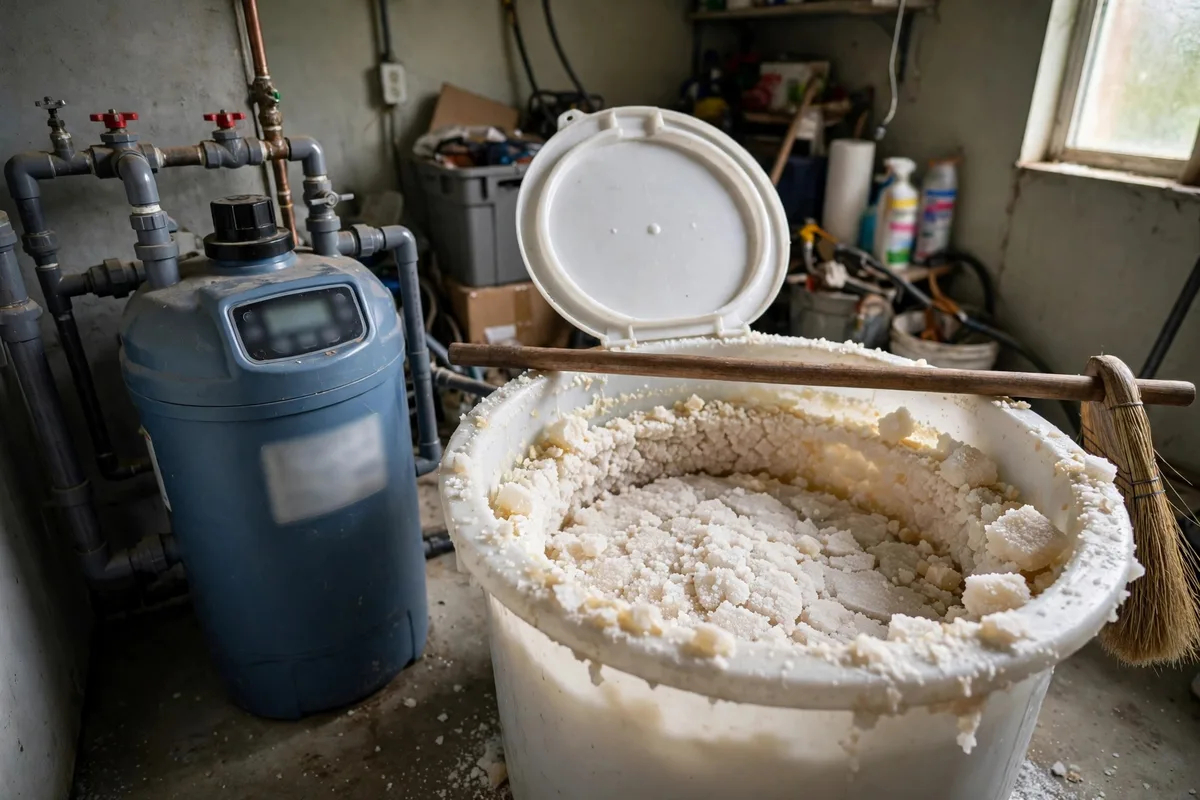
Care & Maintenance
The Softener That Stopped Using Salt: A Maintenance Guide for Brine Tanks, Resin, and Valves on Well Water
The brine tank has been full for months and the scale is quietly back — a crust of fused salt arched over hollow brine. Salt levels and types, resin care on iron-bearing well water, the clock check after every outage, and the injector rinse, on the EPA's and the manufacturers' own instructions.
Read the guide →