
Home Test Kits vs a Certified Lab: What the Strip in Your Glass Can Tell You, and What It Can't
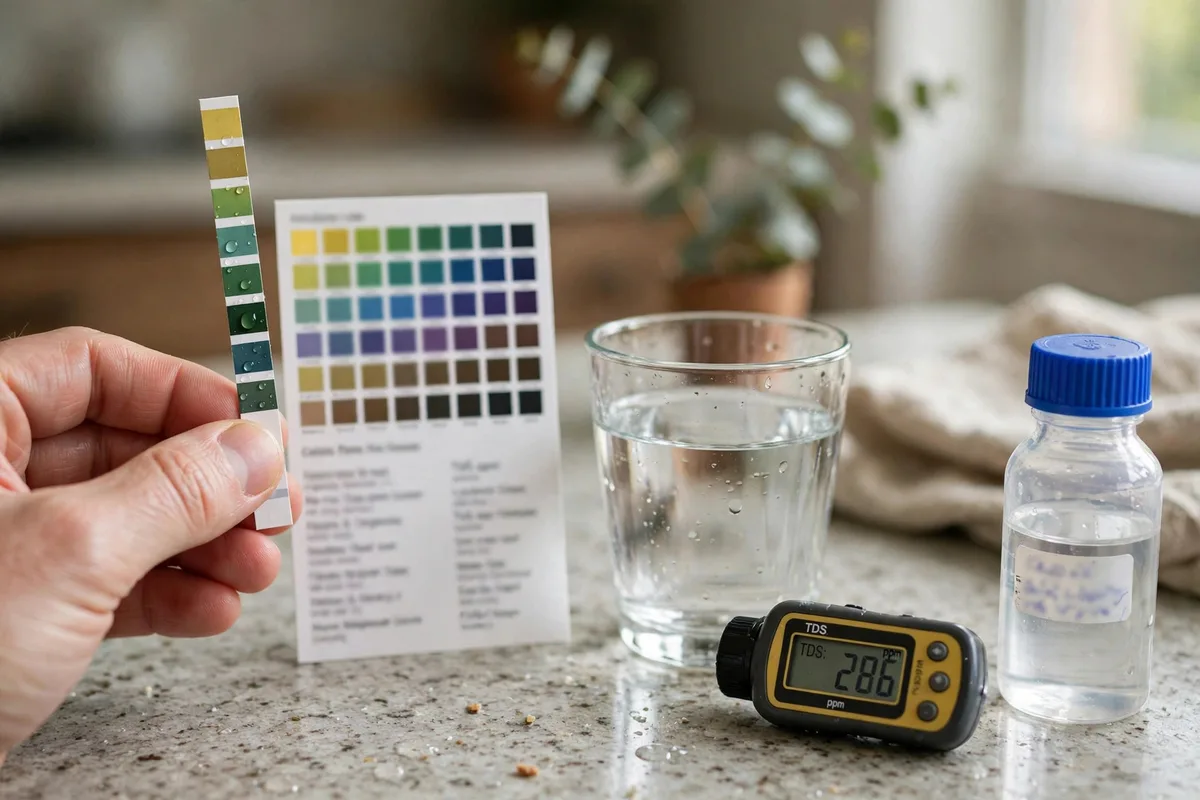
The color between two squares
The strip comes out of the glass, and you hold it against the chart on the bottle, tilting both toward the light. The color is supposed to match one of the printed squares. It doesn't. It sits between two of them — darker than the lower band, lighter than the one above — and the two bands straddle exactly the line you needed to resolve.
This is not a defective strip. This is what a strip is. The question on the table is the problem: whether this water is fine for mixing formula, whether the softener is failing, whether the number on last year's lab report has moved. Those are three different questions, and a color band can carry one of them. The well owner's shelf now holds four kinds of home test — strips, drop kits, digital meters, and bacteria vials — next to the older option of a certified laboratory, and the honest comparison is not "cheap versus expensive." It is that the two sides return different kinds of answer. One returns a band, a direction, a yes or a no. The other returns a number, with a detection limit attached, that a health department will accept and a treatment contractor can size equipment from. Everything in this guide follows from that difference.
Two kinds of answer
A test strip is semi-quantitative: it sorts your water into a range. The range is honest as far as it goes — "somewhere between these two values" is a real measurement — but the width of the range is fixed by the printing on the chart, and no care in dipping or reading can narrow it. A drop kit works the same way with liquid reagents: a color develops, you compare it, you get a band.
A certified laboratory returns a concentration, and just as importantly, it returns the floor below which it cannot see. When a lab report says a contaminant was not detected, it says so against a stated detection limit — the report distinguishes "none found at the level we can measure" from "not measured." Our guide to reading those numbers covers what they decide. A strip cannot make that distinction at all: below its lowest band, everything reads the same blank.
Neither answer is fake. They are answers to different questions, and most of the trouble in home testing comes from asking one tool the other tool's question.
The home shelf, tool by tool
Test strips. Dip, wait the stated seconds, compare the color to the chart. Strips exist for pH, hardness, iron, nitrate, chlorine, and more, often combined on one multi-parameter strip. What they measure is real chemistry — the pad reacts with what's in the water — but the readout is your eye matching a wet, changing color against a printed square, in your kitchen's light. The result is a band, and the band is the product.
Liquid reagent kits. Drops or tablets dissolved in a sample vial, with the same color comparison at the end. The chemistry is a step more controlled than a strip — a measured sample, a measured dose — but the answer still arrives as a color you match by eye, in the same bands.
Digital meters. Two kinds live in the drawer. A pH meter reads an electrode directly and gives a genuine number, to a tenth of a unit — for pH, the home meter is a real instrument. The TDS meter is a different creature wearing the same shape. North Dakota State University Extension's guide to these meters (WQ1923) is plain about the mechanism: the meter measures electrical conductivity — how well the water carries current, which rises with dissolved minerals — and then estimates TDS by multiplying that reading by a conversion factor. The factor is not a constant of nature: in the Extension's own table it runs from 0.50 at low conductivity to about 0.8 at high, because different mineral mixtures conduct differently. The laboratory's standard method, the same guide notes, is to evaporate a measured sample and weigh what remains. And the estimate comes with a maintenance condition: meters must be calibrated regularly, checked against a calibration solution before sampling, and recalibrated after a battery change or a drop — an uncalibrated meter doesn't announce that it has drifted. Finally, a TDS number is a total. It sums everything dissolved and identifies none of it; as the Extension guide puts it, some of those dissolved minerals can be toxic at high enough concentrations, and the meter cannot tell the toxic fraction from the harmless bulk.
Bacteria vials. The home bacteria kit is a sealed vial or bottle with a growth medium: fill it, keep it warm for a day or two, and a color change reports coliform bacteria present or absent. Notice what it cannot return — no count, and no laboratory's confirmation. Hold that against how the agencies frame the bacteria question. The CDC's instruction to well owners is to test for total coliform at least once a year and to "use a state-certified laboratory to test your water." Penn State Extension's report guide puts the passing line at less than one coliform per 100 milliliters — a standard that is about a controlled culture run by a lab, not a vial on a counter. What a home vial can do is raise a flag between lab tests. What it cannot do is be the annual bacteria test, and a "no color change" from a vial is not the same statement as a lab's "absent." Our coliform guide covers what a real positive means and the order of response.
The one head-to-head study
Home kits are usually argued about from anecdotes — a strip that matched a lab once, a strip that missed badly once. There is at least one proper evaluation. Engineers at the University of Massachusetts Amherst bought off-the-shelf home kits that measure iron, copper, manganese, and fluoride, and ran them against laboratory results in three waters — deionized, tap, and river — with both trained staff and untrained users doing the testing (D'Andrea and Kumpel, Journal of Water and Health, 2025).
Three of their findings set the honest ceiling for every kit on the shelf:
- The kits are unregulated, with no performance data behind them. Unlike lab methods, nothing requires a home kit to demonstrate that it works before it is sold.
- Performance was "highly repeatable but variable." The same kit, used the same way, tends to give the same reading again — while its distance from the true value varies. A kit can therefore be genuinely useful for watching change in your own water while being a poor authority on the absolute number.
- Most kits performed best in deionized water — the water with nothing in it. Real water, with its mixture of minerals and organic matter, is where readings degrade. And the authors' conclusion is a sentence worth taping to the test-kit drawer: whether a result can be relied on "depends on which parameter is being measured in which water with which kit and for which purpose."
That last clause — for which purpose — is the whole comparison in miniature. The study does not say home kits are useless. It says their reliability is conditional, and the conditions are exactly the ones a well owner can't see from the packaging.
The parts-per-billion wall
Even a perfect color band runs into a simpler problem: the size of the numbers that matter. Drinking-water standards for the contaminants well owners worry about most are written in parts per billion — thousandths of a milligram per liter. The EPA's arsenic standard is 0.010 mg/L, with a health goal of zero. The lead action level is 0.015 mg/L, also with a goal of zero. The passing line for coliform bacteria is less than one organism per 100 milliliters. These are concentrations at which water looks, tastes, and smells completely clean — Penn State Extension's testing guide states the underlying fact directly: many pollutants in private water systems "have no obvious symptoms and can only be detected through laboratory testing."
A color chart resolves in bands of milligrams per liter. The arsenic decision lives a hundred times finer than that. No improvement in strip chemistry changes the arithmetic: a tool whose smallest printed step is larger than the standard cannot tell you which side of the standard you are on. This is why arsenic is a lab-only subject, why lead is a lab-only subject, and why the annual bacteria test is a lab test. It is not snobbery about credentials. It is resolution.
Nitrate sits at the boundary, which is why it generates the most confusion. Its standard — 10 mg/L measured as nitrogen — is at least written in milligrams, inside a strip's theoretical range. But the decision the number feeds is not theoretical: as our nitrate guide covers, that line was set to protect infants under six months, and a band that straddles it (the opening scene of this article) leaves the one question that matters unanswered. A strip can tell you nitrate is present and roughly how the level is trending. The number you act on, in a house with a baby, comes from a lab.
What "certified" actually buys
"Certified" does specific work in the agencies' advice, because a mail-order kit that sends your sample to a laboratory is not automatically this. State certification is granted test by test: Minnesota's Department of Health publishes its accredited-lab list showing which labs are certified for which analytes — arsenic, coliform bacteria, lead, manganese, nitrate — because a lab can be certified for one and not another. Penn State's university laboratory states its accreditation (by the Pennsylvania DEP) the same way. What that accreditation stands behind is an approved method, run on calibrated instruments, with a detection limit the lab will print next to your result.
Three practical things ride on that:
- A number a contractor can size from. The EPA's home-testing fact sheet puts testing before shopping: if you are considering a treatment unit, find out what is in your water before contacting dealers. Penn State's testing guide makes the same point from the symptom side — even when a stain or taste already tells you the culprit, a certified test is valuable because it provides "the form and concentration" of the pollutant, which is what determines the treatment. Equipment is sized on concentrations and ceilings. A band cannot size anything.
- A result that stands as a record. Regular testing, the EPA notes, establishes a record of water quality that helps solve future problems and supports compensation if someone damages your supply. Penn State is blunter about the legal end: where land use near your well may end up disputed — drilling, mining, construction — samples should be collected by a disinterested third party with chain of custody, because that is what makes results admissible. No home kit produces a record of this kind.
- Independence from the sale. Penn State's caution deserves quoting whole: "Be cautious of water test results from any uncertified lab or from water treatment salespeople." The free in-home test offered by a treatment company is a sales instrument that also produces numbers. An accredited lab sells only the number.
The sample can defeat either one
The least discussed failure in home testing is not the kit or the lab — it is the glass of water itself. A flawless analysis of a badly taken sample is a wrong answer with a certificate. The agency sampling rules are specific — and several run in opposite directions depending on the question:
- The wrong tap. Most samples are taken at the kitchen faucet — but if treatment equipment is installed, that water has already been treated, and the result describes your softener's output, not your well. For raw well water, Penn State directs you to the spigot on the pressure tank, before any treatment or house plumbing.
- The wrong container. Never collect in used food or drink containers — use the lab's sanitized containers, obtained ahead of time. One subtlety from Penn State catches careful people: many lab bottles contain a fixing compound that preserves the sample, and if you rinse the bottle out of tidiness, or let it overflow, you wash the compound away.
- The bacteria clock. A bacteria sample is alive, and it is perishable. Penn State's protocol: sterile bottle (lab bottles contain a chemical that neutralizes chlorine), many labs recommend removing the faucet aerator and sterilizing the faucet end with a flame or rubbing alcohol, run the water a few minutes, fill without touching the inside of the cap or bottle or setting the cap down, keep the sample cool, and deliver it to the lab within 24 hours — "the shorter the time that elapses between collection and analysis, the more reliable the results will be." Penn State's own lab must receive a mailed bacteria sample within 30 hours of collection and cannot accept bacteria samples on a Friday at all. A sample drawn into a jam jar on Saturday and mailed Monday has been defeated before any kit or lab touches it.
- The lead exception — where flushing is the mistake. For almost everything else you flush the line first. For lead and copper from your own plumbing, the sample is the opposite: Penn State instructs letting the water stand in the pipes at least 12 hours and collecting a first-draw sample first thing in the morning, because the metals accumulate in water that has sat against the pipes. Flush that tap out of habit and you have thrown away exactly the water the test exists to measure.
Notice that none of these failures belong to one side. A home strip dipped in treated kitchen water misleads just as completely as a lab analyzing it. The sample discipline is the shared price of a meaningful result.
What the lab route actually costs
Prices vary by state and laboratory, so the honest way to show cost is one accredited lab's published fee schedule, named as an example. Penn State's Agricultural Analytical Services Laboratory — the DEP-accredited university lab — publishes these prices:
| Test (Penn State AASL, published fees) | Fee |
|---|---|
| Standard package: total coliform, E. coli, pH, TDS | $60 |
| Agriculture/Septic package: standard + nitrate-nitrogen | $70 |
| Trace package: standard + arsenic and 7 other metals | $130 |
| Extensive package: 16 parameters incl. first-draw lead | $220 |
| Individual tests: bacteria $40 · arsenic $30 · lead $25 · nitrate $15 | — |
The other cost is time. Results are generally complete within 10 to 14 business days of the lab receiving the sample, and the bacteria clock above governs how the sample gets there. Against that, the EPA notes that county health departments often test for bacteria or nitrates themselves, and the CDC advises asking your health department which labs serve your area. The lab route is neither instant nor free — it is, at these prices, roughly the cost of the treatment cartridge it might save you from buying wrong.
A rhythm that uses both, honestly
The agencies' schedules and the tools' real strengths fit together into a division of labor:
Once a year, the lab. The CDC's baseline for every well: total coliform bacteria, nitrates, total dissolved solids, and pH, at a state-certified laboratory. Penn State's routine schedule is close kin — coliform and E. coli every year, pH and TDS every three years. Either way, the annual anchor is a lab panel, and the report goes in a file, because the trend across years is worth more than any single year. Add the tests your local conditions call for — the CDC's list of off-schedule triggers is practical: problems reported with wells in your area, flooding or land disturbance near the well, any repair to the well system, a change in taste, color, or smell, a pregnancy, or a child coming to live in the house.
Between lab tests, the home tools — watching for change. This is the job the UMass study's "repeatable" finding actually qualifies them for. A TDS meter read monthly will not give you a laboratory TDS value, but Penn State's framing of TDS is built for exactly this use: the value "should not change much from one test to the next," and an increase can indicate pollution and warrant more detailed testing. A stable reading is reassurance of the modest, honest kind; a jump is a reason to book the lab early. Strips earn their place the same way — a quick band check after a treatment change, a hardness or pH watch between panels — as change detectors read against your last lab report, never as replacements for it.
Never delegated to the home shelf: the annual bacteria result, any arsenic or lead number, a nitrate decision in a house with an infant, and any number you are about to spend treatment money on. Those go to the lab, in the lab's bottles, on the lab's clock.
The strip in the opening scene was not lying. It was answering, in bands, a question that needed a number. Keep both tools — and keep each one on its own side of that line.
The IronInMyWater rule
Test first, treat second — and never choose equipment from one number alone. Iron, pH, manganese, and hardness together decide the system; the manufacturer's published ratings, checked against your test, decide the model. How we work
FAQ
My strip says nitrate is low. Can I skip this year's lab test?
No — the annual test is the one the agencies build around a certified lab: the CDC's yearly four are total coliform, nitrates, TDS, and pH, tested at a state-certified laboratory. The strip result and the lab test are also not measuring with the same resolution: the nitrate standard is 10 mg/L as nitrogen, the UMass evaluation found home-kit accuracy variable and water-dependent, and a strip band that sits near the line cannot settle which side you are on. Use the strip between lab tests to watch the trend; keep the annual appointment.
A treatment company offered to test my water free at my kitchen table. Is that enough?
It is a starting look, not a basis for a purchase. Penn State Extension advises caution with results "from any uncertified lab or from water treatment salespeople," and the EPA's guidance is to find out what is in your water before contacting dealers. The structural problem is independence: the company testing your water also sells the equipment the result would justify. If their numbers suggest treatment, confirm with an accredited lab first — at the published prices above, the confirmation costs a fraction of the equipment.
My TDS meter reads 480, just under the 500 guideline. Is my water safe?
The meter cannot answer that question, because TDS is a sum, not an identification. NDSU Extension's meter guide is explicit that the reading is an estimate — conductivity multiplied by a conversion factor — and that the dissolved total can include minerals that are toxic at high concentrations alongside harmless ones. A 480 made mostly of calcium is a scaling nuisance; the same total carrying arsenic or lead is a health problem, and the meter reads them identically. Safety questions are about specific contaminants, and those are the lab's job. What the 480 is good for: compare it with your last reading. A stable TDS is a quiet well; a rising one is a reason to test properly.
Can I collect a bacteria sample on Friday and mail it Monday?
That sample is already lost. Penn State's sampling instructions say to keep the sample cool and deliver it within 24 hours, with reliability falling as time passes; its laboratory must receive a mailed bacteria sample within 30 hours of collection and cannot accept bacteria samples on a Friday. The organisms in the bottle keep changing after collection, so an old sample describes the bottle's weekend, not your well. Collect early in the week, keep it cold, and get it moving the same day.
Sources
The ratings, prices and guidelines in this guide were checked against these primary sources in November 2026.
- US CDC — Guidelines for Testing Well Water (test yearly for total coliform, nitrates, TDS and pH; use a state-certified laboratory; extra tests after flooding, repairs, or a change in taste, color or smell)
- US EPA — Home Water Testing Facts, EPA 816-F-05-013 (annual tests; sterile containers for coliform; use the lab's containers and follow its instructions; testing before contacting treatment dealers; the value of a testing record)
- US EPA — National Primary Drinking Water Regulations (arsenic MCL 0.010 mg/L with a goal of zero; lead action level 0.015 mg/L; nitrate 10 mg/L measured as nitrogen)
- Penn State Extension — Testing Your Drinking Water (all tests by a certified lab; caution about uncertified labs and salespeople; bacteria samples delivered within 24 hours; lead and copper first-draw after 12 hours standing)
- Penn State Agricultural Analytical Services Laboratory — Drinking Water Testing (PA DEP-accredited lab: published package and per-test fees; bacteria sample must arrive within 30 hours; results in 10–14 business days)
- D'Andrea & Kumpel, University of Massachusetts Amherst — Evaluation of drinking water quality test kits for home use in the United States, Journal of Water and Health 2025 (home kits are unregulated and lack performance data; repeatable but variable; best in deionized water)
- North Dakota State University Extension — Using Electrical Conductivity and Total Dissolved Solids Meters to Field Test Water Quality, WQ1923 (EC is a proxy for TDS; the conversion factor varies with level; meters must be calibrated regularly)
- Minnesota Department of Health — Well Water Quality / Well Testing (accredited laboratories are certified per test: arsenic, coliform bacteria, lead, manganese, nitrate)
The numbers, on one sheet
The benchmarks behind every guide here — iron, manganese, pH, hardness, coliform, nitrate — plus the treatment order and the equipment ceilings, on a free two-page PDF. Get the free cheat sheet
The IronInMyWater rule
Test first, treat second — and never choose equipment from one number alone. Iron, pH, manganese, and hardness together decide the system; the manufacturer's published ratings, checked against your test, decide the model. How we work
Read next

Getting Started
The New Well Owner's Checklist: The Paperwork, the First Test, the Wellhead Walk, and the First-Year Calendar
The keys came with a folder: one old test result and a page you can't read. The paperwork hunt, the baseline lab test before any treatment talk, the wellhead walk, and the first-year calendar — the sequence that turns a house with a well into a water supply you actually know.
Read the guide →
Bacteria & Disinfection
Well Water After Heavy Rain and Flooding: Which Changes Are Signals, and the Order of Operations When the Well Goes Under
The storm is over and the water runs cloudy for the first time in years. Most rain changes nothing — but water that reached the wellhead changes everything. How to read the changes, the agencies' order of operations for a flooded well, and the grading and cap work that keeps the next storm out.
Read the guide →
Costs & Buying
One Quote, Six Jobs: What a Whole-House Well Water System Actually Costs in 2026
One installed quote, six separate jobs — and no way to tell which dollars treat which problem. The stack unbundled stage by stage with manufacturer prices checked in November 2026, the running costs nobody quotes, and five-year totals for three real water profiles.
Read the guide →