
SpringWell vs US Water Systems vs iSpring for Well Water (2026)
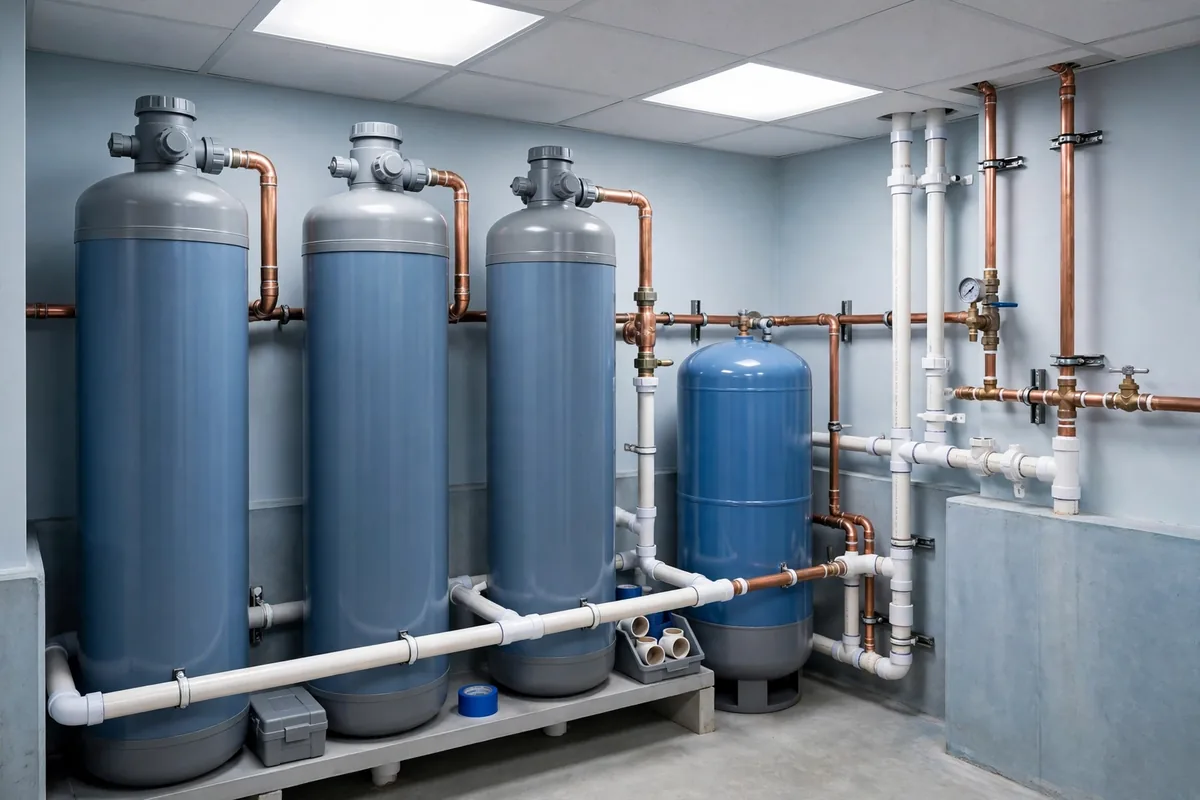
$474, $2,231, or $3,295: the price is not the ranking
Three systems, three very different prices — and the cheapest one is not always the wrong one.
The three systems are the iSpring WGB32BM at $473.68, the SpringWell WS1 at $2,231, and the US Water Systems Matrixx inFusion at $3,295. Those are the manufacturers' published prices as of November 2026, and all three brands run sales often enough that the number on the day you buy may be lower. What does not change with the sales is the design of each system — and the design, not the price, is what decides whether it works on your water. The most expensive system here treats water the cheapest one cannot touch. The cheapest one is the correct purchase for a well the expensive one would be wasted on.
So this comparison is not ranked by price, and it does not end with a single winner. It is organized around the one document that should decide the purchase: your water test. Every rating below is the manufacturer's own published figure — what each company says its system can handle, in parts per million (ppm, the same unit as mg/L on a lab report). Read your iron, hydrogen sulfide, manganese and pH numbers off your test, and the tables below will narrow three systems down to the one that fits — or tell you honestly that none of them does.
The three systems at a glance
| SpringWell WS1 | US Water Matrixx inFusion | iSpring WGB32BM | |
|---|---|---|---|
| How it treats | Air injection oxidation + greensand media, backwashing tank | Hydrogen peroxide injection + catalytic carbon, backwashing tank | Three cartridges: sediment, carbon block, iron/manganese cartridge |
| Iron rating | Up to 7 ppm | Up to 20 ppm | Up to 3.0 ppm |
| Hydrogen sulfide rating | Up to 8 ppm | Up to 30 ppm | Not rated |
| Manganese rating | Up to 1 ppm | Up to 1 ppm | Up to 1.0 ppm |
| Flow rate | 12 GPM service | 10 or 15 GPM by size | Up to 15 GPM peak |
| Working pH range | 6.5–10 | 6–9 | 6–11 |
| Needs power and a drain | Yes | Yes | No |
| Warranty | Lifetime on tank, valves and fittings; shorter term on the electronic head | Lifetime on the tank; 10 years on valve and electronics; 5 years on the injection panel | 1 year |
| Price (Nov 2026) | $2,231 | $3,295 | $473.68 |
Two things to notice before the details. First, the manganese ceiling is the same on all three — 1 ppm. If manganese is your main problem and it tests above 1 ppm, none of these systems is rated for your water, whatever the price. Second, only two of the three publish a hydrogen sulfide rating at all. That single line in the table eliminates one system from every sulfur conversation, and it is not the most expensive one.
SpringWell WS1: air does the oxidizing
The WS1 is a single tank with an electronic head, and the treatment happens in two steps inside it. Water first passes through a pocket of air held at the top of the tank. The oxygen converts dissolved iron, hydrogen sulfide and manganese into solid particles. A bed of greensand fusion media then catches those particles, and each night an automatic backwash flushes them down a drain and refreshes the air pocket. There are no chemicals to buy or refill — the oxidizer is air. SpringWell puts the media life at 10+ years, and the head is Bluetooth-controlled. The system needs electricity and a drain line, like a water softener.
SpringWell's ratings are the middle of this comparison: iron up to 7 ppm, hydrogen sulfide up to 8 ppm, manganese up to 1 ppm, at a pH between 6.5 and 10. The WS1 flows 12 GPM and is sized for homes with 1 to 4 bathrooms; a larger size, the WS4, covers bigger homes. Those ceilings cover the most common well test results — iron in the low single digits, a sulfur smell that is strong to your nose but modest on paper. Remember that people can smell hydrogen sulfide well below 0.5 ppm, so a smell that fills the bathroom can still be a 2 ppm problem, comfortably inside this system's rating.
One part of buying a WS1 is different from the other two, and it is worth copying whatever you buy: SpringWell requires a lab water test before it ships the system, and if the results show your water is outside what the system can treat, it cancels the order and refunds you in full. (The test itself, sold by SpringWell for $134.25 when we checked, is not refundable.) It is the only one of the three that checks your numbers before taking your money.
The warranty is the strongest headline of the three — lifetime against defects on the tank, valves, fittings and other covered parts, plus a 6-month money-back guarantee — with one honest wrinkle: the electronic head is covered for a shorter term, and SpringWell's own pages do not agree on it, listing 5 years in one place and 7 in another. Get the head's term in writing before you buy.
Buy it if your iron is between about 3 and 7 ppm, your hydrogen sulfide is under 8 ppm, your manganese is under 1 ppm and your pH is 6.5 or higher. Skip it if any of those numbers is above its ceiling, or your pH is below 6.5 — oxidation struggles in acidic water, and a rating is a ceiling, not a suggestion. And like the other two, it is not a disinfection system: SpringWell's own instructions say not to use it where water is microbiologically unsafe.
US Water Matrixx inFusion: peroxide does the oxidizing
The inFusion is built for the wells the WS1 cannot handle, and it uses a stronger tool to do it. A Stenner metering pump on a wall panel injects hydrogen peroxide into the water ahead of a tank of coconut-shell catalytic carbon. Peroxide is a far stronger oxidizer than air. It converts iron, manganese and hydrogen sulfide on contact, and the carbon bed filters out what it creates. The valve backwashes the carbon about every two days, runs on 12 volts with a battery backup, and is programmed from a phone app. A 15-gallon solution tank holds the peroxide, and the system ships with two jugs — 10 gallons — to get you started.
The ratings show what the extra money buys: iron up to 20 ppm and hydrogen sulfide up to 30 ppm, the highest sulfur ceiling of the three by a wide margin, with manganese again at 1 ppm and a working pH range of 6 to 9. It comes in two sizes — 10 GPM for 1 to 2 bathrooms and 15 GPM for 2 to 3.5 bathrooms — and your well pump also has to supply the backwash flow, 5 or 8 GPM depending on size, on top of household use. US Water also says the system works on iron and sulfur bacteria, the slime-forming kind that live in wells and plumbing; it is the only one of the three whose maker makes that claim. It is still not a disinfection system — US Water's own manual notes that it does not remove biological contaminants, and a well that tests positive for coliform still needs disinfection as a separate step.
The trade-off is that the treatment is never finished being bought. Peroxide is a consumable: how fast you use it depends on your sulfur and iron levels and how much water your household runs, but the tank will need refilling for as long as you own the system. The catalytic carbon is a wear item too, replaced every 3 to 5 years. Against that, the warranty is long where it matters: lifetime on the tank, 10 years on the valve and electronics, and 5 years on the injection panel.
Buy it if your hydrogen sulfide is above 8 ppm, your iron is above 7 ppm, or iron and sulfur bacteria are part of the problem — the cases where the other two are simply not rated. Skip it if your numbers are mild. On a well with 2 ppm iron and a faint smell, the inFusion is the most expensive way to do a job the other systems are rated for, and you would keep buying peroxide to treat water that air or a cartridge could have handled.
iSpring WGB32BM: cartridges do the catching
The WGB32BM is a different kind of machine — three 20-inch cartridges in a row on a bracket, with no tank, no valve, no backwash, no drain and no power cord. Water passes through a 5-micron polypropylene sediment filter, then a coconut-shell carbon block that takes out chlorine, taste and odor, then the stage that defines the system: a cartridge of catalytic media that reduces iron and manganese. The media is not consumed as it works, which iSpring says makes the cartridge last up to three times longer than greensand. You install it on the main line with 1-inch fittings, and when a cartridge is spent you swap it, the way you would change a furnace filter.
Its ratings are the lowest of the three, and iSpring publishes them plainly: iron up to 3.0 ppm and manganese up to 1.0 ppm, each reduced to 0.01 ppm, across a wide pH range of 6 to 11. Peak flow is up to 15 GPM. What the specifications do not list is any hydrogen sulfide rating at all. Read that absence correctly: this is not a sulfur system. If your problem is a rotten-egg smell, this is the wrong box at any price.
The other limit is capacity. The iron cartridge is rated for 50,000 gallons at 3.0 ppm iron; the sediment and carbon cartridges for up to 100,000 gallons or 12 months — and iSpring describes that larger figure as about a year of water for a family of four, which makes the iron cartridge's rating roughly half a year for the same family. The closer your iron runs to the 3.0 ceiling, the faster the cartridge is spent. iSpring's own product notes tell well owners with very high iron or manganese to contact them about other solutions — the maker itself is telling you where its ceiling is. The warranty matches the price tier: 1 year, activated by registering the product, with lifetime technical support after that.
Buy it if your iron is at or under 3 ppm, your manganese is at or under 1 ppm, you have no sulfur smell to fix, and you would rather swap cartridges a few times a year than install a backwashing tank — or your space has no drain and no outlet for one. Skip it if your iron is above 3 ppm, sulfur is part of the problem, or iron bacteria are present to clog the cartridges.
Match the system to your test numbers
| Your test shows | The system that fits | Why |
|---|---|---|
| Iron up to 3 ppm, manganese up to 1 ppm, no sulfur smell | iSpring WGB32BM | It is rated for exactly this water, and the other two would be money spent on capacity you never use |
| Iron 3–7 ppm, and/or hydrogen sulfide up to 8 ppm, manganese up to 1 ppm, pH 6.5 or higher | SpringWell WS1 | The air-injection ratings cover the common middle of well test results, with nothing to refill |
| Hydrogen sulfide above 8 ppm (up to 30), or iron above 7 ppm (up to 20), or iron/sulfur bacteria | US Water Matrixx inFusion | The only one of the three rated for those levels, and the only one whose maker claims it works on the bacteria |
| pH below 6 | None of the three, yet | All three publish a minimum pH of 6 or 6.5. Acidic water needs neutralizing first; then choose by the numbers above |
| A positive coliform or E. coli result | None of the three | None of these systems disinfects. That is a separate treatment step, and it comes first |
| Hardness and scale as the main complaint | None of the three | None of these systems is a softener. Iron filtration and softening are different jobs, often done by two systems in a row |
Notice what the table is really saying: the three systems barely overlap. Each one owns a band of test results, and the bands are defined by the manufacturers' own ceilings. The buyer's job is not to pick a brand. It is to find out which band their water is in.
Flow rate: three numbers that are not measured the same way
Flow is where comparison tables quietly mislead, because the three makers are not publishing the same kind of number. SpringWell's 12 GPM for the WS1 is a service flow — the rate it can treat continuously. The inFusion's 10 and 15 GPM are the peak flows of its two sizes, and the system also needs your well to deliver 5 or 8 GPM of backwash flow while it cleans itself. The iSpring's 15 GPM is a peak through clean cartridges; as the cartridges load up with iron and sediment over their life, the pressure drop across them rises, so the flow your showers actually get late in a cartridge's life is less than the number on the box.
The practical version: size any of the three by your bathrooms and your well pump's output, not by the biggest GPM figure in the table — and with a cartridge system, treat a falling water pressure as the signal that a cartridge is spent, not as a surprise.
The cost after the purchase
The sticker prices — $473.68, $2,231, $3,295 — are the beginning of each system's cost, not the whole of it.
The WS1 has the lightest upkeep of the two tank systems: no chemicals, nothing to refill, and a media bed SpringWell rates at 10+ years. It uses some water and electricity for its nightly backwash. The inFusion adds a permanent consumable — hydrogen peroxide, used at a rate set by your water — plus a catalytic carbon replacement every 3 to 5 years. On the severe water it is built for, that running cost is the price of a system that works at all; on mild water, it is money spent treating numbers that were never a threat. The WGB32BM has no power or water costs, but its cartridges are a repeating purchase on a schedule your iron level sets: at 3 ppm iron, the iron cartridge's 50,000-gallon rating goes quickly, and over a decade of swaps the gap between its price and a tank system's narrows — though for low-iron water it stays the cheapest way to solve the problem by a wide margin.
None of the three prices includes installation. The iSpring is the realistic do-it-yourself project of the three. The two tank systems are softener-style installs — main line, power, drain — that many owners hand to a plumber, so budget for that on top of either price.
Where each one is the wrong buy
Buying the iSpring for a sulfur smell. It publishes no hydrogen sulfide rating. A carbon cartridge can polish a faint odor briefly, the way any carbon can, but a rated sulfur problem will walk straight through it, and the purchase will have bought you a few weeks of hope.
Buying the WS1 above its ceilings. Seven ppm of iron and 8 ppm of hydrogen sulfide are the top of what SpringWell says the system can do, at a pH of 6.5 or better. At 10 ppm iron, or in acidic water, the system is not "a bit undersized" — it is outside the conditions its maker stands behind.
Buying the inFusion for mild water. Peroxide injection earns its cost at high sulfur and iron levels and against bacteria. At 2 ppm iron it is the most expensive system here, plus a chemical bill that never ends, treating water the cheapest system is rated for.
Buying any of the three for bacteria or hardness. None of them disinfects, and none of them softens. A positive bacteria test needs disinfection; scale and hard water need a softener. Each of these systems can sit alongside that equipment, but none of them replaces it.
The short version
If your test shows low iron and no sulfur, buy the iSpring and do not let anyone talk you upward — the cheapest system is the right one for your water. If your test shows the common middle — iron up to 7 ppm, sulfur up to 8, pH in range — the SpringWell WS1 treats it with nothing to refill and a lifetime warranty on its tank and valves. If your sulfur or iron numbers run past those ceilings, or bacteria are in the picture, the Matrixx inFusion is the only one of the three rated for your water, and its peroxide bill is part of the deal. And if your numbers run past all three — iron above 20 ppm, hydrogen sulfide above 30 ppm — close this comparison and call a water treatment professional, because the honest answer is a custom system, not a bigger box from this list.
The IronInMyWater rule
Test first, treat second — and never choose equipment from one number alone. Iron, pH, manganese, and hardness together decide the system; the manufacturer's published ratings, checked against your test, decide the model. How we work
FAQ
Which of the three is the best system overall? There isn't one, and a ranking would mislead you. Each system is rated for a different band of water: cartridges up to 3 ppm iron, air injection up to 7 ppm iron and 8 ppm sulfur, peroxide injection up to 20 ppm iron and 30 ppm sulfur. The best system is the one whose ratings cover your test results with room to spare — and for low numbers, that is the cheapest one.
Is the iSpring too cheap to actually work? Within its published limits, no. The design is sound — sediment, carbon, then a catalytic iron cartridge — and iSpring states its ceilings plainly: 3.0 ppm iron, 1.0 ppm manganese, no hydrogen sulfide rating. The risk is not the price; it is buying it for water above those ceilings, where no cartridge system can keep up.
Can one of these replace my water softener? No. None of the three softens water — they remove iron, manganese and, in two cases, hydrogen sulfide, and hardness minerals pass through all of them. Homes with both problems typically run an iron filter first and a softener after it.
My well tested positive for bacteria. Which one should I buy? None of them, yet. None of these systems is a disinfection system. SpringWell's instructions say not to use the WS1 where water is microbiologically unsafe, and US Water's manual notes that the inFusion does not remove biological contaminants, even though its peroxide works on iron and sulfur bacteria in the water. A coliform or E. coli result needs disinfection, such as shock chlorination or UV, handled as its own step.
What if my pH is below 6.5? Then the WS1 is outside its published range, and below 6 the other two are as well. Acidic water also corrodes plumbing on its own. The usual order is a pH neutralizer first, then an iron system chosen by the remaining numbers.
Why do the prices move so much? All three manufacturers sell direct and discount frequently, so treat the prices here as the published figures from November 2026 rather than a promise about today's checkout page. The ratings, unlike the prices, do not change with the sales — which is one more reason to choose by the numbers.
The IronInMyWater rule
Test first, treat second — and never choose equipment from one number alone. Iron, pH, manganese, and hardness together decide the system; the manufacturer's published ratings, checked against your test, decide the model. How we work
Read next
Choosing Equipment
Iron Filter vs Water Softener vs Whole-House System: Which One Do You Actually Need?
Three boxes, three different jobs — and one correct order. Why a softener will not fix iron stains, and how your test numbers pick the equipment you actually need.
Read the guide →
Water Testing
Get Your Well Water Tested First: What the Numbers Mean Before You Buy Anything
Before you buy any filter, test the water. What each number on the report — iron, pH, hardness, sulfur, bacteria — actually decides, and the treatment order it forces.
Read the guide →
Sulfur Smell
Well Water Smells Like Rotten Eggs: Sulfur, Bacteria, and How to Tell Them Apart
Rotten-egg smell in well water is hydrogen sulfide gas — and it has three different causes. The hot-and-cold test that tells them apart, and the fix for each one.
Read the guide →