
Get Your Well Water Tested First: What the Numbers Mean Before You Buy Anything
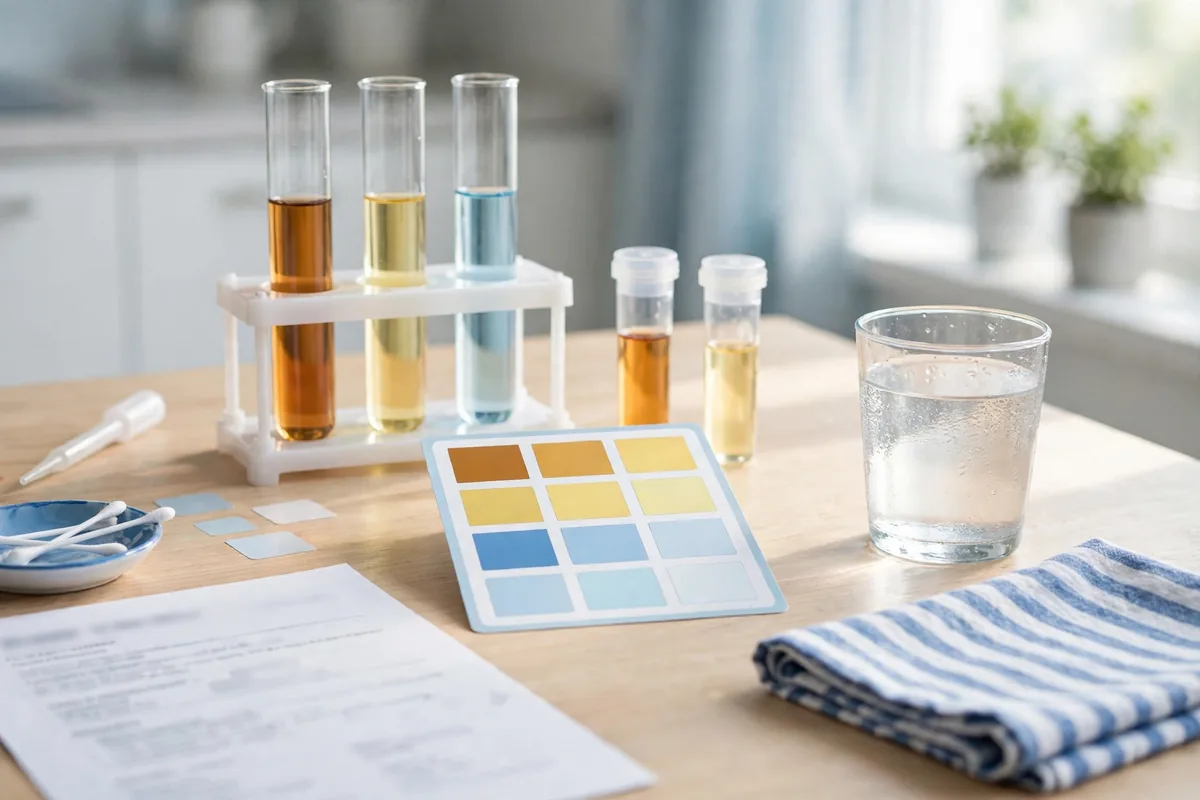
Do not buy a filter before you test your water
Do not buy a filter before you test your water. The test costs less than the wrong system — and the wrong system is exactly what you get when the sizing starts from a stain, a smell, or a sales visit instead of from numbers.
Here is how the wrong purchase usually happens. Your water leaves orange rings, or smells of rotten eggs, or coats the kettle in white scale. A treatment system gets recommended — sometimes honestly, sometimes straight from a catalog — based on that symptom alone. But a symptom is not a measurement. Orange stains say "iron" without saying how much iron, in what form, or what else is dissolved alongside it. And it is the alongside that decides whether the equipment works: the same iron level needs different treatment depending on your pH, your manganese, and your sulfur, and a system chosen without those numbers is a guess wearing a price tag.
A proper water test replaces the guess with a page of numbers. This guide walks through the numbers that matter — what each one is, the reference point to read it against, and what it decides — then puts them in the order they force on you. Because treatment is a sequence, and the sequence comes from the test.
First, know what kind of numbers these are
Most of the numbers on a well water report are read against guidelines published by the US Environmental Protection Agency, and it pays to know which kind. The EPA's primary standards are health-based limits that public water systems are required to meet. Its secondary standards are something else: non-enforceable guidelines for what the agency calls nuisance chemicals — the things that stain, taste, smell, and corrode. Iron, manganese, sulfate, total dissolved solids, and the pH range all live on the secondary list. Their numbers mark the level where the nuisance becomes hard to live with. They are not lines between safe and unsafe.
Two more facts frame everything below. The EPA does not regulate private wells at all — no inspector samples your water, so the test happens because you arrange it, or it does not happen. And the EPA advises well owners to test at least yearly for a short core list: total coliform bacteria, nitrate, total dissolved solids, and pH. The full panel in this guide is the wider version of that habit — the one you run before spending real money, and whenever the water changes.
So read each number below the same way: as a decision input. Every one of them either picks a step in the treatment sequence, sizes it, or tells you the step is not needed at all.
The numbers on the report, and what each one decides
| Test number | What it decides | Reference point |
|---|---|---|
| Iron (mg/L) | Whether you need oxidation and filtration, and the capacity that step must be rated for | EPA secondary guideline: 0.3 mg/L |
| Manganese (mg/L) | Whether the oxidation step must also be rated for the harder job — manganese oxidizes more slowly than iron | EPA secondary guideline: 0.05 mg/L |
| Hydrogen sulfide (mg/L) | Whether sulfur needs real oxidation capacity, or a little carbon is enough | No federal standard; most people smell it well below 0.5 mg/L (Penn State Extension) |
| pH | Whether acid correction has to come first — oxidation runs poorly in acidic water, and low pH corrodes plumbing | EPA secondary range: 6.5–8.5 |
| Hardness (mg/L or gpg) | Whether a water softener belongs in the system at all, and its size in grains | USGS classes: hard at 121–180 mg/L, very hard above 180 |
| Sulfate (mg/L) | The raw material for hydrogen sulfide; high sulfate keeps feeding the rotten-egg problem | EPA secondary guideline: 250 mg/L |
| Total dissolved solids (mg/L) | A bulk warning light — how much is dissolved in total, before you ask what it is | EPA secondary guideline: 500 mg/L |
| Total coliform / E. coli | Not a sizing number — a gate. Decides whether the well itself needs attention before any equipment question | Any E. coli detection: stop and get professional advice |
| Nitrate (mg/L) | The annual-check item, and one of the few with a health-based federal standard behind it | EPA primary standard for public systems: 10 mg/L |
Iron decides the main step. Below the 0.3 mg/L guideline, iron rarely justifies equipment on its own. Above it, staining is a matter of time, and the answer is the sequence this site keeps returning to: oxidize the dissolved iron, then filter out the rust it becomes. What your number decides is capacity — the system's published iron rating has to clear your measured level, at your household's flow, or it will pass iron exactly when you use the most water. A water softener can absorb small amounts of dissolved iron within the clear-water iron rating its manufacturer publishes, but that is a side capacity, not the main step.
Manganese decides whether "iron treatment" is enough. Manganese travels with iron, stains black and dark brown instead of orange, and tastes bitter. Its guideline is only 0.05 mg/L, so a little stains a lot. It also oxidizes more slowly than iron, which makes it the harder removal job: a system that clears your iron can still let manganese through. If your report shows manganese, the equipment's published manganese rating matters as much as its iron rating — and that rating is the line that tends to appear in spec sheets rather than on sales pages.
Hydrogen sulfide decides the sulfur capacity — after the cause is found. The rotten-egg smell is hydrogen sulfide gas, and your nose detects it at levels far below anything a test needs to confirm: most people smell it well below 0.5 mg/L, according to Penn State Extension. The number still matters, because it sizes the fix — low levels can be polished off with activated carbon, while higher levels need oxidation capacity rated for the measured amount. But the number comes second. The gas has three sources — sulfur bacteria, the water heater, and the groundwater itself — and each needs a different fix. Find the source first, then let the number size the treatment.
pH decides what goes first. pH is a 0–14 scale, and each whole step is a tenfold change in acidity. Inside the EPA's secondary range of 6.5–8.5, treatment chemistry behaves. Below it, two problems start: acidic water corrodes metal plumbing, and the oxidation that iron and manganese removal depends on runs slowly and incompletely. Low pH is therefore corrected before the main treatment, usually with a neutralizing filter — and because neutralizing media such as calcite dissolve into the water and add some hardness, the correction changes a downstream number too. Above 8.5, expect a slippery feel and mineral deposits instead. Either way, pH is read early because everything else is read through it.
Hardness decides the softener — a separate question. Hardness is calcium and magnesium, reported in mg/L or grains per gallon (1 gpg = 17.1 mg/L). The US Geological Survey classifies water as soft at 0–60 mg/L, moderately hard at 61–120, hard at 121–180, and very hard above 180. Hard water leaves white scale, soap scum, and spots on glass — a different nuisance from iron's orange rust, with a different fix. Your hardness number answers two things: whether a softener belongs in the system at all, and, if it does, its size, since softener capacity is rated in grains and the right size comes from your hardness multiplied by the water your household actually uses. What hardness never does is excuse skipping the iron step: the two problems share a wall, not a solution.
Sulfate and TDS are the supporting evidence. Sulfate above its 250 mg/L guideline tastes salty — and matters more as the raw material that bacteria and water heaters turn into hydrogen sulfide, which is why a sulfur problem with high sulfate points at the groundwater case. Total dissolved solids is a sum, not a substance: above the 500 mg/L guideline the water tends toward salty taste, deposits, and staining, but the number alone picks no equipment. Read it with its parts — chloride (EPA secondary guideline 250 mg/L; salty taste, and corrosive to pipes) is a common contributor. When TDS is high and everything else on the report is ordinary, the usual answer is a point-of-use reverse osmosis unit at one drinking-water tap, not a whole-house decision.
Bacteria and nitrate are not equipment numbers. Total coliform bacteria are a well-integrity signal: they say something on the surface may be reaching the water. E. coli is the hard gate — any detection means stop drinking the water, disinfect, find the source, and retest, with professional advice rather than a product catalog. Nitrate sits in the EPA's annual testing list and carries a health-based primary standard for public systems of 10 mg/L; it is on this panel so the number gets watched year to year, not so it can size a filter. Neither line is answered by buying a bigger box. Both are answered by a certified lab result and, when they flag, a conversation with your local health department or a licensed well contractor.
The order the numbers force
You read the report in symptom order — iron, sulfur, pH, hardness. You install in the order the chemistry demands, and the report is what puts each box on the list.
Step 1 — Catch what is already solid. A sediment prefilter takes out particles and oxidized iron first and protects everything downstream. Cheap, unglamorous, and skipped constantly.
Step 2 — Correct the pH, if it is low. This step exists only if your pH number calls for it, and it goes here — ahead of the main treatment — because the oxidation in step 3 depends on it. Remember that the neutralizer adds some hardness; the softener in step 4 is sized with that included.
Step 3 — Oxidize and filter. This is the iron, manganese, and sulfur step. One stage of equipment carries all three, but each has its own published rating, and each rating has to clear your measured number. The heaviest demand sizes the step. Where bacteria are part of the picture — iron bacteria in the tank, sulfur bacteria behind the smell — disinfection joins this step, because no filter outruns a colony living upstream of it.
Step 4 — Soften last, and only if hardness says so. In this position the iron step protects the softener instead of the softener dying as an iron filter. Sized in grains from your hardness and your household's use, it finishes the water — if your number called for it at all.
Anything beyond this — a carbon cartridge for taste at the kitchen tap, for instance — is polish, chosen by preference rather than by the report. Every step on the list is there because a number put it there — and a step with no number behind it is a step you can skip.
Test strip, home kit, or laboratory?
What strips and home kits are good for. Screening and watching. A strip or a simple home kit gives you pH and hardness trends, a rough indication of iron, and a quick check on whether last year's numbers have drifted. It is also the practical way to measure hydrogen sulfide, the one number that escapes from a sample bottle on its way to a lab. Read a strip's answer for what it is: a range between two colors, not a figure.
What they cannot do. Size equipment. A manufacturer's rating is stated in mg/L; a strip's answer is "somewhere in this band." The distance between those two is where wrong systems live. And bacteria is not a strip question at all — whether coliform or E. coli is present is settled by a laboratory test, full stop.
What the lab report is for. The numbers you will spend money on. Use a state-certified laboratory, and order the panel that covers the decision numbers above plus the annual bacteria and nitrate checks. Follow the lab's bottles and instructions exactly — some samples are preserved, some are timed, and the point of paying for a lab is that its number can be aimed at a spec sheet.
The rule of thumb: strips for watching, the lab for deciding.
How to take a sample that tells the truth
A good panel can still be ruined by a bad sample. Five habits protect the result.
Sample the well, not the equipment. Draw from a tap ahead of any softener or filter — an outdoor spigot before the treatment equipment is ideal. A sample drawn after the softener measures the softener: it will report the iron and hardness the equipment removed and tell you nothing about what is coming out of the ground.
Let it run first — with one exception. For the chemistry numbers, run the cold tap until the water is freshly out of the ground and steady in temperature. You want the well's water, not water that sat in your pipes all night. The exception is metals from your own plumbing: lead and copper are tested first-draw, after the water has stood in the pipes for at least six hours, following the EPA's sampling protocol — because there, the pipes are the question.
Respect the fragile numbers. Hydrogen sulfide escapes from the sample, and dissolved iron starts oxidizing the moment the water meets air. Use the lab's preserved bottles, fill them the way the instructions say, and keep the sample cold and moving. If your stains and your report disagree, believe the stains and test again — the fragile numbers are the usual reason.
Mind the bacteria clock. The bacteria sample has the shortest fuse: keep the bottle cold and get it to the lab the same day. And do not take it in the first days after shock-chlorinating the well, while chlorine is still working through the system — the result will flatter the well, and a flattering bacteria result is worse than none.
Test on a rhythm, and on events. The EPA's core list — total coliform, nitrate, total dissolved solids, and pH — belongs on an annual rhythm. The full panel belongs at events: moving into a home on a well, before buying treatment equipment, after well or pump work, after flooding, and whenever taste, odor, or color changes. After treatment is installed, test once more downstream of it. That after-report is the receipt that the numbers you planned for are the numbers you got.
Three mistakes that waste money
Sizing from a single number. Iron at 2 mg/L with a pH of 7.2 and no manganese is one system. The same 2 mg/L at pH 6.0 with manganese on the report is a different system — pH correction first, and a filter whose manganese rating clears your number. Same iron, different water, different answer. The catalog comes after the panel, never before.
Testing the treated water, and relaxing. A sample drawn after the softener that shows low iron and low hardness proves the equipment works today. It says nothing about the well — and on the day the equipment falters, the untreated numbers are the ones that come back. Keep the raw-water report. It is the design document for everything downstream of it.
Skipping the bacteria line because the water is clear. Coliform bacteria are invisible and tasteless, and they are the one item on the report that is a gate rather than a dial. Clear water with a bacteria problem looks exactly like clear water. The lab line costs little next to any system on the list, and it is the only line that can stop the whole purchase and redirect it at the well itself.
When to call a professional
Some results end the equipment conversation and start a different one. Any E. coli detection — or a sudden change in taste, odor, or color, especially with illness in the house — means stop drinking the water and work with a certified lab and your local health department or a licensed well contractor until the source is found and the retest is clean. Coliform that keeps returning after disinfection is a well-integrity question, and it belongs to a contractor's inspection rather than another round of chlorine. And when numbers run beyond the published ratings of standard equipment — very high iron or hydrogen sulfide — sizing stops being a catalog exercise and becomes a contractor's job, with your lab report as the brief.
The lab test itself is professional work in the only sense that matters: every decision in this guide hangs on its numbers, and it is cheap next to any system it might talk you out of.
The IronInMyWater rule
Test first, treat second — and never choose equipment from one number alone. Iron, pH, manganese, and hardness together decide the system; the manufacturer's published ratings, checked against your test, decide the model. How we work
FAQ
Is a home test kit enough? For watching your water between lab tests, yes — strips and home kits track pH, hardness, and rough iron levels well enough to spot drift. For buying equipment, no: sizing needs mg/L figures from a laboratory, and bacteria can only be settled by a lab. Strips for watching, the lab for deciding.
How often should I test my well water? The EPA advises at least yearly for total coliform bacteria, nitrate, total dissolved solids, and pH. Run the full panel when you move in, before buying treatment, after well or pump work or flooding, and whenever the water changes in taste, odor, or color.
My iron is under 0.3 mg/L, but I still get stains. Why? Three usual suspects. Manganese, which stains black and brown at levels far below what iron needs — check its line on the report. Iron bacteria, which announce themselves as a slimy rust-colored coating inside the toilet tank. And your own plumbing: acidic water corroding old metal pipes can add its own rust and metallic taste downstream of a clean test result, which is one more reason the pH number matters.
Should I test before or after my softener? Before, for the well's numbers — that raw-water report is what equipment gets sized from. After, to verify the equipment is doing what it promised. Label the bottles carefully: the two samples answer two different questions, and mixing them up produces a report that answers neither.
What does a high TDS number actually mean? Less than it appears to. Total dissolved solids is a sum of everything dissolved — it tells you a lot is in the water, not what. Above the EPA's 500 mg/L secondary guideline, expect salty taste, deposits, and staining, but the decision comes from the breakdown: which solids, led by things like chloride and sulfate, make up the total. High TDS with an otherwise ordinary report is usually a one-tap reverse osmosis question, not a whole-house one.
Two tests disagree. Which one do I believe? The certified lab's — provided the sample was taken the way the lab instructed. For iron and hydrogen sulfide, suspect the journey before you suspect the lab: both change inside the bottle. And if the lab report and your fixtures disagree, retest before you buy. A second test is cheaper than the wrong system, which is where this guide came in.
The IronInMyWater rule
Test first, treat second — and never choose equipment from one number alone. Iron, pH, manganese, and hardness together decide the system; the manufacturer's published ratings, checked against your test, decide the model. How we work
Read next
Comparisons
SpringWell vs US Water Systems vs iSpring for Well Water (2026)
$474, $2,231, or $3,295 — the price is not the ranking. SpringWell, US Water and iSpring compared on the manufacturers' own ratings, matched to your test numbers.
Read the guide →
Choosing Equipment
Iron Filter vs Water Softener vs Whole-House System: Which One Do You Actually Need?
Three boxes, three different jobs — and one correct order. Why a softener will not fix iron stains, and how your test numbers pick the equipment you actually need.
Read the guide →
Sulfur Smell
Well Water Smells Like Rotten Eggs: Sulfur, Bacteria, and How to Tell Them Apart
Rotten-egg smell in well water is hydrogen sulfide gas — and it has three different causes. The hot-and-cold test that tells them apart, and the fix for each one.
Read the guide →