
Iron Filter vs Water Softener vs Whole-House System: Which One Do You Actually Need?
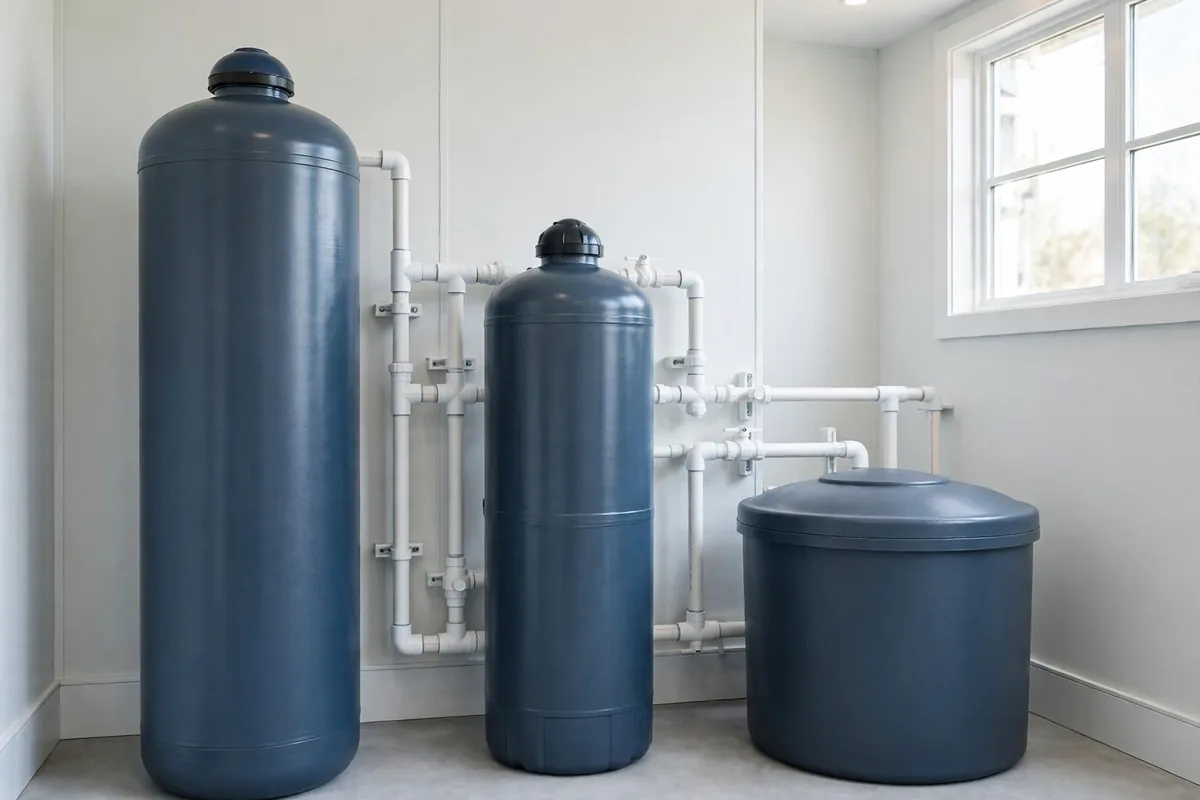
The softener was brand new, and the orange ring came back anyway
The softener was three weeks old when the orange ring reappeared in the toilet bowl. The unit was not broken. It regenerated on schedule, the brine tank was full, and the water genuinely felt softer — soap lathered better, and the chalky film inside the kettle had stopped forming. By every measure, the softener was doing its job. The problem was that its job was never the stains.
This is the most common wrong purchase in well water, and it is not really the buyer's fault. Most well-water owners buy the wrong box first, because nobody told them the order matters — or that the three boxes on the shelf are not three versions of the same thing. An iron filter, a water softener, and a whole-house system do three different jobs. One of them is not even a technology; it is a location.
This guide separates them. What each box removes, what each one cannot remove, the order they have to run in when you need more than one, and how to read your own test numbers to decide which ones your water actually needs. Some houses need a single box. Some need three in a row. Almost nobody needs to guess.
Three boxes, three different jobs
The confusion starts with the shelf. All three are sold as "water treatment," all three are large tanks that plumb into your main line, and all three promise cleaner water. Under the marketing, each one is a different mechanism aimed at a different target.
| Equipment | What it removes | What it does not remove |
|---|---|---|
| Iron filter (oxidation + filtration) | Dissolved iron, converted to particles and strained out; manganese; hydrogen sulfide gas, oxidized and caught | Hardness minerals (calcium and magnesium); bacteria living in the well |
| Water softener (ion exchange) | Calcium and magnesium — hardness | Iron particles, hydrogen sulfide, iron bacteria; heavy iron damages it |
| Whole-house system (point-of-entry train) | Whatever its stages are built to remove — it is a sequence, not a technology | Anything it has no stage for; a bundle in the wrong order fails like any wrong order |
The one-sentence versions. An iron filter is chemistry plus a strainer: change dissolved iron into solid particles, then catch the particles. A softener is a swap: trade hardness minerals for sodium at a resin bed, and flush the minerals away. A whole-house system is an address: treatment installed where water enters the house, so every tap gets treated water. That third one can contain the first two inside it — which is exactly why comparing the three as if they were rivals leads people astray.
Hold on to the middle row of that table, because it explains the opening story. Nothing in a softener's design touches iron particles, sulfur gas, or bacteria. It was built for one enemy, hardness, and it is very good at that enemy. Asking it to fix orange stains is asking the wrong box to do a job it never claimed on its specification sheet — only on its sales page.
What an iron filter actually does
Start with why the iron is invisible. In most wells, iron sits in the water dissolved — ferrous iron, the clear-water kind our iron guide walks through. It comes out of the tap clear and only turns orange after air gets to it, which is why the stains bloom in the toilet tank and the washing machine rather than in the glass. You cannot strain out something that is dissolved. So an iron filter works in two steps: oxidize, then filter.
Oxidation converts dissolved iron into ferric iron — tiny solid rust particles. The filter bed then catches those particles, and a periodic backwash flushes them to a drain. Systems differ in how they do the oxidizing: some draw in air, some inject an oxidant such as chlorine ahead of the tank, and some pass the water through catalytic media — types such as Birm or manganese greensand — that speed the reaction up. The variations matter for maintenance and cost, but the logic is identical: change the iron's form, then strain it out.
Two passengers come along on the same step. Manganese, iron's usual companion in well water, is removed by the same oxidation-and-filtration route. And hydrogen sulfide — the rotten-egg gas from our sulfur guide — is also oxidized and caught, which is why iron and sulfur so often turn out to be one stage of treatment rather than two purchases.
The limits matter as much as the mechanism. Oxidation runs poorly in acidic water, so a low pH can quietly undermine an iron filter that is correctly sized on paper. And if iron bacteria are present — the slimy kind that builds rusty gunk in toilet tanks — they clog filter media. Bacteria are a living source, and the fix for a living source is disinfection, not a finer strainer. An iron filter also does nothing at all to hardness. Water leaves it iron-free and exactly as hard as it entered.
What a water softener actually does
A softener runs on ion exchange. Inside the tank, resin beads hold sodium ions. As hard water passes over them, the beads trade that sodium for calcium and magnesium — the hardness minerals — and when the beads are loaded, the softener regenerates: brine flushes the hardness to the drain and recharges the beads with sodium. That is the whole trick, and for hardness it is the right one. The US Geological Survey classifies hardness, measured as calcium carbonate, as soft up to 60 mg/L, moderately hard from 61 to 120, hard from 121 to 180, and very hard above 180. (Labs and softener makers also use grains per gallon; 1 grain per gallon equals 17.1 mg/L.) Scale on the water heater, spots on glassware, stiff laundry — that is the territory above those lines, and a softener is how you leave it.
Now the iron question, because it is where the money gets lost. A softener will pick up some dissolved iron incidentally, as ferrous iron behaves a little like a hardness mineral at the resin bed. That small tolerance is the seed of the sales claim "softens and removes iron." What the claim leaves out:
- Oxidized iron fouls the bed. Once iron has turned to particles — and it starts turning the moment it meets air anywhere in your system — it coats and clogs the resin instead of exchanging with it.
- Heavy dissolved iron exhausts the resin. Iron that does exchange clings harder than hardness does, so regeneration stops fully restoring the beads. Capacity fades, and the softener quietly becomes a tank the water passes through on its way to stain your fixtures.
- Iron bacteria colonize it. A resin bed is a fine home for the slimy bacteria behind rusty gunk, and as our sulfur guide notes, a softener can become the source of a problem it was bought to solve. It removes no hydrogen sulfide at all.
The fair summary: a softener is a hardness appliance that tolerates a little clear-water iron. It is not an iron treatment. And notice the flip side — a softener installed after an iron filter never meets iron at all. It receives clean water, does its one job, and its resin lasts. The same box, protected or punished purely by its position in line.
What a whole-house system actually is
"Whole-house" describes where treatment happens, not how. It means point of entry: the equipment sits on the main line where water comes into the house, so showers, laundry, and every tap draw treated water. The alternative, a filter at one tap, cannot protect a water heater, a washing machine, or a toilet tank — and stains and scale are house-wide problems, so their treatment belongs at the door.
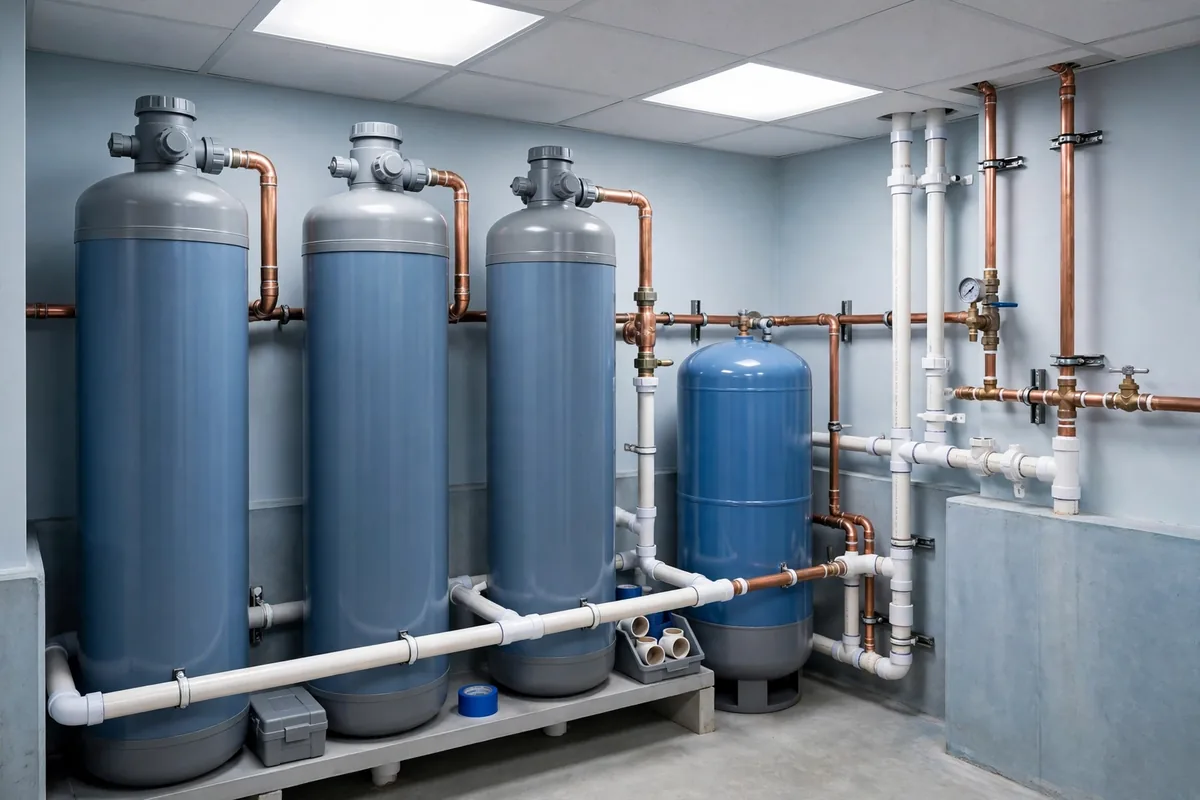
Inside that label, a whole-house system is a train: a sequence of stages plumbed in a row. A typical well-water train runs a sediment prefilter first, then the oxidation and iron-filtration stage, then a pH neutralizer if the water is acidic, then the softener, sometimes with a carbon stage at the end for taste. Sometimes those stages share one cabinet; sometimes they are separate tanks. The plumbing does not care. The water only experiences a sequence.
So the label, by itself, guarantees nothing. A whole-house bundle with no oxidation stage will fail iron water just as completely as a softener alone did — you have simply bought the failure in a single crate. When you shop this category, the useful questions are not "is it whole-house?" but: which stages does it contain, in what order, and rated for which test numbers? A seller who can answer those three questions precisely is selling treatment. A seller who answers with the label is selling the label.
The order: iron and sulfur first, pH in its place, softener last
When a house needs several stages, their order is not a preference or an upsell. It is dictated by what each stage does to the water — and to the next stage.
Step one: iron. The oxidation-and-filtration stage goes first among the treatment stages, because raw well water is at its dirtiest here, and because everything downstream deserves protection from it. (If iron bacteria are present, disinfection of the well comes before this — a filter fed by a living colony is a filter being clogged on schedule.)
Step two: sulfur. Hydrogen sulfide is handled by the same oxidation step, in the same stage — the gas is converted and caught alongside the iron. This is why the sequence lists it separately but the plumbing usually does not: one stage, two jobs, provided the system is rated for your measured hydrogen sulfide level and not just your iron.
Step three: pH. If your water is acidic — below the EPA's secondary guideline range of 6.5 to 8.5 — a neutralizer stage raises it, typically a tank of calcium carbonate media that dissolves slowly into the water. Placement has one honest complication: because oxidation itself works poorly in acidic water, strongly acidic wells may need the pH raised before, or as part of, the iron stage rather than after it. Your pH number decides. What never changes is step four.
Step four: softening, last. The softener goes at the end of the line, where it receives water already stripped of iron, manganese, and gas. Its resin meets only the hardness it was built for. Reverse the order and the softener becomes the iron filter — a job it does badly, briefly, and at the cost of its own resin bed.
Read the sequence once more and notice what it really is: each stage removes the thing that would damage or defeat the stage after it. That is the entire logic of well-water treatment, and it is why "which box?" is always the second question. The first is "what is in my water?"
Match the box to your numbers
Symptoms tell you where to look; numbers tell you what to buy. The reference points below are the EPA's secondary guidelines — iron at 0.3 mg/L, manganese at 0.05 mg/L, pH between 6.5 and 8.5 — plus the USGS hardness scale. Read them the way they are meant to be read: they are aesthetic yardsticks, not safety lines. The EPA's secondary standards are non-enforceable guidelines even for public water systems, and the EPA does not regulate private wells at all. They mark the levels where stains, taste, and scale become complaints — which is precisely the decision you are making.
| Your symptoms | Your test numbers | What you actually need |
|---|---|---|
| Orange stains, metallic taste | Iron above 0.3 mg/L; hardness soft to moderate (up to ~120 mg/L) | An iron filter alone |
| Orange stains and white scale, stiff laundry | Iron above 0.3 mg/L; hardness above 120 mg/L | Iron filter first, softener after it |
| White scale and spotting, no stains | Iron at or below 0.3 mg/L; hardness above 120 mg/L | A softener alone |
| Rotten-egg smell, steady in hot and cold water | Hydrogen sulfide present; iron often elevated too | The oxidation stage, sized to your hydrogen sulfide level — not a softener |
| Black stains, dark tinge to the water | Manganese above 0.05 mg/L | Oxidation + filtration, the iron filter's stage |
| Blue-green stains, pinhole leaks in copper pipe | pH below 6.5 | A neutralizer in the train — and re-check the iron stage, which struggles in acid |
| Slimy reddish-brown gunk in the toilet tank | Iron bacteria (seen, more than measured) | Disinfection first, then filtration to maintain |
If you found yourself in two rows at once, you have answered the whole-house question: you need a train, with those stages in the order the previous section laid out. And if your numbers sit far above a guideline — iron not at 0.4 but at 4 — the stage must be rated for your measured level, not for the words "high iron" on a brochure. Equipment is sized to numbers. Buy it that way.
Three mistakes to avoid
Buying the softener first because it is the famous one. Softeners are the best-known box, so they get bought for every water complaint — including complaints they cannot touch. With iron in the water, the softener-first order does not just fail to fix the stains; the iron damages the softener, and the second purchase has to replace the first one's resin along with adding the iron filter that should have led.
Paying for the words "whole-house" without asking for the stage list. The label promises coverage of your house, not capability against your water. Before any bundle, get three answers in writing: which stages, in what order, rated for which numbers. If the answers do not match your test results, the bundle is a crate of wrong boxes at a package price.
Trying to filter iron bacteria. A finer filter against a living colony is a clogging schedule, not a cure. The bacteria live in the well and recolonize the media; shock chlorination resets the colony, and filtration then maintains the result. Skipping the disinfection step is how a good filter gets blamed for a biology problem.
When to call a professional
Choosing the equipment is a numbers exercise you can do yourself; installing it is plumbing. Treatment stages cut into the main line and need a drain for backwash and regeneration water, and many owners reasonably hire a plumber or well contractor for that work even when they selected every stage themselves. Call a professional sooner when the well itself needs disinfection, when acidic water has already produced pinhole leaks — corrosion damage is a plumbing problem, not a settings problem — or when two tests disagree and the numbers will not settle. And whichever route you take, the certified lab test comes first. It is the cheapest line item in the entire project, and every other decision is priced off it.
The IronInMyWater rule
Test first, treat second — and never choose equipment from one number alone. Iron, pH, manganese, and hardness together decide the system; the manufacturer's published ratings, checked against your test, decide the model. How we work
FAQ
Can a water softener remove iron? A little dissolved iron, incidentally — ferrous iron exchanges at the resin much like a hardness mineral, and that small tolerance is where the marketing claim comes from. But a softener does not remove iron particles, hydrogen sulfide, or iron bacteria, and iron above trace levels fouls the resin until regeneration no longer restores it. Treat a softener as a hardness appliance. If iron is your problem, it needs its own stage, ahead of the softener.
Will an iron filter soften my water? No. Hardness minerals pass straight through an oxidation filter; the water comes out iron-free and just as hard as it went in. That is not a defect — it is the division of labor. If your test shows both iron and hardness above their guidelines, you need both boxes, iron first.
Which goes first, the iron filter or the softener? The iron filter, always. Raw water carries the iron that coats and exhausts softener resin, so the softener goes last in the train, where it receives iron-free water and meets only hardness. Installed the other way around, the softener becomes a short-lived, expensive iron filter — and then a replacement bill.
Is a whole-house system better than buying the units separately? Neither, inherently. "Whole-house" means the treatment sits at the point of entry; the results come from which stages are inside, in what order, and whether they are rated for your numbers. Separate units in the right order produce the same water as a good bundle. A bundle in the wrong order, or missing the stage your water needs, produces the same failure as any wrong box.
My iron is only slightly above 0.3 mg/L. Do I still need an iron filter? The 0.3 mg/L figure is the EPA's secondary benchmark — the level around which staining and metallic taste become the expected complaint. Slightly above it, with no stains and no taste, waiting is a defensible choice; the number matters more than the label, and a retest tells you whether it is climbing. Two cautions: staining tends to announce itself in the toilet tank and laundry before the tap, and any softener you already own is the first thing a rising iron level will damage.
My water is acidic as well as rusty. Does that change the order? It can move one stage. Oxidation — the step the iron filter depends on — works poorly in acidic water, so with a pH well below 6.5 the neutralizer may need to come before, or be integrated with, the iron stage instead of after it. What does not change is the end of the line: the softener still goes last, after the iron is out.
The IronInMyWater rule
Test first, treat second — and never choose equipment from one number alone. Iron, pH, manganese, and hardness together decide the system; the manufacturer's published ratings, checked against your test, decide the model. How we work
Read next
Comparisons
SpringWell vs US Water Systems vs iSpring for Well Water (2026)
$474, $2,231, or $3,295 — the price is not the ranking. SpringWell, US Water and iSpring compared on the manufacturers' own ratings, matched to your test numbers.
Read the guide →
Water Testing
Get Your Well Water Tested First: What the Numbers Mean Before You Buy Anything
Before you buy any filter, test the water. What each number on the report — iron, pH, hardness, sulfur, bacteria — actually decides, and the treatment order it forces.
Read the guide →
Sulfur Smell
Well Water Smells Like Rotten Eggs: Sulfur, Bacteria, and How to Tell Them Apart
Rotten-egg smell in well water is hydrogen sulfide gas — and it has three different causes. The hot-and-cold test that tells them apart, and the fix for each one.
Read the guide →