
Nitrate in Well Water: 10 or 44? The Two Rulers on Your Lab Report, and the Limit Written for Infants
The number that depends on the ruler
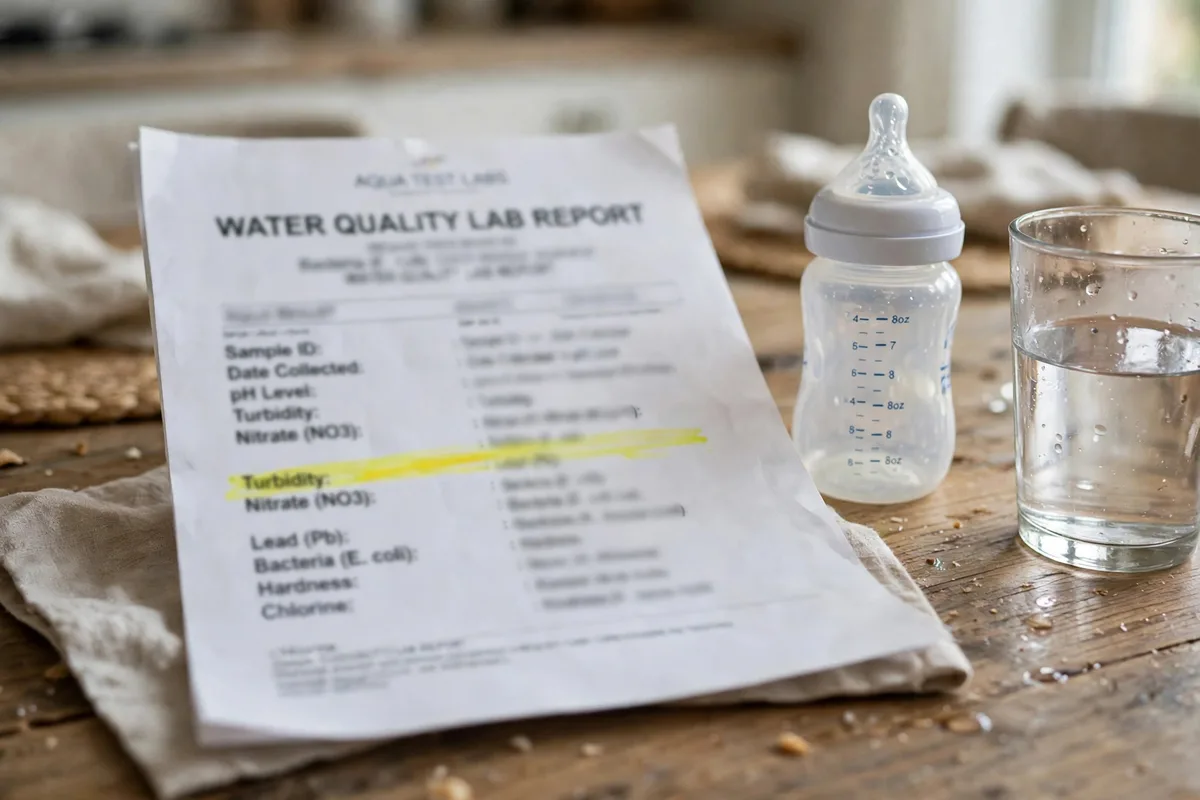
The lab report is open on the kitchen counter, and one line is doing more work than all the others: Nitrate: 23 mg/L.
There is a baby in this house, or one on the way, and formula gets mixed with this water. So the question matters: is 23 over the limit, or under it?
It depends on a word that may be printed in small type next to the number — or not printed at all. If the lab measured your nitrate as nitrogen, 23 mg/L is 2.3 times the federal limit of 10, and Minnesota's Department of Health says to switch the baby's water today. If it measured as nitrate — the whole molecule, oxygen included — the same 23 is about 5.2 in nitrogen terms: under half the limit, no action needed. Same water, same report, same number. Two opposite answers.
Nitrate cannot be tasted, smelled, or seen in water — the Minnesota Department of Health states that flatly, and it puts nitrate in the same invisible family as arsenic. But arsenic's trap was that only a lab could find it. Nitrate's trap is different: the lab finds it, prints it, and the number still cannot be read until you know which ruler measured it. This guide starts there.
One contaminant, two rulers
Nitrate is NO₃ — one nitrogen atom wearing three oxygen atoms. The nitrogen is the part the body cares about, and it is a minority of the weight. Weigh the whole molecule and it comes to about 4.4 times the nitrogen alone.
Labs report nitrate either way, and both are legitimate:
- As nitrogen — written "nitrate-nitrogen," "Nitrate-N," "NO₃-N," or "nitrate (as N)." This counts only the nitrogen.
- As nitrate — written "nitrate (as NO₃)" or just "nitrate." This counts the whole molecule.
The federal standard is written in the first ruler. The EPA's regulation names the contaminant "Nitrate (measured as Nitrogen)," and both the health goal and the enforceable limit are 10 mg/L. Penn State Extension states the same standard in both rulers in one sentence: public supplies "should not contain more than 45 mg/L of nitrate or 10 mg/L of nitrate-nitrogen." (The exact conversion of 10 as nitrogen is about 44 as nitrate; Penn State rounds the pair to 45 and 10.)
So the arithmetic every well owner with a nitrate line should be able to do:
| The report says | In nitrogen terms | Against the 10 mg/L limit |
|---|---|---|
| 10 mg/L as N | 10 mg/L | At the limit |
| 44 mg/L as NO₃ | 10 mg/L | At the limit |
| 23 mg/L as NO₃ | about 5.2 mg/L | Under |
| 23 mg/L as N | 23 mg/L | 2.3 times over |
Divide an "as NO₃" result by about 4.4 to get the nitrogen number; multiply the other way to go back. And if the report does not say which basis it used — call the lab. The lab knows its own ruler, and no decision in this guide is safe until you do.
One neighboring line deserves a sentence. Nitrite (NO₂) is regulated separately, at 1 mg/L as nitrogen in the same EPA table — because nitrite is the form that actually acts on blood. A baby's stomach is where nitrate becomes nitrite. That conversion is the whole health story, below.
The standard: 10, written for the youngest drinker
The limit: 10 mg/L as nitrogen. In the EPA's National Primary Drinking Water Regulations, nitrate's Maximum Contaminant Level Goal and its enforceable Maximum Contaminant Level are the same number: 10. That pairing is worth noticing. For arsenic, the goal is zero and the limit a compromise above it. For nitrate, goal and limit coincide, because the standard was built directly on the effect it exists to prevent — and Minnesota's health department says whose effect that is: "Based on the data available at this time, this standard protects infants against methemoglobinemia. Infants are the most sensitive group of people for known health effects." Missouri Extension adds that the standard has "a small margin of safety built into it," and levels above it "are considered to be potentially hazardous."
Whose rules these are. As with every number on this site, the EPA's limits legally bind public water systems. Private wells are not regulated — Penn State notes they fall under neither EPA nor state DEP jurisdiction, and Minnesota reminds owners that testing is their own responsibility. The 10 mg/L line is the benchmark anyway: the number state health departments judge private wells by, and the number this guide uses.
Where it comes from: the surface, carried down by water
Nitrate is a plant nutrient — the primary source of nitrogen plants cannot live without, in Missouri Extension's words — and it occurs naturally in soil and water. Penn State notes that all rainfall and groundwater contains some nitrate-nitrogen. Minnesota puts a scale on the natural background: natural levels in its groundwater are "usually quite low (less than 1 milligram per liter)." A result in the low single digits is already a human fingerprint.
The human sources are the ones the EPA lists in its regulation table: "Runoff from fertilizer use; leaking from septic tanks, sewage; erosion of natural deposits." Unpacked by the other sources:
- Fertilizer — on cropland above all, but also lawns and golf courses (Minnesota). The mechanism is arithmetic: nitrogen the crop does not take up stays in the soil as nitrate, and nitrate moves.
- Manure and sewage — animal waste, feedlots, septic systems. Missouri traces the chemistry: manure and sewage carry ammonia and organic nitrogen; soil bacteria convert the ammonia to nitrate in a process called nitrification. What the bacteria make is exactly the form that leaches. The CDC's fact sheet adds the well itself to the list: high levels "often result from improper well construction, well location," or waste disposal.
And the transport is water itself. Missouri: excess nitrate "is carried through the soil into groundwater supplies by irrigation, rainwater and snowmelt," particularly where soil is sandy or gravelly, or shallow over porous limestone bedrock. Then the property that makes nitrate so persistent: it "is not filtered out of water by the soil" (Missouri). Depth and distance help against most contaminants because soil strains them out. Against nitrate, soil is a conveyor, not a filter — the defense is isolation from sources and an intact well, not depth alone.
Which wells get it
Minnesota's health department lists the vulnerable wells directly:
- Shallow wells — and Penn State adds springs: "shallow wells and springs are particularly prone to nitrate contamination."
- Wells in sand, karst, and fractured rock aquifers — the geologies water moves through fastest.
- Dug wells with casings that are not watertight, and wells with damaged or leaking casings or fittings.
Penn State's construction checklist reads like the same list from the other side: casing, grouting, and a cover to keep surface water out; the casing extending at least a foot above ground, with a suitable cap; diversion ditches for runoff. A well can sit in clean geology and still drink from its own yard if the top of it leaks.
What the health agencies say — in their words
The mechanism first, because it explains the age line. In the first months of life, a baby's digestive system carries bacteria that convert nitrate into nitrite. Penn State describes what the nitrite then does: it "binds to oxygen molecules in red blood cells, depleting oxygen." Missouri names the product: nitrite reacts with hemoglobin — the protein that carries oxygen — to form methemoglobin, which does not carry oxygen, and "as the oxygen level decreases, the baby is suffocated. This condition is called methemoglobinemia." Its common name is blue-baby syndrome, for the bluish skin, particularly around the eyes and mouth, that both sources call the most obvious symptom.
The EPA's regulation table states the stakes in one sentence: "Infants below the age of six months who drink water containing nitrate in excess of the MCL could become seriously ill and, if untreated, may die. Symptoms include shortness of breath and blue-baby syndrome."
Minnesota fills in the exposure: "Bottle-fed babies under six months old are at the highest risk of getting this illness" — formula is where well water enters a baby in quantity. The CDC agrees on the route: "The main nitrate exposure for infants is contaminated well water used to prepare formula and other baby foods," while adults are mainly exposed through food. Minnesota adds two facts that belong next to the frightening ones: the bluish color "may be difficult to detect in infants," and "symptoms will often resolve once the nitrate source is removed."
The treatability is part of the record too. Penn State: "If detected at this early stage, methemoglobinemia is rarely fatal, readily diagnosed, and rapidly reversed with clinical treatment." Missouri directs parents of a baby showing the bluish symptom to an emergency facility immediately, and notes that "in most cases the baby makes a full recovery" — while insisting it be dealt with immediately, because without treatment a baby can die. The CDC lists the diagnosis as a simple finger-prick blood test, and the treatment as, usually, changing the drinking water to a source below 10 mg/L nitrate-nitrogen.
Why six months? The window closes on its own. Missouri: around three months, rising stomach acid kills most of the converting bacteria, and by six months none remain. Penn State, from the other side: "After the age of six months, methemoglobinemia is not a threat since the nitrate-converting bacteria are no longer present in the baby's stomach."
And the proportion for everyone else, in the sources' own framing. Penn State, citing studies by the World Health Organization and the National Academy of Sciences: nitrate in drinking water "does not represent a significant health risk to the adult population." Missouri: "In older children and adults, nitrate is absorbed and excreted, and methemoglobinemia is no longer a concern." Minnesota names the exceptions — conditions that can raise an older person's risk: anemia, cardiovascular disease, lung disease, sepsis, glucose-6-phosphate-dehydrogenase deficiency, and some metabolic problems. And one hedged note, in Minnesota's own caution: the department reports emerging science describing possible impacts of long-term exposure below the standard — associations with thyroid problems, adverse pregnancy outcomes, and cancers, particularly colorectal — and states in the same breath that "further research is necessary to confirm these observations."
Nitrate is also a signal
A nitrate result above the natural background says something beyond itself: surface material is reaching your groundwater, on a pathway other things can use.
Penn State states it as a testing instruction: "nitrate may indicate the presence of other contaminants in your water supply. Other soluble substances, like pesticides, can be more harmful than nitrate" — a discovered nitrate problem is a reason to test for other contaminants in your area. Minnesota quantifies the signal: concentrations above 3 mg/L — under a third of the standard — suggest "human-made sources of nitrate have contaminated the water and the level could increase over time."
The pairing to make is with bacteria. Minnesota's schedule puts nitrate and coliform bacteria on the same annual rhythm — the two tests that watch the surface pathway. Coliform says whether microorganisms are getting in now; nitrate says whether dissolved surface material — fertilizer, manure, septic effluent — is getting in as a matter of routine. Either one elevated is a reason to walk the property and inspect the well before pricing treatment.
If your number is over: the order of operations
Minnesota's sequence for a result above 10 mg/L (as nitrogen) starts with water, not equipment:
- Get drinking water from a safe alternative source, such as bottled water. Today, not after the treatment consult.
- Make sure babies under six months old do not drink the well water. Missouri's alternatives: breastfeeding, formula prepared with bottled distilled water, or pre-mixed formula.
- Do not try to boil nitrate out of the water. Boiling makes it more concentrated — the next section explains why.
- Have a licensed well contractor inspect the well, and find and get rid of potential sources — the septic system, the manure pile, the fertilizer storage, the leaking casing.
- Then consider treatment — with one Minnesota precaution: even with home treatment in place, the department recommends that no baby under six months drink the water, "a safety precaution in the event the water treatment fails." Treatment is machinery, and machinery has bad days; the alternative source is the guarantee.
Treatment: three things work, and the kettle is not one of them
Reverse osmosis — the kitchen-tap answer, with a math warning. RO pushes water through a membrane that leaves nitrate behind. Penn State puts the rejection rate at "around 83 to 92 percent of the incoming nitrate" — which is why the starting number matters. At a raw 40 mg/L as nitrogen, 90 percent rejection lands at 4: under the standard. Penn State's warning case: at extremely high nitrate-nitrogen — above 110 mg/L — even up to 90 percent removal "may still result in drinking water that exceeds the standards of 10 mg/L." Missouri adds the yield reality: RO reduces but does not remove all nitrate, and at household pressures much of the water goes down the drain as reject. That is why RO lives at one tap — the same point-of-use logic as arsenic, and our guide to reading your well water test numbers covers how the panel decides which tap needs what.
Ion exchange — the whole-house answer, with a saturation trap. A nitrate unit works like a softener with a different resin and a different trade: chloride ions are exchanged for nitrate (and sulfate) ions, and the resin is recharged with brine. Both Extension guides name the same three limits. Sulfate competes — the resin prefers it, so high-sulfate water shrinks the nitrate capacity. The water can come out corrosive, so a neutralizing filter follows the unit (the same device family as in the low pH guide). And the regeneration brine is high in nitrate and must be disposed of so it does not re-contaminate the groundwater. Penn State adds the failure mode with teeth: "If the resin becomes saturated, it releases the nitrates in place of sulfates, resulting in an increased nitrate concentration in the 'treated' water." An unmaintained exchanger can hand you back your nitrate in a slug, worse than the raw water. Note what this unit is not: it is not your water softener. A conventional softener exchanges hardness minerals and does nothing to nitrate at all — the iron filter vs. softener guide covers where each box belongs in the train.
Distillation — slow, complete, indifferent to chemistry. Boil, condense, collect: the nitrate stays concentrated in the boiling tank (Missouri). Penn State prices the pace: about a gallon every four to five hours from a typical home unit, with real energy costs and frequent descaling.
Blending — dilution, not removal. Mixing high- and low-nitrate water lowers the number on paper, and Missouri calls it the most common reduction method — for livestock. Both guides attach the same limit: blended water still may not be safe for infants.
What does not work — the persistent beliefs, retired by name. Boiling heads the list in every source: it evaporates water and leaves the nitrate in a smaller volume — Minnesota: "Boiling will make nitrate more concentrated"; Missouri calls boiling "the worst thing to do." Softening and ordinary filtration: Missouri — "Softening and filtration do nothing at all to remove nitrate." Chlorination and mechanical filters: the CDC — "Mechanical filters or chemical disinfection, such as chlorination, DOES NOT remove nitrate from water." If a device claims nitrate removal and it is not RO, ion exchange, or distillation, the agencies have already answered it.
The structural fixes. Sometimes the permanent answer is a different source: Penn State notes that if the well is too shallow, "developing a new well that drains water from a less contaminated aquifer may be the only answer," and source prevention beats treatment in the long term — a septic field repaired, runoff diverted, a casing extended and capped. Bottled water, meanwhile, is not a failure state: Penn State calls it "an effective, low-cost means of decreasing health risks" for the household's at-risk members, for as long as it is needed.
Testing: every year, and spring is the honest season
The cadence is annual. Minnesota's instruction: "Test for nitrate every year" — through an accredited laboratory, and additionally if you are planning on becoming pregnant or infants will be using the water.
The season matters, and here nitrate parts company with arsenic. Arsenic comes out of the rock and sits still; nitrate rides the weather. Missouri explains why it sends you to spring: "Accurately determining the nitrate level in a well can be difficult since nitrate levels vary according to the time of year. For this reason, spring is the best time to test, because snowmelt and rains will leach any excess nitrate into the groundwater. A water test done in late fall can be misleading because the well may be temporarily low in nitrate if there have been no heavy rains." An annual spring test reads your well at its worst — the reading a safety standard should be judged against. A reassuring autumn number, in a dry year, is the same well on its best behavior.
And read the ruler every time. Report formats differ. The annual habit that protects you is the pair: the number, and the basis it was measured on. Ten as nitrogen, forty-four as nitrate — one limit, two rulers.
The IronInMyWater rule
Test first, treat second — and never choose equipment from one number alone. Iron, pH, manganese, and hardness together decide the system; the manufacturer's published ratings, checked against your test, decide the model. How we work
FAQ
My report says 38 mg/L. Am I over the limit?
Not enough information — the most common nitrate problem there is. If the 38 is as nitrate (NO₃), it converts to about 8.6 mg/L as nitrogen: under the standard. If it is as nitrogen, it is nearly four times the standard, and Minnesota's over-limit steps apply today. Look for "as N," "as NO₃," "nitrate-nitrogen," or "NO₃-N" on the report. If the basis is not printed, call the lab and ask — then write the answer on the report, because you will need it again next year.
We are expecting a baby. What should we do now?
Test now — Minnesota says to test for nitrate if you are planning on becoming pregnant or if infants will be using the water, on top of the annual test. At or below 10 mg/L as nitrogen, the standard built to protect infants is met. Above it, use bottled or another safe source for formula from the start, do not boil the well water to "make it safe" (boiling concentrates nitrate), and note Minnesota's precaution: even with treatment installed, babies under six months should not drink the water, in case the treatment fails.
Will boiling, my softener, or a carbon filter remove nitrate?
No — all three are named non-solutions in the primary guidance. Boiling concentrates nitrate as water evaporates (Minnesota, Penn State, Missouri, and the CDC all say so). A conventional softener and ordinary filtration "do nothing at all to remove nitrate" (Missouri), and the CDC adds that mechanical filters and chlorination do not remove it either. What removes nitrate: reverse osmosis, nitrate-selective ion exchange, and distillation.
My result is 6 mg/L — under the standard. Am I done?
Under the standard, yes; finished, no. Six is well above the natural background Minnesota cites (usually under 1 mg/L), and above the 3 mg/L level at which the state says human-made sources have reached the water and the level could increase over time. Read it as a signal: something at the surface — fertilizer, manure, a septic system — has a path to your well, and the same path is worth checking for coliform bacteria. Keep the annual test, take it in spring when levels run highest, and watch the trend rather than the single number.
Sources
The ratings, prices and guidelines in this guide were checked against these primary sources in November 2026.
- US EPA — National Primary Drinking Water Regulations (nitrate measured as nitrogen: MCLG 10, MCL 10 mg/L; nitrite 1 mg/L; infants under six months and blue-baby syndrome; fertilizer runoff, septic tanks, sewage, natural deposits)
- Minnesota Department of Health — Nitrate in Well Water (test every year; bottle-fed infants under six months at highest risk; never boil — boiling concentrates nitrate; vulnerable wells; above 3 mg/L signals human-made sources)
- Penn State Extension — Nitrates in Drinking Water (45 mg/L as nitrate = 10 mg/L as nitrate-nitrogen; the infant conversion to nitrite; ion exchange and its saturation trap, RO rejection 83–92%, distillation; nitrate as an indicator of other contaminants)
- University of Missouri Extension — Nitrate in Drinking Water, WQ103 (spring is the best time to test; rain and snowmelt carry nitrate down; nitrate is not filtered out by soil; softening and filtration do nothing; boiling concentrates it)
- US CDC — Nitrate and Drinking Water from Private Wells, Healthy Water fact sheet, archived copy (formula is the infant exposure route; DO NOT boil; mechanical filters and chlorination do not remove nitrate; ion exchange, distillation, reverse osmosis do)
The numbers, on one sheet
The benchmarks behind every guide here — iron, manganese, pH, hardness, coliform, nitrate — plus the treatment order and the equipment ceilings, on a free two-page PDF. Get the free cheat sheet
The IronInMyWater rule
Test first, treat second — and never choose equipment from one number alone. Iron, pH, manganese, and hardness together decide the system; the manufacturer's published ratings, checked against your test, decide the model. How we work
Read next

Getting Started
The New Well Owner's Checklist: The Paperwork, the First Test, the Wellhead Walk, and the First-Year Calendar
The keys came with a folder: one old test result and a page you can't read. The paperwork hunt, the baseline lab test before any treatment talk, the wellhead walk, and the first-year calendar — the sequence that turns a house with a well into a water supply you actually know.
Read the guide →
Bacteria & Disinfection
Well Water After Heavy Rain and Flooding: Which Changes Are Signals, and the Order of Operations When the Well Goes Under
The storm is over and the water runs cloudy for the first time in years. Most rain changes nothing — but water that reached the wellhead changes everything. How to read the changes, the agencies' order of operations for a flooded well, and the grading and cap work that keeps the next storm out.
Read the guide →
Costs & Buying
One Quote, Six Jobs: What a Whole-House Well Water System Actually Costs in 2026
One installed quote, six separate jobs — and no way to tell which dollars treat which problem. The stack unbundled stage by stage with manufacturer prices checked in November 2026, the running costs nobody quotes, and five-year totals for three real water profiles.
Read the guide →