
Arsenic in Well Water: No Taste, No Smell, No Color — the Lab Report Is the Only Warning
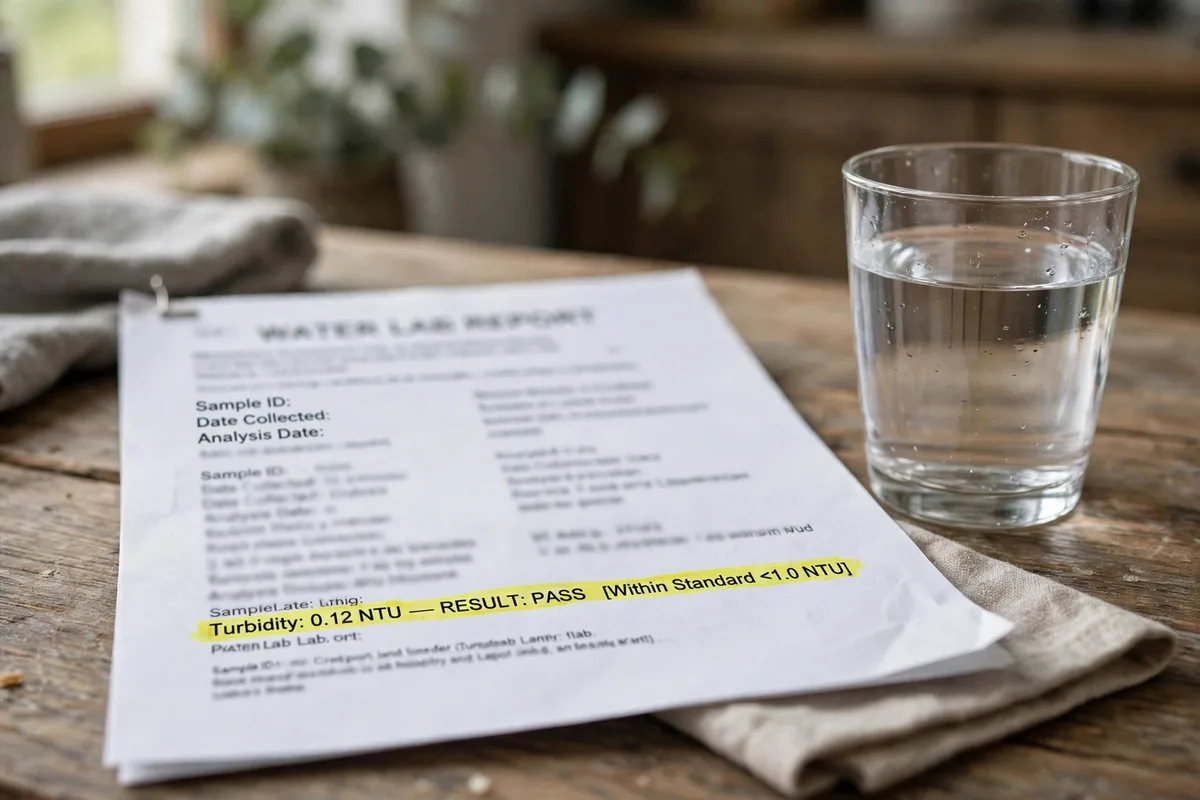
The line on the lab report
The lab's email looks like every other water test you have ordered. Iron: fine. Hardness: a little high. Coliform: absent. And then one line sits there doing nothing dramatic at all: Arsenic: 18 µg/L.
Nothing in the house announced it. The water in the glass is clear. It tastes like water. The laundry is the right color, the fixtures are unstained. Arsenic arrives as a number — and 18 is above the 10 µg/L standard the EPA sets for public water systems.
Arsenic in well water cannot be seen, tasted, or smelled. It is a long-term exposure question, not a tonight question. The test is cheap, the answer is exact, and treatment works — when it is matched to the form the arsenic is in.
The one contaminant your senses cannot check
Run down the list of well water problems and each has a signal. Iron stains the sink orange. Sulfur announces itself at the door. Tannins turn the water the color of tea. Arsenic has none of these. The Minnesota Department of Health puts it in one sentence: "You cannot taste, see, or smell arsenic in your water." New Hampshire's DES adds the part people find hardest to believe: no color, taste, or odor even when present at elevated levels.
The glass test and the sniff test are worthless here. Only a laboratory detects it. The USGS hydrologist who led the national study said it the same way: "the only way for them to be certain of what's in their water is to have it tested." A clear glass proves nothing — but a lab result proves everything.
It comes out of the rock
Arsenic in American well water is, overwhelmingly, a geology story. The EPA's source list for arsenic in drinking water leads with "erosion of natural deposits" (the others — orchard runoff, glass and electronics wastes — are rarely the well story). A joint USGS and CDC study, modeled from samples of more than 20,000 domestic wells, estimated that about 2.1 million people in the contiguous United States may be drinking well water above the 10 µg/L standard — nearly all of it likely from natural sources, coming "primarily from rocks and minerals through which the water flows." Of the roughly 44 million people in the lower 48 on domestic wells, the hotspots cluster where the geology loads the water: much of the West, parts of the Northeast and Midwest (Maine, Massachusetts, New Hampshire, Michigan, Wisconsin among them), and some Atlantic southeast coastal states. High-arsenic wells can occur in all 48 contiguous states.
In Minnesota, arsenic has been detected in about 40 percent of new wells drilled since 2008 (at a detection level usually around 2 µg/L), about 10 percent of private wells run higher than 10 µg/L, and some have measured as high as 350 µg/L. In New Hampshire, where wells draw from highly fractured bedrock, private wells carry roughly a 30 percent probability of naturally occurring arsenic above 5 µg/L.
And the neighbor rule, which both states state outright: arsenic follows the fracture and the formation, not the property line. Minnesota's health department warns that levels "can vary between wells, even within a small area," and that there is no way to know the level in a well before it is drilled. New Hampshire says the same of its fractured bedrock. A clean test next door is encouraging. It is not your result.
The form in your glass is the one that matters: inorganic arsenic, the type found in drinking water. (The organic arsenic common in fish and shellfish is a different, less harmful form.) Minnesota adds that most arsenic in its environment is natural, with some from past uses — pesticides and wood preservatives.
The standard: a limit of 10, and a goal of zero
The limit: 10 µg/L. The EPA's National Primary Drinking Water Regulations set the maximum contaminant level (MCL) for arsenic at 0.010 mg/L — the same concentration written as 10 micrograms per liter, or 10 parts per billion. It has applied to public water systems since January 23, 2006. It replaced the old 50 µg/L standard, in place since 1975, when the EPA lowered it in January 2001 — adopting the enforceable level, in New Hampshire's summary, "based on balancing treatment costs in public water systems with public health benefits."
The goal: zero. In the same regulations table, arsenic's Maximum Contaminant Level Goal — the level below which there is no known or expected risk — is 0. The goal is a non-enforceable health target. Minnesota's health department explains why it sits at zero: consuming water with arsenic at levels lower than the standard over many years can still increase the risk of cancer.
Whose rules these are. Both numbers legally bind public water systems. Private wells are not regulated by the EPA — maintenance, testing, and treatment are the homeowner's sole responsibility. The 10 µg/L line is nonetheless the benchmark state health departments use for private wells. Some states set their own bar lower: New Hampshire's state arsenic MCL is 5.0 ppb, in effect since July 2021.
What the health agencies say — in their words
This site states health effects the way the agencies state them, at the scope they state them.
The EPA's summary line for long-term exposure above the MCL: some people "could experience skin damage or problems with their circulatory system, and may have an increased risk of getting cancer."
Minnesota's Department of Health expands it: consuming water with even low levels of arsenic over a long time is associated with diabetes and increased risk of cancers of the bladder, lungs, liver, and other organs; arsenic can also contribute to cardiovascular and respiratory disease, reduced intelligence in children, and skin problems such as lesions, discoloration, and the development of corns — and "health impacts of arsenic may take many years to develop." New Hampshire frames the exposure the same way: chronic or repeated ingestion over a person's lifetime.
Three structural facts from the same sources keep that in proportion:
- The exposure route is drinking. Penn State Extension states it flatly: arsenic "is only a health problem when water is ingested." New Hampshire reports that dermal absorption is not a significant exposure path, and that washing and bathing do not pose a known risk. Minnesota agrees: skin does not easily absorb arsenic, so the water is safe for washing, showering, and bathing — unless the level is above 500 µg/L.
- It is a years-long exposure, not a single glass. Every agency statement above is about long-term consumption. The correct response to a result like 18 µg/L is a plan — confirm, treat, verify — executed over weeks, not panic tonight.
- Below the limit is not the same as zero. Minnesota recommends that if arsenic is detected at any level, you consider treatment or a different drinking water source — and it highly recommends action above 10 µg/L. A result of 6 or 8 µg/L is under the enforceable line and over the health goal.
Testing: one lab visit, an exact answer
Use an accredited laboratory. Minnesota recommends an accredited lab; Penn State Extension advises a certified commercial laboratory — arsenic is a trace metal, so look for one certified for trace-metal analysis — and puts the typical cost at $15 to $50. Our guide to reading your well water test numbers covers how the full panel fits together.
Test at least once — and know the new-well trap. Test for arsenic at least once, beyond the test done when the well was constructed. Minnesota's well contractors have tested each new well since August 2008 — but the department warns that construction results may not accurately measure long-term concentrations, and its research found that a detected level may increase or decrease in the first few months. Its advice: retest about six months after construction. The reassuring mirror image: if arsenic was not detected in the first sample, your water is unlikely to have it later.
Confirm before you buy. Minnesota's guidance is to consider retesting a detected result to confirm it before committing to treatment. Two agreeing samples are a fact you can spend money on.
Know what the number includes. Most lab results report total arsenic — both forms added together, and the right number to compare against 10 µg/L. But the split between the forms decides the treatment, which is why New Hampshire recommends a follow-up test for Arsenic-III specifically if your total comes back above 5 ppb, before a system is selected.
Fit it into the rhythm you already have. Arsenic is a test-at-least-once contaminant, not an annual one — unlike coliform bacteria, which health departments want checked every year. Add it to the next annual lab order: New Hampshire's recommended Standard Analysis suite bundles it with bacteria, lead, uranium, and other parameters in a single order.
Two forms of arsenic, and why the split decides everything
Arsenic in natural water comes in two inorganic species, and the difference between them is a single fact with long consequences: charge.
Arsenate — As(V). At the pH of ordinary groundwater, arsenate exists as negatively charged ions (H₂AsO₄⁻ and HAsO₄²⁻). A charged particle can be grabbed — by exchange resin, by adsorptive media, by membranes. New Hampshire's fact sheet compresses it to: As(V) "is negatively charged and thus more easily removed." Penn State adds the distribution: arsenate is more common in surface waters.
Arsenite — As(III). Arsenite at typical water pH is present as H₃AsO₃ — no charge at all. Penn State Extension: arsenite occurs more frequently in groundwater, and because most private supplies rely on groundwater, it is likely the most common form in a well. The same source adds the uncomfortable pairing: arsenite is both a greater health concern and more difficult to remove. New Hampshire is blunter about the treatment gap: some technologies reduce both forms, but "their efficiency for removal of Arsenic-III is drastically lower."
So treatment starts with oxidation. Convert the As(III) to As(V) and every downstream technology works better. New Hampshire's fact sheet, citing the EPA's laboratory study of the conversion, lists which oxidants do the job:
- Effective: chlorine, ozone, permanganate, and solid manganese dioxide (pyrolusite) media.
- Not effective: air, UV light, chlorine dioxide.
Two practical thresholds from New Hampshire: if raw-water As(III) is at or above 10 ppb, a pre-oxidation step should be added to improve overall treatment efficiency; and a pre-oxidation cartridge in front of an adsorptive cartridge can extend that cartridge's life three to five times. Oxidation is not an optional refinement on a well whose arsenic is mostly As(III). It is the difference between the rated removal and the real one.
Treatment: start at the kitchen tap
One piece of logic organizes everything below. Arsenic harms you when you drink it. It is not volatile, so it does not ride shower steam into your lungs, and it is not absorbed through skin in any significant amount. New Hampshire's fact sheet draws the conclusion directly: "For most wells, POU arsenic treatment is recommended as the most cost-effective and simplest solution" — treat the one tap you drink and cook from, and take all drinking, cooking, and ice-making water from that tap.
Whole-house (point-of-entry) treatment has a narrower list of reasons: household members — young children above all — are likely to drink from other taps; other treatment needs pretreatment anyway; or levels are very high. The fact sheet numbers that last one: whole-house treatment is recommended at 100 ppb and higher if anyone would regularly drink from an untreated tap, or if iron removal is also necessary.
Reverse osmosis — the default point-of-use answer, with a species asterisk. An under-sink RO unit stores treated water in a small tank at its own faucet. New Hampshire gives the deciding split: RO removal efficiency for As(III) is only about 60 percent, compared to 95 percent for As(V) — so if As(III) is present, a pre-oxidation cartridge goes in front of it. Penn State agrees on the favorable side: under ideal pressure, RO removes more than 95 percent of arsenic. The reject stream runs about 3 to 4 gallons per gallon treated, which is why RO lives at one tap.
Adsorptive media — the cartridge that grabs arsenic and little else. Iron-based media, along with titanium-based media, bind arsenic as water passes. New Hampshire prices the point-of-use version: adsorption cartridges are selective for arsenic and waste no water, with equipment from around $150 and replacement cartridges at $80 to $90. Whole-house versions run $1,500 to $3,000 installed, with a new filter every one to three years at roughly $1,000 per cubic foot of media. Two limits: the capacity is finite — the media fills up — and its life is shortened especially by As(III) and by pH above 7.5. Breakthrough, when capacity runs out, is gradual.
Activated alumina — strong on arsenate, awkward to keep. Penn State's account: arsenate is very strongly attracted to the alumina media, and it is the preferred method when your water has high total dissolved solids or high sulfate — the conditions that hobble ion exchange. The catch is maintenance: regeneration takes strong acid and base solutions, undesirable to handle at home, and the alumina must be replaced every one to two years regardless.
Anion exchange — effective, and strictly for As(V). An arsenic ion-exchange unit works like a softener with a different resin: arsenate is swapped for chloride and the resin is regenerated with salt. It removes the negatively charged As(V) ion only — As(III), uncharged, is not removed at all, so oxidation ahead of it is not optional. Competing ions eat its capacity: Penn State lists sulfate, total dissolved solids, selenium, fluoride, and nitrate as all reducing efficiency. It can also make water corrosive by removing alkalinity — New Hampshire is emphatic that anion resin must be followed by a calcite neutralizer (the same device as in the low pH guide) to prevent leaching lead and copper from home plumbing. And it carries a failure mode with a name: if the salt runs out, accumulated arsenic can be released in a slug — "dumping." Whole-house cost runs $1,500 to $3,000, with salt around $100 and regeneration every three to four weeks.
Iron oxidation-filtration — when the iron problem pays for the arsenic fix. If your water also carries iron, the two problems can share one train. New Hampshire: if natural iron levels are 0.1 mg/L or higher, iron-arsenic oxidation followed by filtration is the most cost-effective whole-house approach, because manganese-dioxide media (Birm, Greensand, Filox) oxidize iron and arsenic simultaneously, and the arsenic then adsorbs onto the iron particles. It works best at about 20 parts iron to 1 part arsenic, at pH 7 to 7.5 — with partial removal at lower ratios, and point-of-use polishing afterward if needed. Penn State sounds the necessary caution: where iron is removed this way, the arsenic present "would likely be removed as an added benefit" — but efficiency varies considerably, and tests should determine whether the removal is significant for your setup. Co-removal is a hypothesis you verify with a treated-water test, not a promise. That is the site's test-first, equipment-second logic at its highest stakes.
Distillation asks nothing about species or charge: Minnesota lists it among the units that reduce arsenic — boil the water, condense the steam, and the contaminants stay behind.
What does not work — three persistent beliefs. Minnesota's health department retires all three. Conventional water softeners and activated carbon filters alone will not remove arsenic. And boiling will only concentrate the arsenic, as some of the water evaporates. A fourth caution, from New Hampshire, on filter pitchers: the department identified only one model that reliably removes arsenic to below 5 ppb, has not evaluated many others, and notes that even NSF-certified pitchers are required only to reduce arsenic from 50 ppb to below 10 ppb.
The other door: a different source. A new well drawing from a different water-bearing formation may produce water with less arsenic — Minnesota notes it can be cheaper in the long run than maintaining treatment if the well needs replacing anyway, and states the limit in the same breath: a new well may still contain natural arsenic, with no guarantees. Connection to a community public water system moves you under the EPA standard and its regular testing. Bottled water works as an interim or permanent drinking source — but no single standard covers all bottled water, so ask the bottler for its test results and confirm its level is lower than your well's.
After the box is installed: prove it, then keep proving it
Arsenic treatment has a property the stain problems do not: when it stops working, nothing changes color. The media exhausts silently, the salt runs out quietly, and the water tastes the same on the day the system fails as on the day it was installed. Verification is the treatment's second half.
Minnesota's buying rule: choose a system certified by an independent organization — NSF International, Underwriters Laboratory (UL), or the Water Quality Association (WQA). Then follow the manufacturer's maintenance schedule and have the treated water tested periodically.
New Hampshire puts numbers on "periodically": quarterly arsenic testing for the first year of treatment, and semi-annually after that. And if the system depends on a pre-oxidant or a salt regenerant, check the feed tank weekly.
That is the complete shape of it. A contaminant with no symptoms, found by one cheap test, judged against a limit of 10 and a goal of zero, removed by equipment chosen around one chemical fact — which of its two forms your water carries. Test first. The rest is engineering.
The IronInMyWater rule
Test first, treat second — and never choose equipment from one number alone. Iron, pH, manganese, and hardness together decide the system; the manufacturer's published ratings, checked against your test, decide the model. How we work
FAQ
My result came back at 7 ppb — below the limit. Am I done?
You are below the enforceable standard for public systems, and above the EPA's health goal of zero. Minnesota's Department of Health recommends considering treatment or a different drinking source if arsenic is detected at any level, because water below the standard consumed over many years can still increase cancer risk — while reserving its "highly recommends action" for results above 10 µg/L. Confirm the result — and if the well is new, retest about six months after construction, since early levels can move. It is a decision, not an emergency.
Can I shower, bathe, and wash with water that has arsenic in it?
Yes, at ordinary levels. Minnesota's health department states that skin does not easily absorb arsenic, so the water is safe for showering, bathing, washing dishes and clothes, and brushing teeth — unless the level is above 500 µg/L. New Hampshire agrees: dermal absorption is not a significant exposure path.
Will boiling the water, or my softener and carbon filter, take care of it?
No — all three are named by Minnesota's Department of Health as non-solutions. Boiling only concentrates the arsenic, because some of the water evaporates and the arsenic stays. Conventional water softeners and activated carbon filters, used alone, will not remove arsenic. What removes it is a technology matched to its form — oxidation first if As(III) is present, then one of the systems covered above.
Do I need a whole-house system, or is one tap enough?
For most wells, one tap is enough. New Hampshire's fact sheet calls point-of-use treatment the most cost-effective and simplest solution for most wells: treat the kitchen tap, and take all drinking, cooking, and ice-making water from it. Whole-house treatment earns its cost when young children are likely to drink from other taps, when levels reach 100 ppb or higher, or when iron removal is needed anyway and the two can share a system.
Sources
The ratings, prices and guidelines in this guide were checked against these primary sources in November 2026.
- US EPA — National Primary Drinking Water Regulations (arsenic: MCLG 0, MCL 0.010 mg/L since Jan 23, 2006; skin damage, circulatory problems, increased cancer risk; erosion of natural deposits)
- US Geological Survey — Study Estimates about 2.1 Million People using Wells High in Arsenic (Ayotte et al. 2017: ~2.1M people above 10 µg/L, natural rock sources, owner responsibility, testing is the only way to know)
- Minnesota Department of Health — Arsenic in Well Water (cannot taste, see, or smell it; test at least once; softeners and carbon alone don't remove it; boiling concentrates it; bathing safe below 500 µg/L)
- New Hampshire DES — Arsenic in New Hampshire Well Water, fact sheet WD-DWGB-3-2 (As(III) vs As(V) and oxidation first, point-of-use first, RO 95% As(V) / ~60% As(III), costs and monitoring cadence)
- Penn State Extension — Removal of Arsenic from Wells in Pennsylvania (certified lab, $15–50; As(III) most common in groundwater; activated alumina, anion exchange limits, RO above 95% under ideal pressure)
The numbers, on one sheet
The benchmarks behind every guide here — iron, manganese, pH, hardness, coliform, nitrate — plus the treatment order and the equipment ceilings, on a free two-page PDF. Get the free cheat sheet
The IronInMyWater rule
Test first, treat second — and never choose equipment from one number alone. Iron, pH, manganese, and hardness together decide the system; the manufacturer's published ratings, checked against your test, decide the model. How we work
Read next

Getting Started
The New Well Owner's Checklist: The Paperwork, the First Test, the Wellhead Walk, and the First-Year Calendar
The keys came with a folder: one old test result and a page you can't read. The paperwork hunt, the baseline lab test before any treatment talk, the wellhead walk, and the first-year calendar — the sequence that turns a house with a well into a water supply you actually know.
Read the guide →
Bacteria & Disinfection
Well Water After Heavy Rain and Flooding: Which Changes Are Signals, and the Order of Operations When the Well Goes Under
The storm is over and the water runs cloudy for the first time in years. Most rain changes nothing — but water that reached the wellhead changes everything. How to read the changes, the agencies' order of operations for a flooded well, and the grading and cap work that keeps the next storm out.
Read the guide →
Costs & Buying
One Quote, Six Jobs: What a Whole-House Well Water System Actually Costs in 2026
One installed quote, six separate jobs — and no way to tell which dollars treat which problem. The stack unbundled stage by stage with manufacturer prices checked in November 2026, the running costs nobody quotes, and five-year totals for three real water profiles.
Read the guide →