
The Softener That Stopped Using Salt: A Maintenance Guide for Brine Tanks, Resin, and Valves on Well Water
The softener that stopped using salt
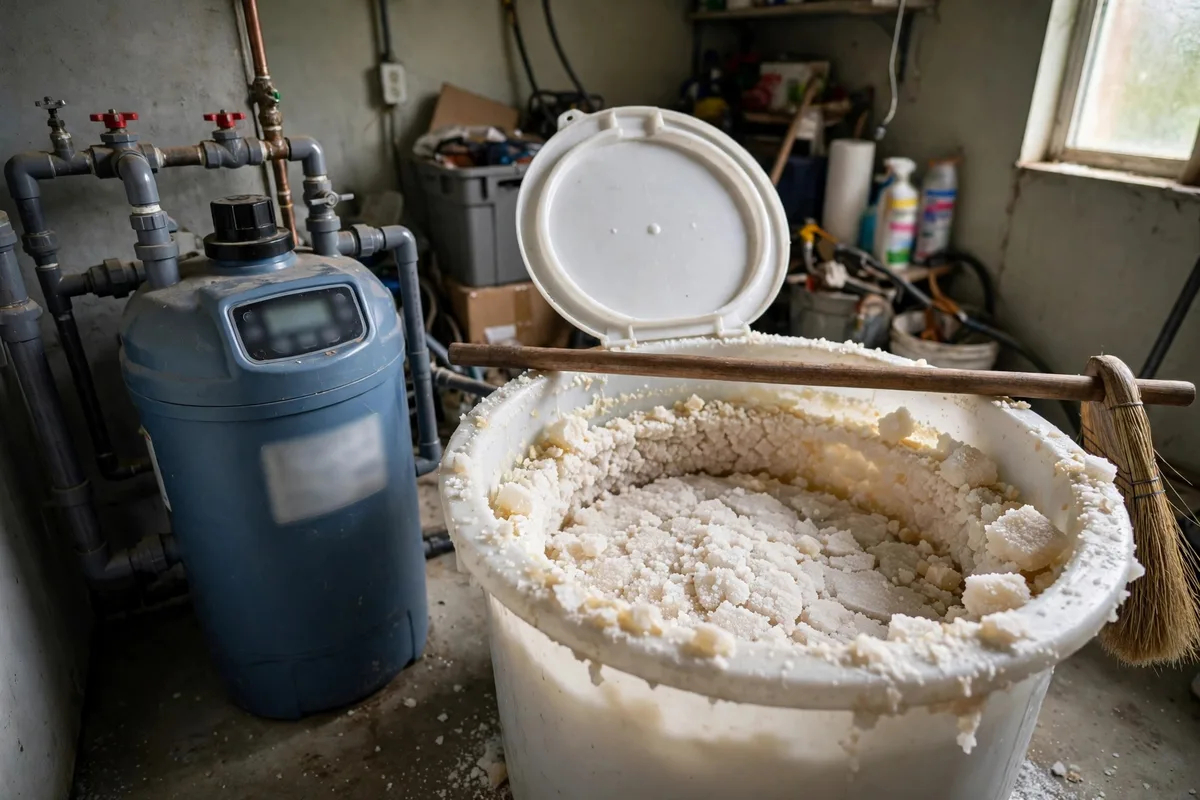
The brine tank has been full for months. That is the strange part — not empty, full. The owner topped it up in the spring, and by autumn the level has barely moved, while the kettle grew its white crust again and the shower glass spots like it used to. The machine still runs its cycle at 2 a.m. Nothing appears broken.
Poke a broom handle down through the salt and the story changes. A few inches in, the handle stops on something hard — a fused crust — and below the crust, when it cracks, there is a hollow, and below the hollow, brine. The salt has bridged: it arches across the tank like a frozen pond, holding itself up while the water below, starved of new salt, weakens with every regeneration. The softener has been "regenerating" with ever-diluter brine — slowly stopping.
A softener is the simplest machine in the treatment train — one resin bed, one tank of salt, one valve — and its maintenance is correspondingly short. But on well water it carries a second burden city-water softeners never see: the iron works on the resin the whole time. This guide covers both jobs, on the EPA's guidance and the manufacturers' own manuals.
Salt: the one consumable, and the rules that govern it
Everything a softener does runs on the brine, and the brine runs on what is in the tank. The EPA's WaterSense guide, Soften Water Without Wasting It, sets the terms: use sodium or potassium salt pellets specifically made for softeners — and avoid rock salt, road salt, or table salt. iSpring's manual for the WCS45KG, the softener in our hard water guide, phrases its version as a pair: use softening granular salt, and avoid small granular, fine salt. Fine and impure salts recrystallize where you do not want them; rock salt carries its dirt into the tank.
The level rules form a band, not a maximum:
- Fill the tank about half full with pellets, and check the level every 4 to 6 weeks (EPA).
- Add salt once it falls below the water level — when you see water standing above the pellets, it is time (EPA). iSpring's inspection list agrees: if the salt is lower than the water level, add salt in time.
- Never let it drop below one quarter full (EPA). If the tank runs out entirely, the water will not soften — and the regenerations the valve keeps running waste water and energy on a bed it cannot recharge.
Potassium chloride is the standing alternative, framed by the sources as a substitution, not an upgrade: Minnesota's Department of Health points to it for households watching sodium, and the EPA lists potassium pellets alongside sodium as a proper softener salt. The rhythm does not change with the chemistry.
The bridge, and its quieter cousin
The opening scene has a name and a mechanism, both from the EPA. Salt bridging occurs when the pellets fuse into a hard layer in the middle of the tank. The layer stops the pellets above from falling, and stops the suspended salt from mixing with the water below to form brine. The EPA names the cause plainly: filling the tank to the top. The excess weight fuses the pellets — which is why the half-full rule is a maintenance rule, not a tidiness preference.
The diagnostic is the one the homeowner missed for months: if the salt level isn't going down over time, suspect a bridge. A working softener consumes salt steadily; a tank that stays full is not efficiency. The fix is gentle: push a broom handle down through the crust until the pellets collapse into the water, then initiate a regeneration so the valve immediately draws on the restored brine. Hot water helps loosen a persistent bridge. The quieter cousin is salt clogging — salt hardened over the openings in the brine well, the tube through which water moves between the tanks, sealing them shut. Its treatment is water first: a gallon of hot tap water into the tank, about 10 minutes, then break up the clogging and regenerate.
And the tank itself, eventually, needs emptying. The EPA's instruction: clean it out at least every few years, per the manufacturer's instructions — let the salt run down, empty the tank, wash with warm soapy water, sanitize with a bleach solution, rinse clean. It is also when the tank tells the truth about your salt: a floor of undissolved sludge is the signature of impure salt.
The resin, and what well water does to it
The resin bed is where softening happens, and it is the part of the machine with no gauge. Its enemy on a well is not hardness — hardness is its job — but iron, and the story turns on which form the iron is in. Two sources state it identically. Minnesota's Department of Health: iron or manganese that has been exposed to air or chlorine can clog the resin and prevent it from working — this is known as fouling. Penn State Extension: colorless, reduced iron will be removed by the unit, but red, oxidized iron will clog the resin.
That distinction is the whole maintenance problem. Dissolved iron exchanges onto the resin like hardness, but every exposure to air converts some of it to the rust form — and the rust form does not exchange; it coats and lodges. Brine strips hardness off the beads by sheer sodium numbers; it does not reliably strip a rust coating. Capacity fades grain by grain, and the household adjusts to less-soft water for months before anyone names it.
Penn State draws the envelope inside which a softener should be asked to handle iron at all: pH greater than 6.7, hardness between 3 and 20 grains per gallon, and dissolved iron less than 5 mg/L. Inside it, iron removal is a legitimate second job. Outside it — and whenever iron arrives already oxidized — the same source is blunt: using the resin bed as a mechanical filter for oxidized iron is generally not recommended, it could damage the bed, and filtration should be used instead. Our iron filter vs. softener guide works through that decision in full.
For resin already fouled, the remedy on record is chemical. The EPA builds it into the annual rhythm: the resin beads need to be cleaned annually to maintain efficiency — pour a cleaner recommended by the manufacturer into the brine well and run a regeneration, following the owner's manual. Minnesota and Penn State agree on the category and the caution: commercial cleaners are available for fouled resin, used according to the manufacturer's instructions — read them before adding any chemicals to the unit.
The limits deserve the same print as the promise. Penn State again: in some instances, resins cannot be washed of contaminants and will need to be replaced — with the parenthetical that this should not be the case if the resin is periodically regenerated and maintained. A cleaner holds the line against fouling caught as a trend; it does not give a rust-cemented bed back its capacity — and iSpring makes replacement a professional's job. A rebed is a service visit.
Two more fouling routes are well-water ordinary. Turbidity: Penn State notes a turbid supply can clog the resin with mud and clay — backwashing will sometimes solve it (Minnesota: typically), and if not, slowly stirring the resin during the backwash helps; a sediment filter before the softener is the structural fix. Biology: bacteria and fungi, in Minnesota's words, can grow on the resin surface in undisinfected water and reduce its effectiveness; the answers are to disinfect the water first or periodically clean the softener.
Regeneration: the clock, the setting, the frequency
The clock, after every outage. Two sources insist on this independently. The EPA: if there is a power outage, double check your softener after power is restored to ensure it's still programmed correctly, and reset the clock. iSpring's emergency section: in case of power failure, readjust the current time and regeneration start time according to the manual. A clock that lost two hours in a storm regenerates at 4 p.m. instead of 2 a.m. — and iSpring adds why that matters: the effluent during regeneration is not softened, and using water during the cycle affects the result, so the manual recommends not using it then.
The hardness setting, matched to the water. Minnesota's instruction is a setting, not a suggestion: make sure the softener is set to the hardness of your water supply — set too high, it will cost more to operate and waste water. The number comes from your test, not the installer's habit; our guide to reading your well water test numbers covers where the hardness line sits on a lab panel. And iSpring's pre-engineered defaults, it notes, are a starting point — adjustable, with an application engineer's help, to the water actually in front of the valve.
The frequency, no more than necessary. The EPA's rule is a sentence: regenerate only as necessary — know your softener's capacity, the hardness needing removal, and how much water your home uses; you probably don't need to regenerate every day, and doing it too often wastes salt and water. The meter the waste runs on: a typical softener uses 20 to 70 gallons per regeneration. Underneath sits the technology choice — Penn State notes timed models regenerate on a schedule whether the resin needs it or not, while demand models regenerate after so many gallons; the EPA says to choose demand-initiated. For an empty house, the EPA's corollary is vacation mode, bypass, unplug, or turn the house water off — and iSpring adds the restart rule: once a softener has been stopped for a while, run a regeneration before reuse.
The valve and the brine line: where "no salt" is actually diagnosed
When a softener stops softening with salt in the tank and no bridge in it, the failure usually sits in the few inches of hardware that move brine to the bed. The brine is not pumped; it is drawn, by suction the valve creates through a small injector — a nozzle and throat that turn water pressure into a venturi pull. Anything narrowing that passage starves the regeneration while the valve clicks through its cycle sounding healthy.
iSpring's troubleshooting table is the diagnostic ladder, in its own order. "No softened water": no salt or weak brine — add salt; brine suction pipeline blocked — clear it; inlet pressure too low — it should be greater than 21 psi; brine pipeline leak — find and eliminate it. "No salt absorption" — the brine level never falls — goes straight at the injector: net blocked — clean it; injector blocked — disassemble, rinse, reinstall; brine valve blocked — clear or replace it; suction orifice blocked — remove the plate, rinse, reinstall.
Clack's service manual for the WS1 — one of the most common valves in the industry — gives the procedure:
- Unscrew the injector cap and lift it off. Attached to the cap is a screen — remove it and clean it if fouled.
- The injector can be pried out with a small screwdriver. It consists of a throat and a nozzle. Chemically clean it with vinegar or sodium bisulfite; the holes can be blown out with air.
- Never clean it with a sharp object. Both pieces have small-diameter holes that control the flow rates and insure the proper concentration of regenerant. Scoring the plastic, or enlarging a hole, changes the injector's operating parameters — a cleaned injector with a reamed hole is a miscalibrated injector.
- Note the two holes labeled DN and UP, and return the injector and plug to the holes they came from. Push everything firmly in place, replace the screen, and hand tighten the cap. The refill flow control gets the same chemistry — and every O-ring you touch gets silicone lubricant only, never Vaseline or oils; iSpring's manual prints the same rule.
This job sits at the edge of owner work — every manual's sequence starts with the bypass and pressure relief — and a homeowner not comfortable there has a precise sentence for a technician: the injector and its screen, cleaned or replaced.
Bypass and plumbing: the short inspection
The bypass is a maintenance tool twice over. It isolates the unit for every job above — and it is also, in the EPA's framing, an efficiency habit: activate it when watering the lawn, washing the car, or filling a pool, and you save the salt, water, and energy those gallons would have consumed — but return the valve to its previous position when you are done. A softener left in bypass after a project is a softener "using no salt" for the most embarrassing of reasons. iSpring adds the emergency use — a failure or leak means running the house on raw water through the bypass until it is fixed — and a caution: do not pull out the bypass clamp until the pressure is released.
The rest of the inspection is iSpring's printed list, and it takes two minutes: any leakage in the pipeline; the overflow pipe blocked — clear it if so; the brine tank vertical — straighten it if not; and the salt against the water level. The EPA adds the one item that is a sound, not a sight: a continuous trickle or flow of water to the drain could indicate a broken valve or other malfunction. A softener should speak to the drain only during regeneration; one that murmurs all day is spending water and salt on a cycle that never ends.
The symptom ladder of a neglected softener
First, the fade. Hardness creeps back at the tap — spots return, soap lathers less, the kettle crusts. The checks above are ordered to meet it: salt level and bridge first (free), clock and hardness setting second (free), injector third (a rinse). Fouled resin is the fourth suspect — fortunate, because it is the only one that costs money to confirm.
Then, the taste. Salty-tasting water, particularly in the morning, points at timing rather than chemistry: a clock drifted by an outage moves the regeneration into the hours when the house is drawing water, and iSpring is explicit that water delivered during regeneration is not softened and that using it then degrades the cycle. Reset the clock to a no-use hour before blaming the brine.
Then, pressure. A softener that has become a bottleneck is usually a clogged one — Penn State's mud-and-clay clogging, or Minnesota's oxidized-iron coating — with backwashing as the first remedy and a sediment filter ahead of the unit as the structural one. The other pressure number is the supply: iSpring sets the floor at an inlet pressure greater than 21 psi for the valve to draw brine properly, and no cleaning fixes a pump that cannot meet it.
Finally, the drain that never stops. Continuous flow to the drain is the EPA's broken-valve sign, and the one symptom here that is not a maintenance item at all. Everything above it is a schedule, a setting, or a rinse; this one is a repair — and the most expensive to ignore, because it runs treated water out of the house around the clock.
Behind an iron filter, or standing alone
Everything here gets easier or harder depending on where the softener sits in the train — the treatment order this site teaches. The EPA's installation guidance states it in one line: if you have a whole-house filter for other contaminants, install the softener after it, so chemicals and sediment are filtered before softening. Penn State's version is the most specific about what the filter is for: filtration prior to softening insures that oxidized iron is not processed in the softener.
Behind an iron filter, the softener's maintenance collapses to the salt discipline, the clock, and the valve — the iron filter upstream takes the rust load, on the rhythm our iron filter maintenance guide lays out, and the annual cleaner is insurance rather than treatment.
Standing alone on iron-bearing water — inside Penn State's envelope of pH above 6.7, hardness 3 to 20 gpg, dissolved iron under 5 mg/L — the softener does two jobs, and the maintenance has to fund both. The cleaner becomes the standing counterweight to a fouling process that runs every day; the water reaching the resin must never meet air or chlorine first, because the moment dissolved iron oxidizes it changes from a passenger the resin can exchange into the coating it cannot shed; and the backwash stops being a formality, because the bed is now also the filter Penn State warned against using it as. Owners here are maintaining two machines that share a tank, and the honest schedule is the sum of both.
The maintenance calendar
Assembled only from the guidance quoted above — each line carries its source, because the right interval is the one in your manual, not a universal number:
| When | What | According to |
|---|---|---|
| Every 4–6 weeks | Check the salt level; keep the tank about half full, add salt when it falls below the water level, never below one quarter full; watch for a level that isn't dropping (bridge) | EPA WaterSense guide |
| After any power outage | Verify the programming; reset the clock and regeneration start time | EPA WaterSense guide; iSpring manual |
| Periodically | Check for leaks at connections, valves, and drains; listen for continuous flow to the drain; check the overflow pipe and that the brine tank stands vertical | EPA WaterSense guide; iSpring manual |
| Annually | Clean the resin: manufacturer-recommended cleaner into the brine well, then a regeneration | EPA WaterSense guide |
| Every few years | Clean out the brine tank: run the salt down, empty, wash with warm soapy water, sanitize with bleach solution, rinse | EPA WaterSense guide |
| When brine stops drawing | Clean the injector screen and injector (vinegar or sodium bisulfite; no sharp objects; hand-tighten the cap) | Clack WS1 manual; iSpring troubleshooting |
| Before any chemical goes in | Read the manufacturer's instructions for that chemical | Minnesota Dept. of Health; Penn State Extension |
Set beside the iron filter's calendar, the softener's list is the shorter one — a bag of salt, a broom handle, a clock, and one screen under a cap. The machine asks for very little. What it does not forgive is being asked to drink rust.
The IronInMyWater rule
Test first, treat second — and never choose equipment from one number alone. Iron, pH, manganese, and hardness together decide the system; the manufacturer's published ratings, checked against your test, decide the model. How we work
FAQ
My softener isn't using any salt. What's wrong?
Work in order. A salt bridge — a fused crust holding the pellets above the water — is the first suspect: probe with a broom handle, break it up, and run a regeneration (EPA). If there is no bridge, confirm the unit isn't sitting in bypass, then follow the brine path: iSpring's troubleshooting for "no salt absorption" is a blocked injector net or injector — clean them — then a blocked brine valve or orifice. Fouled resin is not on this list; a softener that draws no brine never reaches the resin.
Can a resin cleaner fix a softener that stopped softening?
Sometimes — if the cause is iron fouling caught as a trend. Commercial cleaners for fouled resin exist (Minnesota; Penn State), used to the manufacturer's instructions, and the EPA builds an annual cleaning into the rhythm. But Penn State prints the limit: some resins cannot be washed clean and need replacement — though that should not happen to a maintained bed. And a cleaner does nothing for a bridge, a clock, or a clogged injector, the more common causes.
Does an iron filter ahead of the softener change the maintenance?
Yes — it removes most of the resin work. Behind an iron filter, the softener's care is the salt checks, the outage clock reset, and the valve inspections, and the annual cleaning is insurance. Asked to handle iron alone, the same softener needs that cleaning treated as a standing defense — and it only belongs in that job inside Penn State's envelope: pH above 6.7, hardness 3–20 gpg, dissolved iron below 5 mg/L.
Sources
The ratings, prices and guidelines in this guide were checked against these primary sources in November 2026.
- US EPA WaterSense — Soften Water Without Wasting It: Guide to Selecting and Maintaining a Water-Efficient Water Softener (pellets only, never rock, road, or table salt; tank about half full, check every 4–6 weeks, never below one quarter; salt bridging from overfilling, broken with a broom handle followed by a regeneration; resin beads cleaned annually; brine tank cleaned out every few years; reset the clock after an outage; a continuous flow to the drain signals a broken valve)
- Minnesota Department of Health — Home Water Softening (ion exchange, the 7 gpg / 120 mg/L guideline, sodium guidance)
- Penn State Extension — Water Softening (oxidized iron clogs the resin while reduced iron is removed; filtration before softening keeps oxidized iron out; commercial cleaners for fouled resin, and resin that cannot be washed clean must be replaced; bacteria and fungi mat in the resin; timed models waste more water and salt than demand models)
- Penn State Extension — Iron and Manganese in Private Water Systems (a softener is recommended for iron only at pH above 6.7, hardness 3–20 gpg, and dissolved iron below 5 mg/L; oxidized forms foul the resin, and the resin bed should not be used as a mechanical filter for them)
- iSpring — WCS45KG whole house water softener manual (manufacturer's manual: add salt when it falls below the water level; granular softening salt, avoid fine salt; silicone-based grease only; readjust the clock and regeneration time after a power failure; troubleshooting for no soft water and no salt absorption — clean the injector net and injector, inlet pressure above 21 psi)
- Clack Corporation — WS1 Parts and Operational Manual, service instructions (manufacturer's manual: the injector cap carries a screen to remove and clean; clean the injector throat and nozzle with vinegar or sodium bisulfite and blow the holes out with air — never a sharp object, which would change the injector's flow rates; hand-tighten the cap; silicone lubricant only)
The numbers, on one sheet
The benchmarks behind every guide here — iron, manganese, pH, hardness, coliform, nitrate — plus the treatment order and the equipment ceilings, on a free two-page PDF. Get the free cheat sheet
The IronInMyWater rule
Test first, treat second — and never choose equipment from one number alone. Iron, pH, manganese, and hardness together decide the system; the manufacturer's published ratings, checked against your test, decide the model. How we work
Read next

Getting Started
The New Well Owner's Checklist: The Paperwork, the First Test, the Wellhead Walk, and the First-Year Calendar
The keys came with a folder: one old test result and a page you can't read. The paperwork hunt, the baseline lab test before any treatment talk, the wellhead walk, and the first-year calendar — the sequence that turns a house with a well into a water supply you actually know.
Read the guide →
Bacteria & Disinfection
Well Water After Heavy Rain and Flooding: Which Changes Are Signals, and the Order of Operations When the Well Goes Under
The storm is over and the water runs cloudy for the first time in years. Most rain changes nothing — but water that reached the wellhead changes everything. How to read the changes, the agencies' order of operations for a flooded well, and the grading and cap work that keeps the next storm out.
Read the guide →
Costs & Buying
One Quote, Six Jobs: What a Whole-House Well Water System Actually Costs in 2026
One installed quote, six separate jobs — and no way to tell which dollars treat which problem. The stack unbundled stage by stage with manufacturer prices checked in November 2026, the running costs nobody quotes, and five-year totals for three real water profiles.
Read the guide →