
The Iron Filter Didn't Break: A Maintenance Guide for AIO, Chemical-Feed, Catalytic, and Cartridge Systems
The service call that found nothing broken
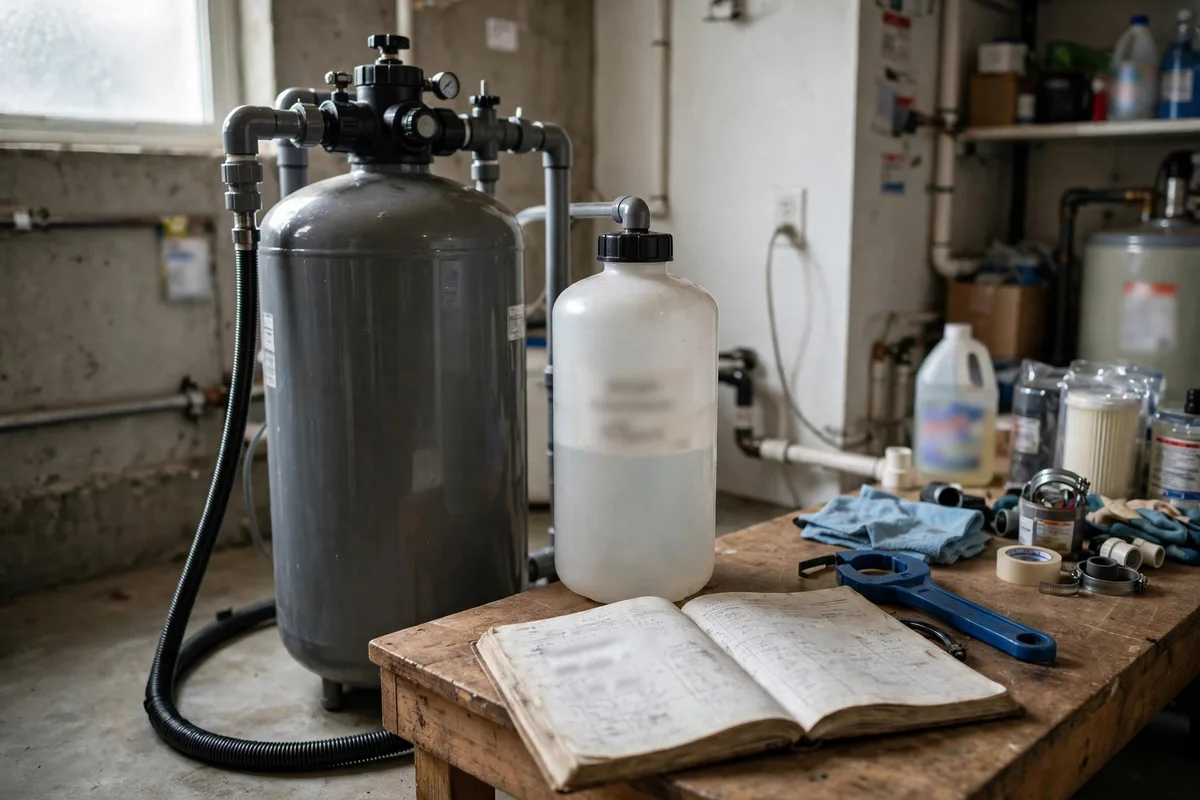
Two years after the iron filter went in, the orange ring is back in the toilet bowl. Not dark — a shadow of it, deepening week by week. The shower does not hit as hard as it used to. A white shirt comes out of the wash with a faint rust blush, and the homeowner does what anyone would do: calls for service, braced for a dead valve or a failed tank.
The technician runs a manual backwash, watches the drain run brown and then clear, checks a solution tank that has been empty for a month, and delivers the verdict nobody expects: nothing broke. The filter did not fail. The maintenance simply stopped happening — a backwash cycle that was never verified, a tank of oxidant that ran dry, a media bed that reached the end of the life its own manual printed on page four.
This is the part of owning an iron filter that the sales page compresses into a footnote. Every iron filter is a machine for moving iron from your water into a drain, and every one of them has a rhythm of small tasks that keeps the moving going. The rhythm differs sharply by family — what an air-injection system asks of you is not what a greensand filter asks — but the pattern underneath is the same: maintenance is the second half of the purchase price, paid in time instead of money. This guide lays out that rhythm family by family, on the manufacturers' own schedules.
The one job every tank shares: the backwash
Every backwashing iron filter does the same physical trick. In service, water flows down through a bed of granular media, and the oxidized iron — now a solid, rust-colored precipitate — is caught in the bed. In backwash, the valve reverses the flow: water rushes up through the bed fast enough to lift and tumble the grains, the trapped precipitate is carried out to the drain, and the bed settles back down, re-sorted. Then the next load of iron can be caught.
The details are in the manufacturers' own numbers, and they explain why a weak backwash is worse than none. Clack Corporation's data sheet for Birm media specifies a backwash rate of 10 to 12 gallons per minute per square foot of bed, enough to expand the bed 20 to 40 percent. Inversand's GreensandPlus sheet asks for a minimum of 12 gpm per square foot at 55°F, producing 40 percent bed expansion, continued until the waste water runs clear or for 10 minutes, whichever comes first. Pentair's iron reduction manual makes the same point from the installer's side: proper backwash is required to maintain the life of the filter media, and on a well, the installer is told to confirm the pump can deliver the drain flow the system needs — 5 gallons per minute for Pentair's own units.
A backwash that cannot lift the bed does not clean it. It stirs the surface, lets the precipitate pack deeper, and leaves channels worn through the bed that raw water will later slip down untreated. The valve clicking through its cycle at 2 a.m. is not proof of a backwash; the drain running dirty and then clear is. Which is why several of the checks below are really one check, repeated: is the backwash actually happening, at full flow, when nobody is using water?
Air-injection oxidation: the air pocket is a consumable
An air-injection (AIO) filter keeps a pocket of compressed air at the top of the tank. Incoming water cascades through that pocket, the oxygen oxidizes the dissolved iron, and the media bed below filters out the rust. The pocket is not permanent — it is spent, a little at a time, on the iron it oxidizes — and the control valve rebuilds it every regeneration. Pentair's manual describes the cycle in one sentence: a simple backwash to refresh the filter bed, followed by an intake of air to establish an air head in the tank. SpringWell describes its WS iron filter the same way: each night, a scheduled backwash flushes captured contaminants down a drain and refreshes the air pocket, automatically.
So the AIO owner's real job is not the air — the valve handles the air — but the valve itself. Pentair's maintenance list for its iron reduction systems is short and entirely about verification: clean the backwash flow control, verify the flow meter is functioning and clean its impeller if necessary, verify the programming of the control, and verify the minimum and maximum water pressure. A clock knocked wrong by a power outage, a flow control slowly crusted with the same iron the system exists to catch — either one quietly converts a self-cleaning filter into a tank that merely sits in the line.
The media underneath lasts years, but not forever, and the manufacturers' numbers differ enough to print both. Pentair instructs owners to replace the filter media every three to five years, warns that systems treating high iron will need it more often, and makes the rebed a dealer job: call your local dealer to replace the filter media. SpringWell, for its own AIO tank, publishes a media life of 10+ years and markets the system as having nothing you need to refill. Both are the manufacturers speaking about their own beds; your manual is the one that governs your tank. And Pentair adds the accelerant that shortens every schedule in this guide: if iron bacteria are present, frequent service may occur and the life of the system may be limited — control the bacteria, the manual says, and the system will function properly. Our iron bacteria guide covers that fight in full.
Chemical oxidation: the rhythm is the refill
Where an AIO system burns air, a chemical-feed system burns an oxidant — chlorine, hydrogen peroxide, or potassium permanganate — injected ahead of a filter tank. The chemical is consumed in proportion to the iron it destroys, so the system's appetite is set by your water. Penn State Extension's summary of oxidation-then-filtration systems is blunt about the workload: significant system maintenance is required, solution tanks must be routinely refilled, mechanical filters need to be backwashed to remove accumulated iron and manganese particles, and a carbon filter downstream needs its carbon replaced occasionally as it becomes exhausted. The frequency, Penn State notes, is primarily determined by the concentration of the metals in the raw water and the amount of water used.
US Water Systems' manual for its Matrixx inFusion — a peroxide-injection system with a catalytic carbon tank, one of the three systems in our whole-house comparison — prints the full schedule, and it is the most honest page in this guide:
- Backwash: the catalytic carbon is backwashed on a programmed cycle — typically every 1 to 3 days, factory default 3, extendable to 4 or 5 days in lighter water.
- Monthly: check the control valve's clock and settings, and again after any power outage. The manual calls this crucial for a specific reason: the carbon must backwash at a time when no water is being used in the house, or contamination of the plumbing system can occur.
- Every 1 to 6 months: remove the peroxide injection fitting and clean off the buildup — the injector fouls with the very precipitate it creates — and drain the well's pressure tank until the water runs clear (the text suggests quarterly is typically sufficient).
- Continuously: check the peroxide solution tank's level and refill as needed; consumption varies with water use.
- Every 1 to 5 years: inspect the injection pump tube and replace it as needed.
- Every 3 to 5 years: replace the catalytic carbon media, which the manual describes as typically exhausted in that window, depending on water usage and the contaminant level treated.
Read that schedule once and the family's character is clear: nothing on it is difficult, all of it is recurring, and the most common failure is the emptiest one — a solution tank that ran dry weeks before anyone noticed the stains returning. The manual even anticipates the bacteria version of the same story: sulfur bacteria established in the home's plumbing can grow back toward the treatment system and keep the smell alive, a problem it answers with a shock chlorination of the well.
Catalytic media: nothing to refill — conditions to keep
Catalytic media filters oxidize iron at the surface of the grains themselves. They ask for no solution tank, but they are not one family when it comes to upkeep; the two classic media sit at opposite ends of the maintenance scale.
Birm: backwash only, inside a fence of conditions. Clack's data sheet for Birm is almost proud of the short list: no chemicals to purchase for maintenance, regenerant not required, negligible labor cost — only periodic backwashing required. The media is a catalyst and is not consumed in the iron removal operation. But the sheet surrounds that simplicity with operating limits that function as the real maintenance. Free chlorine in the water must stay below 0.5 ppm: chlorination greatly reduces Birm's activity, and high concentrations of chlorine compounds may deplete the catalytic coating. Hydrogen sulfide must be removed before the water reaches the bed. Polyphosphates coat the media and reduce its ability to remove iron and manganese. The water must bring its own oxidant — dissolved oxygen equal to at least 15 percent of the iron content and 29 percent of the manganese — at a pH between 6.8 and 9.0. And Clack builds the inspection into the sheet: treated water should periodically be monitored for manganese and iron shortly before a backwash and immediately after, and elevated manganese in the treated water before backwash may mean the media is being destroyed or the bed's capacity has been exceeded. If chlorine and hydrogen sulfide are absent, Clack adds, low pH or lack of oxygen are the most likely conditions leading to media destruction. A Birm bed, in other words, is maintained by keeping its water inside the fence — and tested, not assumed.
Greensand and GreensandPlus: the coating is the consumable. Manganese greensand carries a manganese dioxide coating that does the oxidizing, and the coating is spent as it works. Penn State's description of the upkeep is the heaviest in this guide: manganese greensand filters require significant maintenance, including frequent regeneration with a potassium permanganate solution as it is consumed during oxidation of the dissolved metals, plus regular backwashing — and the permanganate solution is toxic and must be handled and stored carefully. Inversand's GreensandPlus, the modern successor media, is usually run the other way, in what the maker calls catalytic oxidation (CO) operation: a continuous feed of chlorine ahead of the filter, dosed to hold a free chlorine residual of 0.5 to 1.0 mg/L in the filter's effluent, which keeps the media in a continuously regenerated state. Permanganate can be fed the same way, to a "just pink" color at the filter inlet. Either way the oxidant supply is the maintenance, the backwash still applies — Inversand's worked example, water with 1.7 mg/L iron and 0.3 mg/L manganese at a moderate service rate, lands on a backwash roughly every 32 to 38 hours of operation — and the payoff is durability: a silica sand core that withstands waters low in silica, TDS, and hardness without the breakdown that shortens the original greensand's life.
Cartridge systems: the cartridge is the maintenance
A cartridge system — three big housings in a row, like the iSpring WGB32BM in our comparison — has no backwash at all. Nothing is flushed, nothing regenerates. The media's whole capacity sits inside disposable cartridges, so the maintenance schedule and the replacement schedule are the same document. iSpring's manual for the WGB32BM prints it as a table: the polypropylene sediment cartridge every 6 to 12 months, the carbon block every 12 months, and the iron and manganese cartridge every 12 months, with the set rated at 100,000 gallons — about a year for a family of four, depending on water quality and usage.
The manual also tells you the gauge to watch, and it is not a calendar. Its troubleshooting table pairs low water pressure with clogged filters, and its maintenance section puts it plainly in the older series manual's words: if the system has been working properly but the pressure is slowing, it may be time to change the filter cartridge. Symmetrically, iron and manganese breaking through again is the manual's sign of an expired iron and manganese cartridge — replace it, and if levels are consistently high, the manual says to consider additional pre-treatment or a different system. That last clause matters. Minnesota's Department of Health notes that sediment and carbon filters can remove small amounts of iron, but the iron will quickly plug the system: a cartridge set asked to do a backwashing tank's job does not fail dramatically, it just plugs and passes, on a shorter and shorter cycle. The swap itself is the one piece of filter maintenance in this guide that is unambiguously a homeowner task — iSpring's steps are shut off, relieve pressure, unscrew the housings with the included wrench, clean the housings, inspect the O-rings, and seat the new cartridges in order.
The symptom ladder of a neglected filter
Neglect announces itself in a rough order, and each rung points at a different layer of the schedule.
First, pressure. A bed or cartridge loading with precipitate resists flow. Clack quantifies the allowance for Birm: a maximum pressure drop of 2 to 4 psi increase over the clean bed. Past that, the bed is telling you the backwash is not keeping up — or, in a cartridge system, that the swap is due.
Then, breakthrough. The stains return faintly, then honestly. This is capacity arithmetic, not breakage: the bed exhausts its oxidizing power before the next regeneration, or the cartridge's media is spent, and the last water of each cycle passes through a filter that has nothing left to give. Clack's monitoring instruction — test before and after a backwash — exists precisely to catch this rung while it is still a schedule problem.
Then, smell. A rotten-egg note returning to a house whose filter once removed it means the media is exhausted or the biology has moved in. Iron and sulfur bacteria are the standing accelerant: Minnesota's health department describes organisms that combine iron and oxygen into rust deposits and slime that sticks to well pipes, pumps, and plumbing fixtures and causes clogging, and warns that eliminating them can be difficult and that treatments may only be partly effective. UMass Extension says the same thing in scheduling language: it is almost impossible to kill all the iron and manganese bacteria in a system, they will grow back eventually, so be prepared to repeat the treatment from time to time.
Finally, the hard failures. A bed that has packed and channeled no longer responds to backwashing. An injection fitting scaled shut starves a chemical system while its tank sits full. These are the rungs where the cheap tasks become a service visit and, eventually, a rebed — the media change that was always on the calendar, arriving early and on the technician's terms.
Owner's work, and the work that is not
Everything in the schedules above sorts into two piles. The owner's pile: refilling the oxidant tank before it runs dry; swapping cartridges; checking the valve's clock and settings monthly and after outages; cleaning an injection fitting; starting a manual backwash and watching the drain run clear; and keeping the record. UMass Extension's fact sheet closes its treatment section with the habit that makes all the others work: regardless of the quality of the equipment purchased, it will not operate well unless maintained in accordance with the manufacturer's recommendations — keep a logbook to record equipment maintenance and repairs. A filter's memory is its logbook; without one, every symptom is a surprise.
The other pile is smaller and specific. Pentair assigns the media replacement in its systems to the local dealer. Minnesota's health department assigns the physical cleaning of a badly infected well — pulling the pump, scrubbing the casing — to a licensed well contractor. Valve internals, a distributor tube buried under a ton of wet media, a well that needs rehabilitation: these are service visits, and the maintenance calendar's real purpose is to make them rare, scheduled, and cheap rather than sudden.
The maintenance calendar
Assembled only from the schedules quoted above — each line carries its source, because the right interval is the one in your manual, not a universal number:
| When | What | According to |
|---|---|---|
| Nightly to every few days | The automatic backwash runs, at a no-use hour; confirm it is happening | SpringWell (nightly); US Water (every 1–3 days, default 3) |
| Monthly | Check the control valve's clock and settings; repeat after any power outage | US Water maintenance schedule |
| Every 1–6 months | Clean the oxidant injection fitting; drain the pressure tank until the water runs clear | US Water maintenance schedule |
| Periodically | Test treated water for iron and manganese before and after a backwash | Clack Birm data sheet |
| Every 6–12 months | Replace the sediment cartridge (cartridge systems) | iSpring WGB32BM manual |
| Every 12 months | Replace the carbon block and the iron/manganese cartridge | iSpring WGB32BM manual |
| Every 3–5 years | Replace catalytic carbon or AIO filter media — sooner on high-iron water | US Water manual; Pentair service manual |
| 10+ years | The media life SpringWell publishes for its AIO tank | SpringWell product page |
Set against the purchase prices in our iron filter vs. softener guide, the pattern is the honest summary: the tank systems trade a large check now for small recurring attention, and the cartridge systems trade a small check now for a cartridge bill every year. Neither is maintenance-free. One of them is merely maintenance-honest — and now you know which questions to ask of the other.
The IronInMyWater rule
Test first, treat second — and never choose equipment from one number alone. Iron, pH, manganese, and hardness together decide the system; the manufacturer's published ratings, checked against your test, decide the model. How we work
FAQ
My iron filter is two years old and the stains are coming back. Is it broken?
Probably not. The most common causes are maintenance items, not failures: an oxidant solution tank that ran empty, a backwash cycle that stopped running or lost its flow, a cartridge past its replacement date, or a media bed reaching the end of the life its manual states. Work the schedule for your family first — manual backwash, refill, settings check, cartridge date — before pricing a replacement.
How often should an iron filter backwash?
It depends on the family and the iron load, and the manufacturers' own numbers bracket the range: SpringWell's AIO system backwashes nightly; US Water's peroxide system defaults to every 3 days (typical range 1–3, extendable to 4–5); Inversand's worked example for GreensandPlus lands near every 32–38 hours of operation at moderate iron. Higher iron always shortens the interval — Penn State notes the frequency of backwashing and regeneration rises with the metals concentration.
Can I replace the media in my filter tank myself?
The manufacturers split on this. Pentair's manual directs owners to their local dealer for media replacement, and a rebed means handling hundreds of pounds of wet media plus the distributor assembly under it — most owners treat it as a service visit. Cartridge replacement, by contrast, is designed as an owner task in iSpring's manual, wrench included.
What shortens an iron filter's life the most?
Iron bacteria, on the evidence of both a manufacturer and a health department: Pentair warns they bring frequent service and a limited system life, and Minnesota's Department of Health describes the slime clogging wells, pumps, and fixtures, with control — repeated disinfection — rather than eradication as the realistic goal. The runner-up is a backwash that cannot lift the bed: precipitate packs in, channels form, and the media change arrives years early.
Sources
The ratings, prices and guidelines in this guide were checked against these primary sources in November 2026.
- Penn State Extension — Iron and Manganese in Private Water Systems (greensand needs frequent potassium permanganate regeneration plus regular backwashing; Birm needs no regeneration but does need backwashing; chemical oxidation systems need solution tanks routinely refilled)
- US Water Systems — Matrixx inFusion manual, Routine Maintenance and Maintenance Schedule (backwash every 1–3 days, default 3; injection fitting cleaned every 1–6 months; pump tube 1–5 years; valve clock checked monthly; catalytic carbon replaced at 3–5 years)
- Clack Corporation — Birm filtration media data sheet, Form 2350 (only periodic backwashing required; free chlorine below 0.5 ppm; backwash 10–12 gpm/sq ft at 20–40% bed expansion; monitor treated water before and after backwash)
- Inversand Company — GreensandPlus Technical Data Sheet (continuous chlorine feed holding a 0.5–1.0 mg/L residual keeps the media continuously regenerated; backwash at minimum 12 gpm/sq ft to 40% expansion; worked example lands on a backwash every 32–38 operating hours)
- Pentair — Whole House Iron Reduction Systems Service Manual (maintenance requirements: clean the backwash flow control, verify flow meter and control programming; replace the filter media every three to five years, more often on high iron; iron bacteria mean frequent service and a limited system life)
- SpringWell — Whole House Iron Filter WS1/WS4 (manufacturer's product page: nightly backwash flushes contaminants and refreshes the air pocket; 10+ year media life; nothing to refill)
- iSpring — WGB32BM instruction manual (manufacturer's filter replacement schedule: sediment cartridge every 6–12 months, carbon block and iron/manganese cartridges every 12 months; set rated at 100,000 gallons)
- Minnesota Department of Health — Iron in Well Water (iron plugs softeners and must be removed by backwashing; sediment and carbon filters remove small amounts of iron but are quickly plugged by it)
- Minnesota Department of Health — Iron Bacteria in Well Water (slime sticks to well pipes, pumps, and fixtures and causes clogging; elimination is difficult and treatments may only be partly effective)
- UMass Amherst Extension — Iron and Manganese in Private Drinking Water Wells (equipment will not operate well unless maintained to the manufacturer's recommendations; keep a logbook of maintenance and repairs; iron bacteria grow back, so repeat treatment from time to time)
The numbers, on one sheet
The benchmarks behind every guide here — iron, manganese, pH, hardness, coliform, nitrate — plus the treatment order and the equipment ceilings, on a free two-page PDF. Get the free cheat sheet
The IronInMyWater rule
Test first, treat second — and never choose equipment from one number alone. Iron, pH, manganese, and hardness together decide the system; the manufacturer's published ratings, checked against your test, decide the model. How we work
Read next

Getting Started
The New Well Owner's Checklist: The Paperwork, the First Test, the Wellhead Walk, and the First-Year Calendar
The keys came with a folder: one old test result and a page you can't read. The paperwork hunt, the baseline lab test before any treatment talk, the wellhead walk, and the first-year calendar — the sequence that turns a house with a well into a water supply you actually know.
Read the guide →
Bacteria & Disinfection
Well Water After Heavy Rain and Flooding: Which Changes Are Signals, and the Order of Operations When the Well Goes Under
The storm is over and the water runs cloudy for the first time in years. Most rain changes nothing — but water that reached the wellhead changes everything. How to read the changes, the agencies' order of operations for a flooded well, and the grading and cap work that keeps the next storm out.
Read the guide →
Costs & Buying
One Quote, Six Jobs: What a Whole-House Well Water System Actually Costs in 2026
One installed quote, six separate jobs — and no way to tell which dollars treat which problem. The stack unbundled stage by stage with manufacturer prices checked in November 2026, the running costs nobody quotes, and five-year totals for three real water profiles.
Read the guide →