
Sediment in Well Water: Sand, Grit and Cloudy Water — and the Filter Order That Catches Them
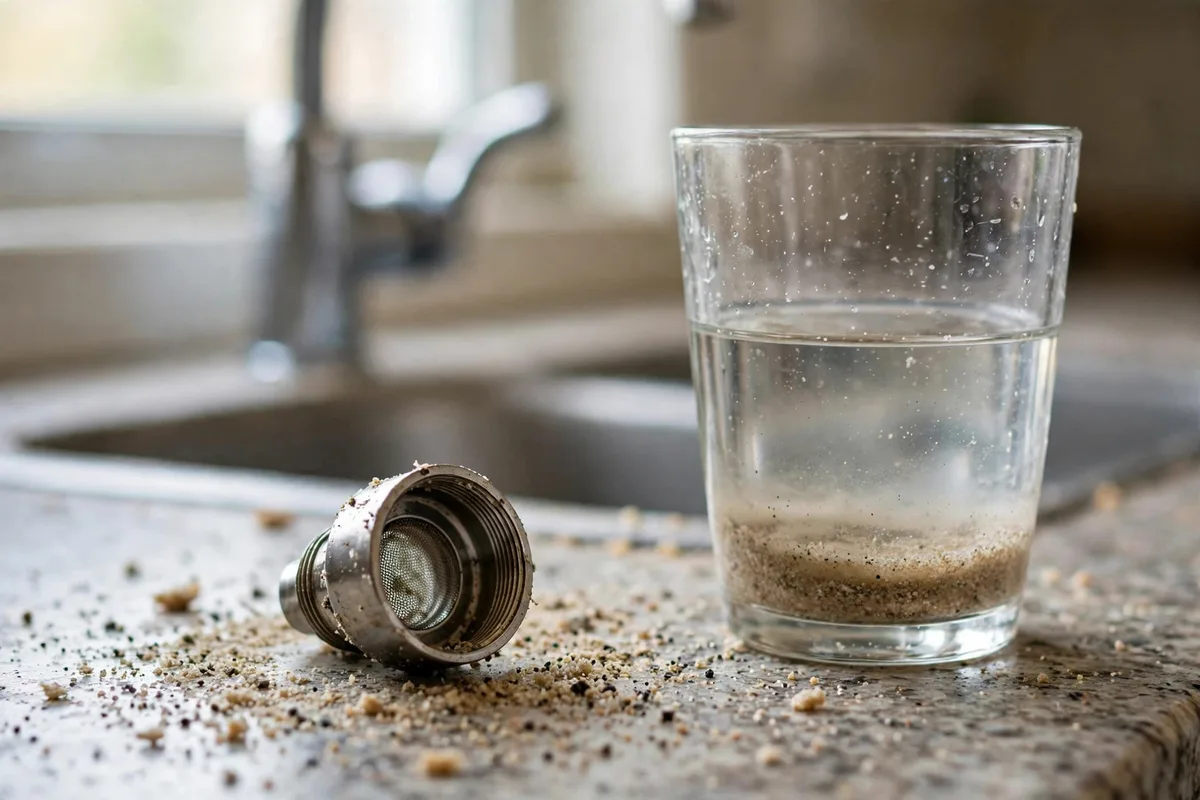
The grit in the aerator
It usually announces itself somewhere small. You unscrew the screen from the end of a faucet — because the flow had slowed to a dribble — and out fall a dozen grains of sand. Or you lift the toilet tank lid and find the bottom dusted with grit, like the inside of a beach bucket. Or a glass of water, left on the counter, grows a thin gray layer at the bottom while the water above it clears.
That material is sediment: solid particles riding in your water instead of dissolved in it. It is the most mechanical problem this site covers — nothing alive, nothing reacting, just something physical arriving at your taps that should have stayed in the ground. Two questions decide everything about the fix, and neither is "which filter should I buy?" The first is what the particle actually is, because sand, silt, clay, rust flakes, and mineral scale are five materials with five different sources. The second is whether it is new. Sediment that has always been there is a filtration problem. Sediment that started last month is a message from your well — and filtering it without reading the message is how a cheap problem becomes a pump replacement.
First, the glass test: sediment, air, or something else entirely
Before any lab, any filter, any purchase: fill a clear glass from a cold tap, set it on the counter, and watch it for a few minutes. What the cloudiness does as it sits sorts almost every case into one of four boxes.
It clears, and leaves nothing behind. That was air. The US Geological Survey explains that water under pressure holds dissolved air, and when the pressure releases at the tap the air comes out as millions of tiny bubbles — the water looks milky or white, then clears as the bubbles rise and escape. Cold water holds more air than warm, which is why this shows up in winter. The USGS verdict is one word: harmless. No filter fixes air, and none is needed: if the glass clears completely and the bottom stays clean, you do not have a sediment problem.
Something settles to the bottom. That is real sediment. Coarse grains drop within a minute or two; finer material drifts down slowly and the glass clears from the top as it falls. What lands there is evidence: how fast it settles is a rough measure of the particle size you are dealing with.
The water is clear at the tap, then turns orange or brown as it sits. That is not sediment yet. That is dissolved iron (or manganese, which turns dark) meeting oxygen and becoming particles after the fact — Penn State Extension's problem table lists exactly this pattern for iron. A sediment filter cannot catch something still dissolved when it passes through. That water needs the iron conversation, which starts with what the three kinds of iron do.
White flakes or chalky chunks. That is usually not the aquifer at all — it is scale: hardness minerals that deposited inside your pipes or water heater and broke loose. It points at your own plumbing, especially if it appears in hot water only, and it belongs to the hard water side of the site.
It stays evenly cloudy and nothing settles. Now you have turbidity — very fine material suspended in the water. Penn State Extension attributes turbid, cloudy, or dirty water to suspended sediment and turbidity from silt, sediment, and clay, arriving from runoff or nearby earth disturbance or drilling, and sometimes to oxidized iron and manganese. The finest fraction — clay — may be too small for any cartridge to catch, as the next section shows. And one branch matters more than the rest: if the cloudiness arrived with, or right after, heavy rain, treat it as a bacteria question before a filter question. Surface water that can carry silt into a well can carry coliform bacteria by the same path, and our coliform guide covers the order for that case.
What sediment actually is: the size table that picks your filter
Sediment filtration is a size game, and the sizes are worth knowing exactly. The University of Nebraska–Lincoln Extension's guide to sediment filtration (NebGuide G1492) lists what a sediment filter removes — sand, silt, loose scale, clay, or organic material — and gives the particle ranges:
| Particle | Size range | What you see |
|---|---|---|
| Sand | 50 microns to 2 millimeters | Grit you can feel between your fingers; settles in seconds to minutes |
| Silt | 2 to 50 microns | Slow-settling haze; a fine gray layer after an hour |
| Clay | 0.2 to 2 microns | Cloudiness that may never settle or clear |
A micron is one thousandth of a millimeter. A filter's micron rating is, in the manufacturer's terms, the smallest particle it is rated to trap — so a 20-micron cartridge is built to stop particles 20 microns and larger. Read the table against the ratings and the whole equipment question clarifies. Sand starts at 50 microns, so almost any sediment filter catches it. Silt straddles the line: the coarse half is easy, the fine half passes through coarse filters. Clay lives almost entirely below cartridge range — Nebraska's guide is blunt that some clay particles and the very fine material sometimes called "flour sand" are too small to be removed by typical cartridge sediment filtration, and that a membrane process (microfiltration, with pores of 0.02 to 2.0 microns) is the tool for that job, not a bigger cartridge.
Two more facts from the same guide keep expectations honest. Sediment filters also catch iron and manganese that are already solid particles — rust flakes, or the particles an aeration or chlorination system creates when it oxidizes dissolved iron. And a sediment filter removes nothing that is dissolved: not nitrate, not heavy metals, not pesticides, and it is not generally recommended for removing microbial contaminants. It is a strainer — a very useful one, placed correctly — but everything dissolved passes straight through it, which is why reading your well water test numbers still comes before any of this.
The two filter families
The spin-down filter: a screen you flush instead of replace. A spin-down is the first stage on wells that produce real quantities of sand. The manufacturer's literature for the Rusco spin-down — the design that named the category — describes how it works: the filter uses centrifugal force to separate sediment from the water; incoming water swirls around the inside of a clear cover at high speed, the heavier contaminants spin out to the wall and drop out of the current, and the water then passes through a screen that stops lighter suspended particles. What collects can be flushed away by opening a flush valve at the bottom while the unit is running, and you can see the accumulation through the clear housing — so you flush when it looks loaded, not on a calendar. The screen is reusable; there is no cartridge to buy.
Spin-down screens are sold by mesh size, and Rusco's own table converts mesh to microns: 24 mesh is 711 microns, 60 mesh is 254 microns (rated for fine sand), 100 mesh is 152 (grit), 250 mesh is 61 (very fine sand and grit, sold as pre-treatment), and the finest, 1000 mesh, is 15 microns. Notice what that range means: even the finest spin-down screen is a coarse filter by cartridge standards. Its job is volume — catching a heavy load of sand without clogging a disposable cartridge every week. One installation rule from the same brochure matters on a well: the filter must be installed after the pressure switch, so it can never sit between the pump and the switch that controls it.
The cartridge filter: finer, disposable, and honest about its limits. A cartridge filter is a housing holding a replaceable element — paper, polypropylene, polyester, and other media, per Nebraska's guide — and water is forced through the medium, which traps particles on its surface or within it. Cartridges reach the fine sizes spin-downs cannot: 20, 10, 5 microns and below. But two rating subtleties decide whether the number on the box means what you think. Filters may be rated "nominal" or "absolute": a nominal rating should trap approximately 85 percent of particles at the rated size, while an absolute rating should trap approximately 99.9 percent. And many cartridges are only rated for particles 20 microns or larger — fine for sand, but they may not effectively remove silt in the 2-to-50-micron range. Read the rating before purchase: housings for very different media often look the same, so the box, not the plastic, tells you what you bought.
Cartridges also age in a specific way: flow is greatest when the cartridge is new and falls as trapped material accumulates, and the guide's instruction is to clean or replace it when a noticeable drop in flow occurs — gallon ratings on the box are rough guidelines at best. One more note from the same guide: bacteria can accumulate on filters, particularly paper media. They may not cause illness, but they can add taste, odor, and corrosion problems, so a nonbiodegradable medium is the safer choice if growth appears.
The third option, for heavy cases. Penn State Extension's table sorts turbid water by severity: a cartridge filter for less severe cases, multi-level media filtration for more severe ones. A backwashing media filter — a tank of graded media that periodically flushes itself clean — is the step up when the load outgrows cartridges, and the option most worth sizing with a professional, from your test numbers and flow.
Choosing the micron rating: coarse to fine, on purpose
The single most common sediment mistake is leading with the finest filter. It feels thorough. It is backwards, and Nebraska's guide states the governing rule plainly: if the pore size is too small, or the load of suspended solids too high, the filter clogs easily and needs frequent replacement — and in general, the largest rating that will remove the intended contaminants requires the least maintenance. Fine is not better. Fine is slower, sooner clogged, and the cause of the weak shower that makes people rip the whole system out.
So choose from the particle, not from anxiety:
- Sand and grit you can feel (50 microns and up): a spin-down screen in the 100-to-250-micron range, or a cartridge around 20 to 50 microns. Sand is the easy case; do not spend fineness on it.
- Silt and slow-settling haze (2 to 50 microns): a cartridge in the 5-to-20-micron range, behind the spin-down if sand is also present. Expect shorter cartridge life the finer you go.
- Cloudiness that never settles (clay, under 2 microns): cartridges will disappoint you — the particles are below their range. This is a testing conversation before it is an equipment conversation.
When both sand and silt are present — the common case — stage them: coarse first, fine second. The spin-down takes the load it can be flushed of; the cartridge behind it sees only the fine fraction and lasts months instead of days. Each stage protects the next, which is the same logic the whole treatment train runs on. Flow is the other half of sizing: Nebraska advises selecting by the flow rate the device delivers at household pressure (30 pounds per square inch is typical), using the manufacturer's stated flow at a given pressure. A filter fine enough to catch your silt but too small to pass your household's peak flow has not solved the problem; it has moved it to the shower.
Where the sediment filter sits in the train
First — with one asterisk. The sediment stage is the train's bodyguard: it goes ahead of everything it protects, because everything downstream is more expensive and easier to foul. Nebraska's guide describes the role directly: sediment filters are used as pretreatment for processes such as activated carbon filtration and reverse osmosis to increase their effectiveness, and after oxidation systems (aeration, ozonation, chlorination) to trap the solid particles those systems create. On a well-water train that translates to: sediment filtration before the softener (grit wears and fouls resin and valves), before or after the iron filter depending on whether it is catching raw sand or oxidized iron particles, before carbon, before UV, and before any point-of-use membrane. The full ordering logic — and why the softener still goes last — is in our guide to iron filter vs. water softener vs. whole-house system.
The asterisk is position relative to the pressure tank. The standard protected position is after the tank, at the head of the house's treatment line — and the spin-down's own installation rule (after the pressure switch) points the same way. But for wells producing heavy sand, the Hampstead, New Hampshire well handbook notes that sand can also be removed before the pressure tank, with a sand and sediment trapper or a coarse screen with a purge valve, keeping the grit out of the tank itself. Both placements exist in primary guidance; the difference is how much sand you have. A little grit: after the tank is fine. A glass full of sand: ask a contractor about trapping it before the tank — and read the next section first, because that much new sand is rarely just a filtration story.
When new sediment is a well problem, not a filter problem
Here is the diagnostic angle this whole guide bends toward. Sediment that has been stable for years is a nuisance to filter. Sediment that is new, sudden, or getting worse is information about the well — and the Hampstead Water Well Handbook, a homeowner guide prepared by the town's Water Resource Committee in New Hampshire, states the pattern directly: "If your well suddenly starts to pump sand, this is often a sign that the well is 'silting in', or filling with sand and silt."
The handbook's list of mechanisms is short and checkable:
- The pump is sitting in the sediment. A well pump is typically installed at least 10 to 20 feet above the bottom of the well, because sediment accumulates at the bottom. When the pump runs, the water level drops — and if the pump is down near the bottom, or the level falls to it, sand gets sucked straight in. A falling water table, a dry season, or heavier demand can close that gap on a well that used to run clean.
- The screen is failing. In screened wells, the screen may have degraded and begun letting sand and sediment in from the gravel pack around it. In open bedrock wells, sand-sized material can be produced from fracture zones in the rock itself.
- The well is filling in. Silting in means the bottom of the well is rising toward the pump — the same end point by a slower road.
And the handbook's warning deserves quoting rather than softening: sand can quickly wear out the pump valves and fill up the bottom of the well, and "a sudden presence of sand is not a good sign and the cause should be determined." Its troubleshooting checklist pairs a sudden appearance of sediment with a change in water quality as a sign of a failed annulus or casing seal — one more path no filter addresses. A brand-new well is the one innocent exception: Penn State's table lists drilling activity among the causes of turbid water, and a freshly drilled or serviced well can shed sediment while it settles. Innocent has a time limit, though — a new well still producing sand after it has been pumped and developed rejoins the list above.
So the practical split is this. Filter to protect the house — the softener, the heater, the washing machine, and the pump's own plumbing all deserve protection while you investigate. But investigate: when did it start, was there pump work or a dry spell before it, is it worse at the end of long pump runs (which points at the water level falling to the intake), is it constant or in bursts? Those answers, plus a contractor's look at pump depth and screen condition, fix the cause. A filter treats the symptom at full price, forever, while the well keeps silting toward the pump.
The order, one more time
Identify the particle before you size the filter — the glass test and, for anything ambiguous, a lab report. Stage coarse to fine: spin-down for the load, cartridge for the polish, media filtration when the load outgrows both. Put the sediment stage first in the train, where it protects everything behind it. And treat new or worsening sediment as a well diagnosis wearing a filter costume: protect the house, then go find out what changed down the hole.
The IronInMyWater rule
Test first, treat second — and never choose equipment from one number alone. Iron, pH, manganese, and hardness together decide the system; the manufacturer's published ratings, checked against your test, decide the model. How we work
FAQ
Is sediment in well water dangerous?
The particles themselves are treated by every source in this guide as a mechanical problem: sand and silt wear pump valves, clog fixtures and aerators, foul softeners, and shorten appliance life. The safety question is what the sediment signals or carries. A sediment filter does not remove dissolved contaminants or microbes, so clear-looking water is not certified water — and if cloudiness follows heavy rain or flooding, test for coliform bacteria before anything else, because surface water carries both. Test the water; do not judge it by the glass alone.
What micron filter do I need for well water?
Start from the particle, not the shelf. Sand runs 50 microns and up, so a 20-to-50-micron cartridge or a coarse spin-down screen catches it. Silt runs 2 to 50 microns, so the fine half needs a 5-to-20-micron cartridge. Clay, at 0.2 to 2 microns, is below cartridge range entirely. The governing rule from Nebraska Extension: the largest rating that removes your target particle requires the least maintenance — finer than needed just clogs faster and costs flow.
Why does my sediment filter keep clogging, and why did my pressure drop?
Because the rating is too fine for the load, or the load grew. Nebraska's guide is direct: too small a pore size or too high a concentration of suspended solids makes a filter clog and need frequent replacement, and flow falls steadily as material accumulates — a noticeable drop is the signal to clean or replace the cartridge. If a fine cartridge is choking on sand, stage a flushable spin-down ahead of it. If the load itself suddenly grew, that is the well question from the section above, not a filter question.
Spin-down or cartridge — which one?
Load decides. A spin-down's reusable screen is built for volume: coarse sand and grit, flushed through a valve, nothing to replace. A cartridge reaches the fine silt a screen passes, but it is a consumable whose life shortens as the load rises. Many wells run both, in that order — spin-down first, cartridge behind it.
My water is cloudy but nothing settles to the bottom. Is it sediment?
Maybe not. If the glass clears completely within minutes and leaves nothing behind, it was air — the USGS calls cloudy "white water" from air bubbles completely harmless. If the cloudiness never settles and never clears, the particles are likely clay-sized (below cartridge range) or oxidized iron and manganese, both of which Penn State lists under turbid water. That case is decided by a water test, not by a finer cartridge.
Sources
The ratings, prices and guidelines in this guide were checked against these primary sources in November 2026.
- University of Nebraska–Lincoln Extension — Drinking Water Treatment: Sediment Filtration (NebGuide G1492: particle sizes, nominal vs absolute ratings, clogging and flow)
- Penn State Extension — Common Drinking Water Problems and Solutions (turbid water: cartridge for less severe cases, multi-level media for more severe)
- US Geological Survey — Water Q&A: Why is my drinking water cloudy? (air bubbles, completely harmless)
- Rusco — Spin-Down Sediment Filters (manufacturer's brochure: centrifugal separation, mesh-to-micron table, install after the pressure switch)
- Hampstead Water Well Handbook — Well is Pumping Sand or large amounts of sediment (sudden sand: silting in, pump 10–20 ft above the bottom, degraded screen)
The IronInMyWater rule
Test first, treat second — and never choose equipment from one number alone. Iron, pH, manganese, and hardness together decide the system; the manufacturer's published ratings, checked against your test, decide the model. How we work
Read next
Bacteria & Disinfection
Coliform in Well Water: What a Positive Test Means, and the Shock Chlorination That Fixes It
Total coliform: PRESENT. It does not mean you will get sick — it means something has a path into your well. Read the result, fix the pathway, then shock chlorinate.
Read the guide →
Bacteria & Disinfection
Iron Bacteria in Well Water: The Slime in Your Toilet Tank, and Why a Filter Can't Fix It
Orange slime in the toilet tank, a rainbow sheen, a swampy smell after the house sits empty. Iron bacteria live in the well itself — why no filter can fix them, and the disinfection order that controls them.
Read the guide →
Hard Water & Scale
Hard Water in Well Water: White Scale, Spotty Dishes, and How to Soften It
White scale on the faucets, spots on every glass, a water heater slowly cooking itself in its own minerals. What your hardness number means, how a softener actually works, and why it goes last in the train.
Read the guide →