
Manganese in Well Water: Black Stains, Bitter Water, and Why Iron Filters Miss It
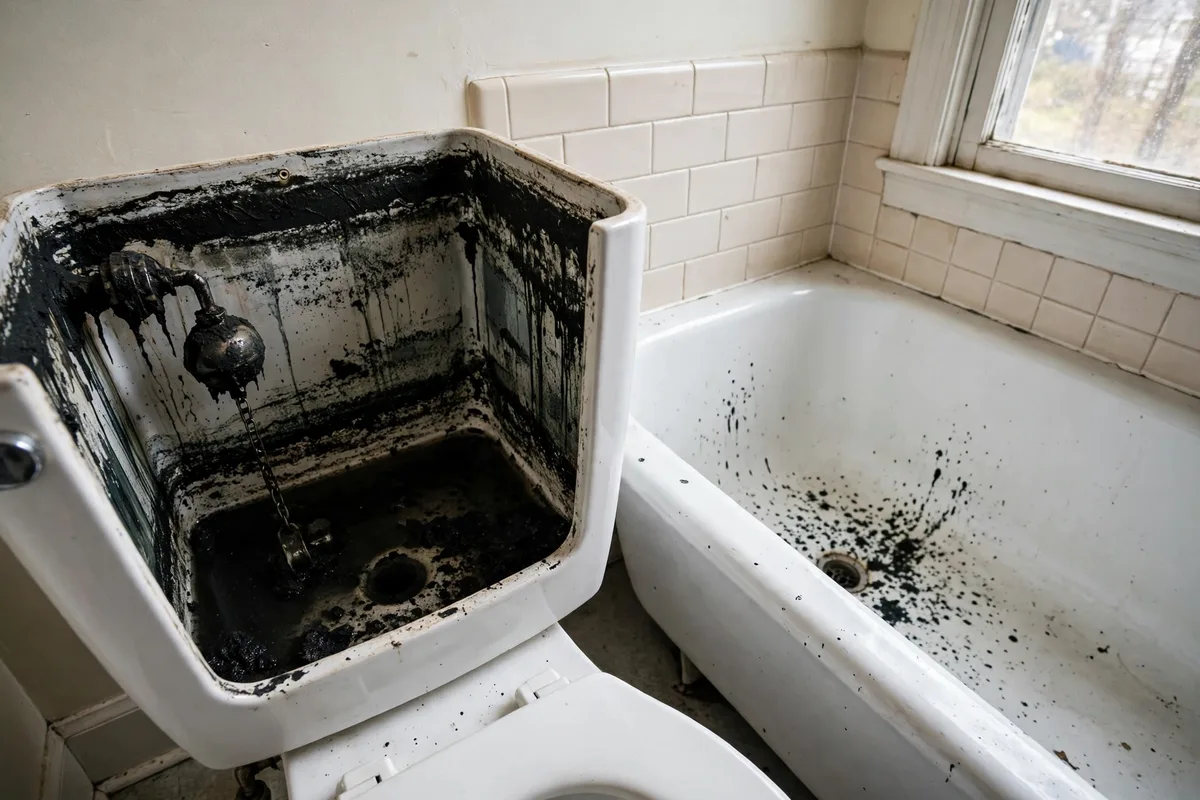
The toilet tank was black inside, and nobody had painted it
You lifted the toilet tank lid to fix a flapper, and the inside of the tank was coated in black slime and grit. The tub had dark specks that scrubbed off like soot. A glass of water left on the counter grew a faint brown-black film, and the coffee had a bitter edge you could not blame on the beans.
The usual first guesses are mold, dirt, or a failing well. The real answer is usually simpler and stranger: manganese — a metal that comes out of the same rock as iron, travels in the same water, and stains everything the opposite color. Where iron paints a house orange, manganese paints it black.
And manganese has a second trick that costs people money. It is harder to remove than iron. A system that clears your iron completely can let manganese straight through, so homeowners replace filter after filter chasing black stains with equipment that was never rated for the metal making them. This guide covers what manganese is, the two numbers that define it, why it defeats iron equipment, and the treatment that matches each level — starting, as always, with the test.
What manganese is, and why it shows up with iron
Manganese is a naturally occurring metal in soil and rock. Groundwater that sits in low-oxygen rock dissolves it, the same way it dissolves iron — Penn State Extension notes the two are usually found together, with manganese typically at much lower concentrations than iron, and both more common in deeper wells where water has been in contact with rock longer.
Dissolved manganese is invisible. The water runs clear from the tap. Then the manganese meets air — in the toilet tank, in the tub, in a glass left standing — and oxidizes into a solid. Penn State describes the result plainly: manganese often produces a dense black stain or solid. That is the black grit in the tank, the dark specks in the tub, the brown-black film on laundry and fixtures. The taste arrives earlier than the stains: bitter and metallic, noticeable in coffee and tea before it is obvious in a plain glass.
Three look-alikes are worth separating before you spend anything:
| What you see | Likely cause | Where to check |
|---|---|---|
| Black or dark brown stains, black grit, bitter taste | Manganese | Your test report's manganese line |
| Orange or rust-colored stains, metallic taste | Iron | The iron guide |
| Black tarnish on silverware, rotten-egg smell | Hydrogen sulfide gas | The sulfur guide |
The colors overlap at the edges — a heavy iron problem can look brown-black, and manganese and iron usually arrive together, so the water can carry both stain colors at once. That is why the stain is a clue and the lab report is the answer. The full panel, and how each number is read, is in the water test guide.
The two numbers: 0.05 for stains, 0.3 for health
Manganese is the one metal in this series that carries two different kinds of number, and confusing them leads to bad decisions in both directions — panic at a staining level, or shrugging at a level that deserves action.
0.05 mg/L — the staining number. The US Environmental Protection Agency's secondary standard for manganese is 0.05 mg/L (the same unit as parts per million, ppm). Secondary standards are non-enforceable guidelines for nuisance chemicals, and the EPA lists manganese's effects above that level as black to brown color, black staining, and a bitter metallic taste. Read 0.05 as the line where the nuisance starts: above it, expect black stains and off flavors. It is not a safety line, and it is a very low line — a little manganese stains a lot.
0.3 mg/L — the health number. The EPA has also set a Health Advisory for manganese of 0.3 mg/L. Penn State Extension explains what that means: a Health Advisory is a non-enforceable standard meant to alert consumers to possible health effects, and the manganese advisory was created because of concerns about neurological effects from regularly consuming water above 0.3 mg/L.
Two honest qualifications. First, neither number is enforced for private wells — no regulator tests your water but you, and both figures are guidelines you measure yourself against. Second, the gap between the numbers is the story: water can stain aggressively at 0.1 mg/L while sitting well below the health advisory, and water at 0.4 mg/L is a health question before it is a laundry question. Below 0.3, treat manganese as a nuisance to be removed at your own pace. Above 0.3, treat it as the first job: arrange treatment promptly, and use another source for drinking water until the treated water tests below the advisory.
Why manganese humbles iron filters
Iron and manganese are removed by the same basic move — oxidize the dissolved metal into particles, then filter the particles out. The difference is speed. Manganese oxidizes much more slowly than iron. Given the same air, the same media, and the same few seconds of contact time, iron converts and manganese largely does not. It passes through the filter still dissolved, then oxidizes later — in your toilet tank, your tub, and your laundry, which is exactly where you did not want it.
Three consequences follow from that one fact:
- An "iron filter" is not automatically a manganese filter. What matters is the manufacturer's published manganese rating — a separate line in the spec sheet, always lower than the iron rating, and the line that tends to disappear from sales pages. A unit rated for 7 ppm of iron may be rated for only 1 ppm of manganese.
- pH matters more for manganese. Oxidation of manganese runs poorly in acidic water, worse than iron's does. On a low-pH well, the manganese job often cannot start until a neutralizing filter has lifted the pH — which is why the treatment order puts pH correction before the main filter. That correction is covered in full in the low pH guide.
- Contact time and oxidant strength are the levers. Given more time or a stronger oxidizer — chlorine, permanganate, peroxide — manganese converts reliably. Most "manganese problems" that survive an iron filter are really contact-time problems: the water moved through too fast for the slower metal.
If your iron is gone and the black stains remain, do not replace the filter with a bigger iron filter. Check its manganese rating against your test first. That mismatch, not the equipment's size, is the usual failure.
The test numbers that decide the treatment
A manganese decision needs four lines from the lab report, read together:
| Test number | Why it decides the treatment | Reference point |
|---|---|---|
| Manganese (mg/L) | The size of the job — and which of the two EPA numbers you are over | Staining guideline: 0.05 mg/L; health advisory: 0.3 mg/L |
| Iron (mg/L) | The two metals share equipment; most ratings are given per metal, and the combined load wears media and sizes chemical feed | Staining guideline: 0.3 mg/L |
| pH | Manganese oxidation stalls in acidic water; low pH must be corrected first | EPA secondary range: 6.5–8.5 |
| Form (dissolved or oxidized) | Dissolved manganese can be exchanged or oxidized; manganese that has already oxidized into particles must be filtered, not softened | Your lab can report total manganese; black particles in the water point to the oxidized form |
One sampling note, borrowed from the iron guide: dissolved metals start changing once the sample meets air. Follow the lab's instructions on drawing the sample, and if the number and the stains disagree, believe the stains and test again.
Treatment, matched to the level
Low manganese, hard water: a water softener can do it — within limits. Ion exchange swaps dissolved manganese out of the water along with calcium and magnesium. Penn State's limit is the one to respect: softeners remove small amounts of manganese, and the University of Massachusetts Extension's treatment table puts ion exchange in the range below about 5 mg/L of combined iron and manganese. Two conditions: the manganese must still be dissolved (oxidized particles foul the resin instead of exchanging), and the softener must not be asked to swallow the iron problem too. The full comparison of what a softener can and cannot carry is in iron filter vs. water softener.
Low to moderate manganese: an oxidizing filter, judged by its manganese rating. Air-injection and catalytic-media filters oxidize and trap manganese in one tank. This is the standard whole-house answer — provided the unit's published manganese rating clears your number at your pH, and the flow rating covers your household's peak demand. Ratings for the three systems we compare head-to-head, including their manganese ceilings, are in SpringWell vs US Water Systems vs iSpring.
Higher manganese, or manganese with bacteria: chemical oxidation, then filtration. When the slower metal needs a stronger push, a feed of chlorine, potassium permanganate, or hydrogen peroxide ahead of the filter does the oxidizing with time to work, and the filter catches the result. Penn State points to oxidation-plus-filtration as the approach for high combined iron and manganese. It is more equipment and more upkeep — a chemical tank to keep filled — and it is the level where professional sizing earns its fee.
Light duty at the entry level: cartridge systems. A big cartridge system can carry a small manganese load, and its maker publishes the ceiling:
- iSpring WGB32BM — rated by iSpring for up to 1.0 ppm of manganese (and 3.0 ppm of iron); readers of this site can take 10% off a first filtration system with the code REFISPRING when ordering through this link. Check the current price at iSpring →
Respect what that ceiling means: at 0.2 mg/L of manganese, the cartridge is a reasonable, inexpensive answer. At 1.5 mg/L, it is a subscription to replacement cartridges that will never quite clear the stains.
Drinking water only: reverse osmosis at the kitchen tap. If your manganese sits above the 0.3 mg/L health advisory and whole-house treatment will take time to arrange, a point-of-use reverse osmosis unit at the kitchen sink addresses the glass of water and the cooking pot. It does nothing for the toilet tank, the tub, or the laundry — it is a bridge for drinking water, not a fix for the house.
Three mistakes to avoid
Buying a second iron filter for a manganese problem. The black stains survived the first iron filter because manganese oxidizes slowly and the unit's manganese rating — if it had one — sat below your level. A larger version of the same filter repeats the experiment at a higher price.
Judging by the stain alone. Black can be manganese, but black slime can also be bacteria, and black tarnish on silverware belongs to the sulfur story. Each has a different fix, and two of them are cheap. The test separates them for the price of a lab fee.
Reaching for chlorine bleach in the laundry. Chlorine is an oxidizer — in the wash, it can convert dissolved manganese into black particles on the fabric, fixing the stain into the load instead of removing it. Manganese laundry is washed without chlorine bleach, and the real cure is upstream, in the treatment order.
When to call a professional
Three situations belong to a licensed well contractor or water treatment professional: manganese above the 0.3 mg/L health advisory, where sizing and a follow-up test both matter and drinking water should come from another source in the meantime; black stains that arrived suddenly alongside cloudiness or a change in taste, which can mean the well itself has changed and deserves a bacteria test before any equipment decision; and chemical-feed systems, where the oxidant dose has to be set against your actual numbers rather than a dial position. A certified lab test is the professional step everything else stands on — cheap next to any of the boxes it might save you from buying.
The IronInMyWater rule
Test first, treat second — and never choose equipment from one number alone. Iron, pH, manganese, and hardness together decide the system; the manufacturer's published ratings, checked against your test, decide the model. How we work
FAQ
Is manganese in well water harmful? At the levels that stain — just above 0.05 mg/L — manganese is classified by the EPA as a nuisance: color, staining, and taste. The EPA's separate Health Advisory sits at 0.3 mg/L and reflects concerns about neurological effects from regularly drinking water above that level. So the honest answer is level-dependent: below 0.3, a nuisance to remove at your pace; above 0.3, a health question to act on first. Only a lab test says which side of the line your water is on.
Why are my stains black instead of orange? Because the metal is different. Iron oxidizes into orange and rust-red solids; manganese oxidizes into black and dark brown ones — Penn State Extension describes manganese's stain as dense black. Wells commonly carry both metals, so both colors can appear in the same house, each from its own line on the test report.
Will a water softener remove manganese? Small amounts of dissolved manganese, yes — ion exchange takes it out with the hardness minerals. The limits are strict: the manganese must still be dissolved, the combined iron and manganese load must be low, and oxidized manganese particles will foul the resin rather than exchange. A softener is a light-duty manganese answer, not a treatment for a real manganese problem.
My iron filter works, but the black stains stayed. Why? Almost certainly a rating mismatch. Manganese oxidizes more slowly than iron, so a filter can convert and trap the iron while dissolved manganese passes through and oxidizes later in your fixtures. Compare the filter's published manganese rating — not its iron rating — with your test result. If the rating is below your number, the fix is a system rated for your manganese, often with pH correction or a stronger oxidant ahead of it.
Can a cartridge filter handle manganese? Within its published ceiling. The cartridge system covered on this site is rated by its maker at 1.0 ppm of manganese, which makes it a sensible answer for low levels and a poor one above them — the cartridges exhaust quickly against a load they were not sized for, and the stains persist. The ceiling, not the cartridge price, is the deciding fact.
Why did black stains appear in a house that never had them? Wells change. A new well, a deeper pump setting, drought or heavy pumping, or a shift in the water's chemistry can raise manganese or start oxidizing what was already there — and manganese that newly meets air, in a new tank or aerator, shows up as stains that seem to come from nowhere. A change in the water is a reason to test again rather than to guess: the new report, not the old one, sizes the fix.
Sources
The ratings, prices and guidelines in this guide were checked against these primary sources in November 2026.
The IronInMyWater rule
Test first, treat second — and never choose equipment from one number alone. Iron, pH, manganese, and hardness together decide the system; the manufacturer's published ratings, checked against your test, decide the model. How we work
Read next
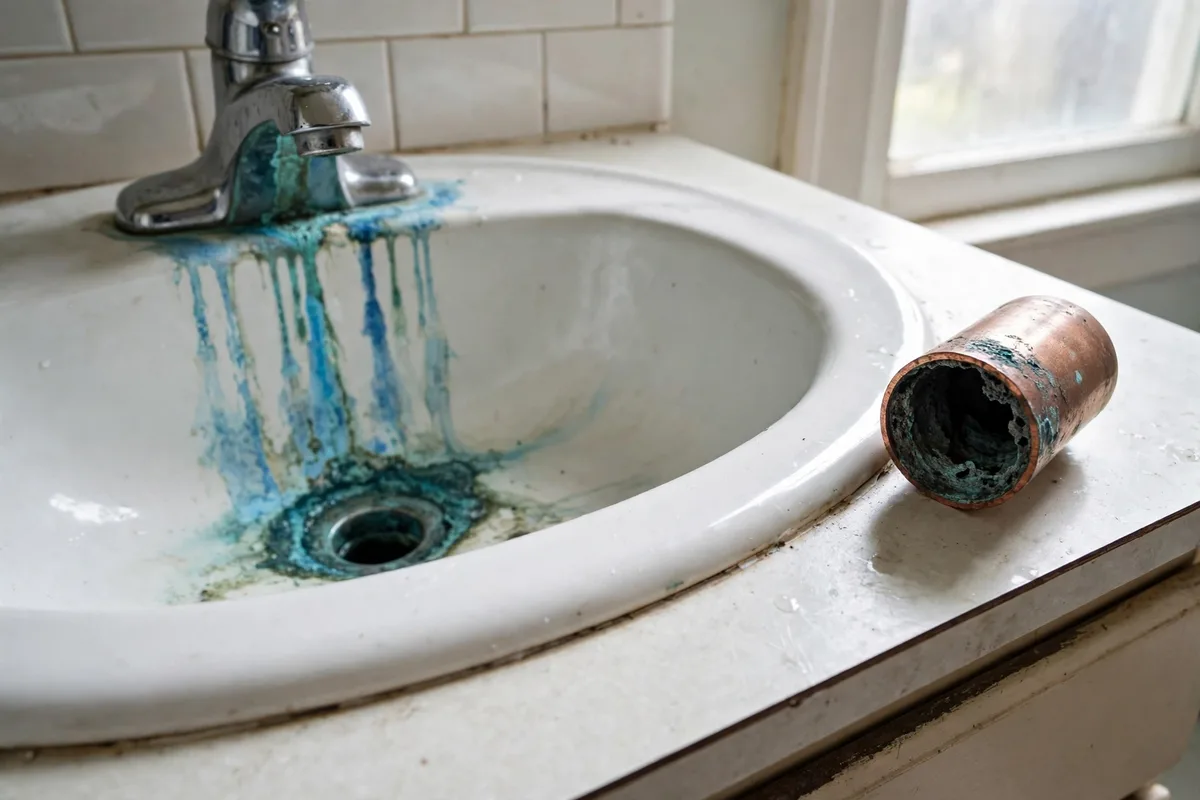
Low pH & Corrosion
Low pH in Well Water: Blue-Green Stains, Pinhole Leaks, and Why Your Filter Is Struggling
Blue-green stains, metallic morning water, pinhole leaks — acidic water eats copper plumbing from the inside, and quietly disables iron and manganese filters. Why pH is fixed first, and the two ways to raise it.
Read the guide →
Comparisons
SpringWell vs US Water Systems vs iSpring for Well Water (2026)
$536, $2,231, or $3,295 — the price is not the ranking. SpringWell, US Water and iSpring compared on the manufacturers' own ratings, matched to your test numbers.
Read the guide →
Choosing Equipment
Iron Filter vs Water Softener vs Whole-House System: Which One Do You Actually Need?
Three boxes, three different jobs — and one correct order. Why a softener will not fix iron stains, and how your test numbers pick the equipment you actually need.
Read the guide →